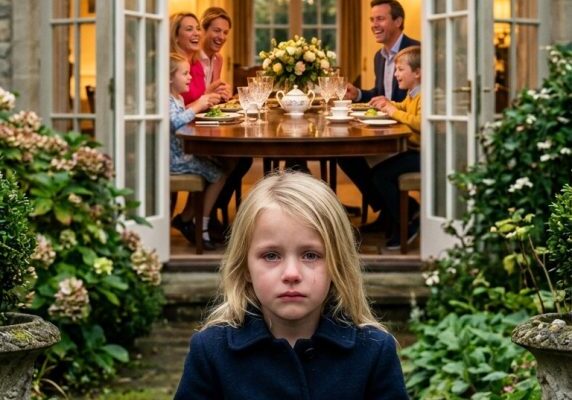
The summer garden party had always been my mother’s stage, a carefully choreographed play where the lawn was the set and we were merely the supporting cast.
Long before today, before Emma and David, before I knew what a mortgage statement looked like or how it felt to carry the crushing weight of someone else’s life on your back, I knew these afternoons by heart. White linen tablecloths stretched tight as drumheads across folding tables. The magnolia trees, older than I was, dropped petals like lazy confetti onto the perfect lawn of Maple Grove. Crystal glasses chimed when someone laughed too hard or gestured too broadly. Everything smelled faintly of cut grass, expensive perfume, and the lemon oil the housekeeper used on the patio furniture.
It was the one day each year my mother, Margaret, became everything she thought she’d always deserved to be—a queen holding court.
As a child, I had tried to love it. I was the one in the stiff lace dress, the one whose hair she curled too tight, whose patent leather shoes pinched by the second hour. I remember hovering around the edges of conversation, ferrying empty glasses inside, listening to my mother brag about my brother Tom’s early promotion or my sister Clare’s engagement, while referring to me as “our creative one” with a fond sigh that always sounded like a public apology.
“She means you’re the disappointment,” my father had told me one year in the kitchen, half-joking, half not, while he stole a deviled egg from a platter. “But don’t worry. Every family needs one.”
He’d laughed. I hadn’t. It took me another decade to realize he wasn’t teasing; he was stating a family law.
By the time I had my own children, those parties felt less like family traditions and more like annual performance reviews I hadn’t asked for. Every year brought a new metric of comparison: who had the bigger house, the nicer car, the more obedient children, the more prestigious title. My mother didn’t ask questions so much as she set up traps for people to praise her.
“Three children,” she’d say today, touching a neighbor’s arm lightly, her voice pitched just right for the surrounding tables to hear. “All so different. Tom with his business acumen, Clare with her lovely home. And Jennifer with her… charity work. It really is sweet how she helps people.”
Charity work. As if I spent my days ladling soup and accepting hand-me-downs instead of building the Riverside Community Foundation, an organization that moved millions of dollars where they were needed most. As if I were a mere volunteer in the narrative of my own life.
Over time, I learned to make myself small. I learned to let her stories roll past me like water around stone. I’d show up, smile, hug whoever needed hugging, and leave with my jaw aching from clenching it shut.
But this year was different. This year, the air felt electric, charged with the weight of a secret that had become too heavy to carry. As we pulled into the gravel driveway, I looked at my daughter, Emma, in her yellow dress with sunflowers embroidered along the hem, and my son, David, who sat in the passenger seat already braced for impact.
“Remember,” I whispered as I turned off the engine. “We stay together.”
David looked at the towering brick facade of Maple Grove, his jaw tight. “How much longer are we going to let her pretend, Mom?”
I didn’t have an answer then. I didn’t know that within the hour, the throne my mother sat upon would begin to crumble.
The party was in full swing by the time we reached the patio. Aunts, uncles, and distant cousins clustered in their usual constellations.
“Jennifer!” Aunt Linda called, waving a champagne flute. “You made it! We weren’t sure—you’ve been so busy with your… homeless people, or whatever it is now.”
“Community development, Linda,” I corrected, my voice steady. “And yes, I’m here.”
“Well, your mother has been fussing about the seating chart. She’ll be thrilled you’re here on time for once.”
My mother would be thrilled that I hadn’t given her another reason to criticize me. That was the ceiling of her affection.
I saw her then, moving through the crowd in a soft, pale pink dress that probably cost more than a month of my staff’s payroll. Her silver hair was swept up into an artfully loose twist, and pearls gleamed at her throat. She looked expensive. She looked untouchable.
“Jennifer,” she said, offering her cheek for a dry air-kiss. “At least you wore something appropriate this time. Navy is very… slimming.”
Her gaze shifted to my children. She cupped David’s cheek briefly, approving of his resemblance to my father. “And you must be—” She paused, searching her memory with a practiced, theatrical frown. “Emily, is it?”
“Emma,” my daughter said. Her hand tightened in mine, her chin lifted.
“Right. Emma.” My mother’s smile didn’t reach her eyes. “I hope you remembered what we talked about last time, dear. Best behavior. We have very important guests today. No running, no shouting, and certainly no helping yourself to the buffet until the adults are finished.”
“She’s eight, Mom, not a golden retriever,” I said, the first spark of heat rising in my chest.
My mother waved a hand dismissively. “Children can ruin the atmosphere of a proper event if they aren’t managed. Come, I want to introduce you to the new pastor. He’s very interested in our family’s philanthropic legacy.”
Our family’s philanthropic legacy. I almost laughed. The only philanthropy my mother had ever cared about was the kind where her name was engraved in a font larger than the donation itself.
“We’ll find our seats first,” I said.
“Fine. Just don’t sit near the hedge. The photographer says the lighting is terrible there.” She touched Emma’s shoulder with two delicate fingers, as if checking for dust. “And remember, dear—napkins in your lap. We don’t want photos of you looking… unkempt.”
We retreated to Table Three, situated under the partial shade of a magnolia. The centerpiece was an arrangement of roses and eucalyptus that looked like it belonged in a bridal magazine.
“Is she always like that?” Emma whispered, sliding into her chair.
“She’s just… particular,” I said, though the lie tasted like ash.
David didn’t speak. He was staring at the house, his eyes tracking the cracks in the mortar that only I knew the cost of repairing. He had found the documents in my office six months ago. He knew about the refinance. He knew about the deed transfer. He knew that the very ground we were sitting on didn’t belong to the woman holding court.
As the servers began to circulate with tiered trays of dainty cucumber sandwiches and deviled eggs, a hush fell over our table. My mother approached, her eyes scanning the spread like a general inspecting the troops.
Emma, hungry and tired from the long drive, reached out a small, hesitant hand toward a sandwich.
Before her fingers could touch the bread, my mother’s hand shot out. She didn’t just stop Emma; she jerked the entire tiered tray away, the silver clattering against the china.
“We have standards at this table,” my mother said, her voice rising just enough to capture the attention of the surrounding guests.
The garden went silent. The only sound was the distant trickle of the fountain.
“Margaret?” Uncle Tom asked from the end of the table. “What’s the matter?”
My mother stood tall, clutching the tray to her chest like a holy relic. She looked down at Emma—my beautiful, adopted, brilliant daughter—with a look of pure, unadulterated disdain.
“I am teaching this girl her place,” my mother declared. “She needs to understand that she is a guest here. She is not blood, and she will not behave as if she is entitled to the same privileges as the rest of this family.”
Emma’s hand remained frozen in the air, her fingers curled toward an empty space. She didn’t cry. She had learned early that tears were a currency my mother didn’t trade in. But the light in her eyes—that fierce, bright spark—dimmed.
That was the moment the water hit the stone. That was the moment the “Not Yet” I had been telling David for years finally became “Today.”
I reached for my water glass. My hands were perfectly steady. I took a slow sip, letting the coldness anchor me. Around us, the silence was suffocating. Seventy-five people were watching a grandmother humiliate an eight-year-old child.
“Mom,” I said. My voice was quiet, but it carried. “Put the tray back.”
“Jennifer, don’t you dare use that tone with me,” she snapped, her face flushing a blotchy red. “I am trying to maintain some semblance of order. You’ve brought this… project into our family, and I’ve been patient. But I will not have her ruin my party with her lack of breeding.”
Project. The word sliced through the air.
David stood up. His chair scraped harshly against the stone patio, a sound like a gunshot.
“David, sit down,” my mother commanded.
“No,” he said. He looked at her, then at me. He saw the green light in my eyes. “Grandma, do you want to tell everyone why you’re so worried about the ‘standards’ of this house?”
“David, that’s enough,” Clare whispered, reaching for his arm.
“No, it’s not,” David said, his voice gaining strength. “Because if we’re talking about who belongs here and who doesn’t, maybe we should talk about who actually pays for the roof over your head.”
The color drained from my mother’s face so fast I thought she might collapse. “You’re confused, boy. This is my home. Your grandfather and I built this—”
“Grandpa built a mountain of debt,” David interrupted. “And you spent the rest. Should I tell them about the foreclosure notice from 2019, Grandma? Or should Mom?”
A collective gasp rippled through the garden. Uncle Tom set his fork down with a heavy clink.
“Jennifer?” Tom asked, his voice low. “What is he talking about?”
I stood up then. I didn’t feel like the “creative disappointment” anymore. I felt like the owner of the foundation. I felt like the woman who had spent seven years quietly holding a crumbling legacy together with her own sweat and salary.
“It’s true,” I said, looking directly at my mother. “When Dad died, he left behind four hundred and seventy-three thousand dollars in business loans, medical bills, and eighteen months of missed mortgage payments. You called me at two in the morning, Mom. You were hysterical. You said you’d rather die than let the neighbors know you were being evicted.”
“I was… I was in shock,” my mother stammered. Her grip on the sandwich tray loosened, and it tilted dangerously. “You said you’d handle it. You said it was our secret.”
“I did handle it,” I said. “I paid off the arrears. I refinanced the entire property into my name to save it from the auction block. I’ve paid every property tax bill, every insurance premium, and every repair for seven years. I pay four thousand two hundred dollars a month so you can sit here and pretend to be a queen.”
“But your job…” Aunt Linda whispered. “The little charity…”
“I don’t work for a charity, Linda,” I said, turning to her. “I own the Riverside Community Foundation. We manage two hundred million dollars in assets. My personal income is four hundred and fifty thousand a year. I stayed in that ‘tiny apartment’ because it was an investment property I was renovating, and I let you believe I was struggling because it made you feel superior. And because I thought it was the only way you’d accept my help without hating me for it.”
I looked back at my mother. She looked small now. The pink dress looked like a costume.
“But I was wrong,” I continued. “Buying your silence only bought your cruelty. You just told my daughter she isn’t ‘blood’ at a table I bought, in a house I own, at a party I am ultimately funding.”
“Jennifer, please,” my mother whispered. Tears were starting to track through her makeup. “Not in front of everyone.”
“Why not?” I asked. “You had no problem insulting Emma in front of everyone. You’ve had no problem making me the family joke for twenty years. You wanted an audience, Mom. Well, you have one.”
I pulled my phone from my clutch. My fingers moved with the efficiency of a CEO.
“What are you doing?” Richard, Clare’s husband, asked.
“I’m emailing my attorney,” I said. “Effective immediately, the residency agreement for 847 Maple Grove is being amended.”
“You can’t throw me out!” my mother wailed, the tray finally slipping from her hands and crashing onto the grass. Deviled eggs and cucumber sandwiches scattered across the lawn she loved so much.
“I’m not throwing you out,” I said, looking down at the mess. “But the terms of your stay are changing. You are no longer the mistress of this house. You are a guest of the Riverside Foundation. And as of today, there will be a zero-tolerance policy for the harassment of my children.”
I hit Send.
The silence that followed was absolute. I looked at Emma. She was staring at me with a mix of awe and fear. I reached down and took her hand. It was warm and solid.
“We’re leaving,” I announced to the table. “Tom, Clare—if you want to help Mom clean up, feel free. But don’t look at me. I’ve done enough cleaning for this family.”
As we walked away, I didn’t look back. I didn’t need to. I could hear the roar of seventy-five voices erupting behind us—the sound of a narrative being rewritten in real-time.
But as we reached the car, I felt a hand on my shoulder. It was my mother. She had run across the grass, her heels sinking into the turf, her face a mask of desperation.
“Jennifer, wait!” she panted.
I turned, shielding Emma behind me. “What, Mom? Do you have more thoughts on bloodlines?”
She stopped, her chest heaving. She looked at the house, then at me, then at Emma. For the first time in my life, I saw the mask of the Queen truly fall away, leaving only a frightened, aging woman underneath.
“I… I didn’t know you felt that way,” she whispered.
“That’s the problem, Mom,” I said. “You never bothered to ask. You were too busy telling everyone who I was to ever find out the truth.”
I opened the car door for Emma. David climbed in the back, his expression grim but satisfied.
“Check your mail on Tuesday, Mom,” I said. “The new agreement will be there. You can sign it, or you can find a new stage to play on. The choice is yours.”
I started the engine and began the long drive away from Maple Grove. The house disappeared in the rearview mirror, and for the first time in my thirty-six years, the air felt thin enough to breathe.
The following week was a blizzard of phone calls. Clare came over first, appearing at my doorstep with a grocery-store bouquet and a look of profound shame.
“I didn’t know, Jen,” she said, sitting at my kitchen table—the one in the house I had actually built for my family, not the one I was maintaining for a ghost. “I swear, I thought you were just… doing okay. I didn’t realize you were carrying all of us.”
“You didn’t realize because you didn’t want to,” I said gently. “It was easier to let me be the ‘creative one’ while you and Tom were the successes. It balanced the scales.”
She stayed for three hours. We talked about things we hadn’t discussed since we were teenagers—the way our father’s shadow loomed over us, the way our mother used shame as a steering wheel. By the time she left, the air between us was clearer, though the bruises were still tender.
Uncle Tom called next. He was blustery, embarrassed, and surprisingly apologetic. “I should have seen the numbers, Jen. I’m an accountant, for God’s sake. I just… I wanted to believe she had it handled. It made life easier.”
“Easy is expensive, Tom,” I told him. “I’m the one who’s been paying the bill.”
But the hardest call was the one that didn’t come. My mother remained silent for six days. On the seventh day, a courier arrived with a signed copy of the residency agreement.
There were no notes. No letters. Just her signature, wobbly and sharp, at the bottom of the page.
“Is Grandma coming to my birthday?” Emma asked that night as I tucked her in.
“I don’t know yet, honey,” I said, smoothing her hair. “We’re taking a break from Grandma for a little while.”
“Because she was mean?”
“Because she needs to learn how to be kind,” I said. “And until she does, we’re going to stay in our own happy place.”
Emma nodded, seemingly satisfied, and fell asleep holding her favorite stuffed rabbit. I stood in the doorway of her room, watching her chest rise and fall, and I realized that I had finally given her the one thing my mother had never given me: a home where the walls didn’t have ears and the love didn’t have a price tag.
Two months later, we returned to Maple Grove. Not for a party, but for a Sunday lunch. Just us.
The house looked smaller. Without the tents and the seventy-five guests and the performative flowers, it was just an old brick building that needed a new roof in five years.
My mother met us at the door. She wasn’t wearing pearls. She was wearing a simple cotton dress and an expression I didn’t recognize—it was tentative.
“Hello, Jennifer,” she said. She looked at Emma. “Hello, Emma.”
“Hi, Grandma,” Emma said, holding onto my hand.
We sat in the breakfast nook, not the formal dining room. The lunch was simple—sandwiches and fruit. My mother had made them herself.
“I’ve been… thinking,” my mother said, her fingers tracing the edge of her placemat. “About what you said. About the foundation.”
“And?” I asked.
“I looked it up,” she said. “The website. I saw the photos of the community center you built in the East End. The one with the library.” She paused, her voice trembling. “It’s… it’s very impressive, Jennifer. I didn’t realize you were doing something so… big.”
“I’ve been doing it for eight years, Mom.”
“I know,” she whispered. “I’m sorry I didn’t see it.”
It wasn’t a grand cinematic apology. It didn’t erase the years of “creative one” comments or the humiliation at the garden party. But it was a crack in the ice.
Emma reached for a piece of melon. My mother watched her, her hand twitching as if to reach out, but she stopped herself. She looked at me, a silent question in her eyes. I gave her a tiny nod.
“Would you like the small plate or the large one, Emma?” my mother asked.
Emma looked up, surprised. “The large one, please.”
My mother passed it to her. “Of course, dear. You should have whatever you like. This is your family’s house, after all.”
David caught my eye and smirked. It was the first time I’d seen him relax in that house in years.
The drive home that afternoon was quiet. The kids were tired, and the sun was setting in a bruise of purple and gold over the highway. I looked at the hands on the steering wheel—the hands that signed the checks, the hands that built the foundation, the hands that finally held the line.
I knew the road ahead with my mother would be long. There would be relapses. There would be moments where she tried to reclaim the throne. But the locks had been changed—not just on the doors of Maple Grove, but on the doors of my heart.
I was no longer the disappointment. I was the architect.
As we pulled into our driveway, Emma woke up and rubbed her eyes. “Mom? Can we have our own party next weekend? A small one?”
“Sure, baby,” I said, unbuckling her seatbelt. “Who do you want to invite?”
“Just us,” she said. “And maybe Aunt Clare. And we’ll have the big sandwiches.”
“The biggest,” I promised.
We walked into our home, the one with the mismatched furniture and the walls covered in the kids’ art, and I realized that I had finally won the only power struggle that mattered. I had stopped trying to earn a seat at my mother’s table and built my own.
And at my table, there was plenty of room for everyone.