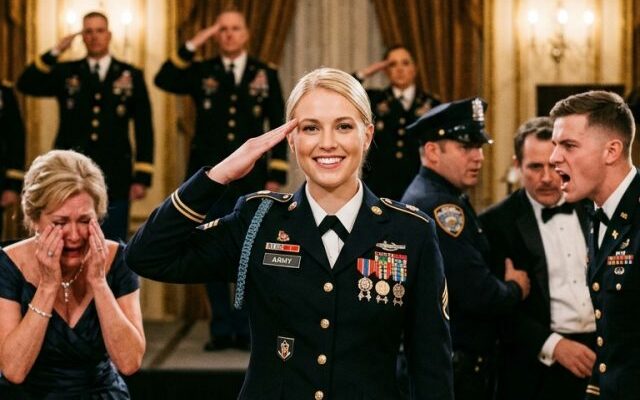
“Ladies don’t get call signs,” the colonel smirked, the bourbon in his glass catching the light of the officers’ club chandelier.
He had intended it as a punchline. He had designed it to make me small. But when I looked him in the eye and delivered my response, the silence that followed didn’t make me small. It made every ranking officer in the room freeze.
I’m Elise Carrian. I am thirty-one years old, and long before I turned thirty, I earned a call sign that made admirals pause and take notice.
But to understand how I got to that dining room in Quantico, Virginia, you have to understand the geography of my childhood. I grew up in a house that smelled perpetually of dark roast coffee and WD-40. It was a neighborhood where every single driveway sported a Navy bumper sticker, and every kid understood the heavy, stretching reality of the word deployment long before they understood the concept of a summer vacation. We lived in base housing in Annapolis, Maryland.
My father was Chief Petty Officer Daniel Carrian, United States Navy. He was an engineman. His job was to keep the massive turbines spinning in the bellies of gray ships that most of the world would never hear about. He possessed hands that felt like coarse sandpaper and a voice designed to cut through the deafening roar of a flight deck. Yet, inside the walls of our home, he was a different man. He was quiet, deliberate, and endlessly gentle. He was the kind of man who would endure a grueling fourteen-hour watch and still sit at the kitchen table to help me conquer fractions before he even thought about taking a bite of his dinner.
I was eight years old in 2002 when he unfurled a massive, creased nautical chart across that same kitchen table. It was a map of the world, but not the kind they showed us in school. This one was alive with purpose.
My mother, Patricia, stood at the sink, the rhythmic sound of her drying a casserole dish providing the soundtrack to the moment. I leaned over the table, my small finger tracing the long, curving paths that stretched across the paper oceans—from Norfolk to Gibraltar, from the Red Sea to the Strait of Malacca.
“What do the lines mean, Daddy?” I asked, looking up at him.
He smiled, a soft, weary smile that crinkled the corners of his eyes. “Somebody drew those lines fifty years ago, Ellie. And because they took the time to get them exactly right, a hundred sailors got to go home for Christmas. That’s what we do in the Navy. We draw the lines.”
I was only eight. I couldn’t grasp the geopolitical weight of it all. But I understood the core philosophy he kept returning to, the unspoken contract of the sea. The deal. “You take care of the ship,” he would tell me, tapping the chart, “and the ship takes care of the crew.”
My father deployed three times before I reached my tenth birthday. Each time, the ritual was identical. My mother would drive us to the pier. We would stand on the concrete and watch the ship pull away, an enormous gray leviathan sliding out of the harbor as if the Chesapeake Bay was swallowing it whole. I would stand on my tiptoes and wave until my shoulder ached. My mother would cry silently in the car on the drive back, and by the time we pulled into our driveway, she would have meticulously reapplied her makeup, pretending the tears had never fallen.
That was my first lesson in the specific kind of silence that powers military families. It isn’t an absence of feeling; it is the rigid discipline required to keep those feelings entirely private.
He would return from those deployments smelling of JP-5 jet fuel, salt spray, and a sharp, metallic scent I could never quite identify. He’d sweep me up into a dizzying spin and laugh. “Still here, Ellie! Still drawing lines.”
And I, with the absolute certainty of a child, believed he always would be.
Then came October 2006. I was twelve years old. It was a Tuesday morning, and I was zipping up my backpack for school when the doorbell rang.
Through the window, I saw the crisp uniform. A Navy chaplain stood on our porch.
My mother answered the door in her bathrobe. What followed was a sound I had never heard before and pray I never hear again. It was not a scream. It was not a cry. It was a primal, shattering noise that tore from a place deep inside her that I didn’t know existed.
There had been a massive steam pipe rupture in the engineering spaces aboard the USS Bonhomme Richard. My father didn’t make it out. Three other sailors died alongside him.
People, well-meaning but foolish, kept telling us that he died doing what he loved. I was twelve. I didn’t want him to love anything that had the power to kill him.
They drove us to the Naval Medical Center in Bethesda. I don’t remember the car ride. I only remember the stark, fluorescent lights of the hospital corridor, the squeak of linoleum floors, and the overwhelming, sterile smell of antiseptic. My mother sat in a hard plastic chair, sobbing uncontrollably while the chaplain knelt beside her, holding her trembling hands.
I sat three chairs away. My legs were too short to reach the floor. Someone in the waiting room had pressed a pamphlet into my hands about military funeral honors. I held onto it like a lifeline. I read it three times over. I memorized the precise order of the flag folds. Thirteen folds. Each one carrying a specific meaning. Life. Eternal life. The departed veteran.
I didn’t shed a single tear that day. I just read the rules.
The funeral was held at the Annapolis National Cemetery. It was a day of full military honors. Seven rifles firing a perfectly synchronized volley into the crisp air. A lone bugler standing on a hill overlooking the Severn River, the mournful notes of Taps drifting over the gravestones.
I stood beside my mother. I was wearing a black dress we had bought in a frantic rush at a department store the day before. It was too big at the shoulders, but neither of us had thought about alterations.
I watched the sailors in their impeccable dress whites. I watched them fold the American flag over my father’s casket. Thirteen precise, razor-sharp folds, exactly as the pamphlet had described. They presented the heavy, folded triangle to my mother. She could barely lift her arms to receive it. Her hands were shaking with such violence that, for a terrifying second, I thought she was going to drop it.
I reached out and placed my small hand over hers to steady the fabric.
I looked up at the sailors. I watched how they moved, how their hands knew exactly where to go without hesitation, how their faces displayed absolutely nothing but profound, unwavering reverence.
And standing there, in an oversized black dress over my father’s grave, I made a silent vow. I want to be one of them.
My mother leaned down at the graveside, her breath warm against my ear. “Your daddy would want you to have a normal life, baby. Not this. Not what took him from us.”
She meant the words to be a comfort.
I heard them as a dare.
CLIFFHANGER:
We moved off the base the following year. My mother desperately wanted to put distance between us and the water, to find a “normal” civilian life. But as I packed my boxes, I carefully placed my father’s Chief Petty Officer insignia in my pocket. She was moving on. I was digging in. And I had no idea that the man she was about to marry would spend the next decade trying to tear down everything I was about to build.
By the time I was fifteen, in 2009, my bedroom walls were a quiet rebellion against my mother’s desire for a “normal” life. Naval Academy pennants hung over my bed. A framed photograph of my father in his khakis, standing proudly on the fantail of a destroyer, dominated my nightstand. And right in the center of my desk sat the United States Naval Academy admissions catalog—dog-eared, heavily highlighted, and studied like scripture.
My mother had started dating again. She would talk on the phone in the living room, her voice carrying a lightness I hadn’t heard since the chaplain knocked on our door. I didn’t pay much attention to the details of her new romance. I was too busy filling out practice applications. I was drafting my admissions essay, writing about the deal.
You take care of the ship. The ship takes care of the crew.
I wrote that essay six times before I deemed it worthy. My mother wanted me to move on from the Navy. I was moving on—just not in the direction she expected. It was a private contract between a fifteen-year-old girl and a ghost, and I fully intended to honor it.
My mother married Colonel Dale Wharton, United States Marine Corps, Retired, in the sweltering summer of 2016.
It was the exact same summer I walked across the graduation stage in Annapolis, shook the hand of the Secretary of the Navy, and tossed my midshipman cover high into the air, officially receiving my commission as an ensign.
Two months later, I found myself standing in the back of the Quantico Officers’ Club, wearing a polite smile as I watched my mother walk down the aisle toward Dale. I didn’t know it then, but Dale Wharton would spend the next eight years of my life making sure I knew that my service, my uniform, and my branch simply didn’t count.
Dale had commanded an infantry battalion in the Marine Corps. He had deployed to the sandbox in Iraq twice, and to the mountains of Afghanistan once. He kept a Bronze Star displayed in a massive, backlit shadow box in his living room. He possessed a voice designed to dominate every room he entered, whether the room wanted him to or not. He was loud, aggressively confident, and operated under the absolute certainty that the Marines were the only branch of the military that truly mattered. Everyone else was just support staff. Everyone else was background noise.
And as a newly commissioned Navy ensign who had chosen the grueling path of surface warfare, I was the most “background” person he had ever been forced to tolerate.
Dale brought his own son into the marriage: Tyler Wharton. Tyler was fourteen at the wedding, looking incredibly awkward in an oversized blazer. He was relegated to the kids’ table at the reception, though he clearly desperately wanted to sit with the adults. When I walked into the hall, Tyler waved at me from across the room. I waved back. In a room full of Dale’s imposing friends, Tyler was the only person who seemed genuinely happy I was there.
During the reception, Dale dragged me over to a table of his Marine buddies.
“Gents, this is Patricia’s daughter, Elise,” he boomed, gesturing toward me with his glass of bourbon. “She decided to go the Navy route.”
He said the word Navy the way someone might announce a relative had decided to take up amateur juggling. It was polite, utterly dismissive, and faintly amused.
His friends chuckled into their drinks. One of them, a thick-necked major, grinned. “Hey, somebody’s got to drive the boats to get us to the fight, right?”
Dale threw his head back and laughed as if it were the most brilliant comedic observation of the century.
I extended my hand. I shook theirs firmly. I smiled politely. I told myself that it was his wedding day, that tensions were high, and that this was simply how infantry Marines talked to sailors.
But it wasn’t just how Marines talked. It was how Dale talked.
It became the soundtrack to every family gathering, every holiday dinner, every phone call for the next eight years.
Thanksgiving 2018. I was twenty-four years old, now a Lieutenant Junior Grade, serving aboard the USS Halsey. I had just returned home from my first Western Pacific deployment. I had spent seven grueling months navigating the Philippine Sea, the East China Sea, and the South China Sea. I had stood tense bridge watches on the exact shipping lanes my father had shown me on that chart sixteen years ago.
I came home carrying sea stories I was profoundly proud of. And I made the fatal mistake of trying to share one at Dale’s dinner table.
I managed exactly two sentences before Dale cut me off.
“WestPac,” he said, leaning back in his chair and picking his teeth with a toothpick. “Yeah, that’s basically just a cruise with extra paperwork.”
His buddies, invited over for turkey, erupted in laughter. My mother laughed nervously, her eyes darting between us. Tyler, now sixteen, looked down at his plate, his face flushing.
Dale grinned at me across the cranberry sauce. “You know what we used to say about the Navy, Ellie? Nice vacation. Almost deployed. No offense.”
Offense was exactly what he intended. He just wanted me to smile while I was forced to swallow it.
So, I smiled. And I swallowed it.
Christmas 2020. I was twenty-six, promoted to full Lieutenant, and officially qualified as Officer of the Deck Underway. I had earned my Surface Warfare Officer pin. It is a gold insignia that tells the fleet you have successfully qualified on every single watch station aboard a warship—that you possess the knowledge to drive the ship, fight the ship, and keep the crew breathing.
I brought the pin home to show my mother. It was the culmination of four years of brutal shipboard service, hundreds of sleepless watch hours, and dozens of high-stress qualifications.
Dale picked the gold pin up off the kitchen counter. He turned it over in his thick, meaty fingers, squinting at it. “We call these water wings,” he snorted. “Cute.”
He then deliberately set my pin down on the mantel piece, right next to his glowing shadow box. My small gold pin looked entirely insignificant next to his rows of combat ribbons and his Bronze Star. That was exactly his point.
After Dale left the room to grab another beer, Tyler walked over to the mantel. He was eighteen now, seriously talking about applying to Officer Candidate School to become a Marine like his father. Tyler carefully picked up my SWO pin.
“I think it’s incredibly cool, Elise,” Tyler said quietly, making sure Dale wasn’t in earshot. “I actually looked it up online. You have to qualify on like a dozen different combat stations to earn this, right?”
“Something like that,” I said softly.
He nodded, turning the pin over with genuine respect, not the contempt his father had shown. Tyler was the only person in that house who ever bothered to look anything up.
I drove away from the Wharton house that Christmas night with my SWO pin secured back in my pocket. I watched the warm lights of their house shrink in my rearview mirror, Dale’s Marine Corps flag flapping proudly on the porch bracket. It was a house where I was granted entry, but where I would never, ever be granted respect.
I gripped the steering wheel of my car as I drove back to the base, wondering why I kept subjecting myself to Dale’s psychological warfare. I promised myself I wouldn’t let his voice dictate my worth. But I had no idea that in just two years, my worth would be tested not at a dinner table, but in the hostile waters of the South China Sea, where the lives of twelve Americans would rest entirely in my hands.
By 2022, I was twenty-eight years old, serving as the Tactical Action Officer (TAO) aboard the USS Rafael Peralta, an Arleigh Burke-class guided-missile destroyer operating deep in the South China Sea. As the TAO, I was the officer who sat in the dark, glowing nerve center of the Combat Information Center (CIC). When the captain wasn’t in the room, I held the weapons release authority. It was my job to make the split-second tactical decisions that kept our ship, and everyone operating in our vicinity, alive.
What unfolded over ten days that sweltering summer never made the evening news. It never will. The exact details remain highly classified, and I will take them to my grave, but I can share the shape of the crisis.
A United States reconnaissance vessel, carrying twelve highly specialized intelligence operators, suffered a catastrophic engineering casualty eighty nautical miles southeast of the Paracel Islands. They were entirely dead in the water. No propulsion. No steering. Twelve Americans trapped in a metal box with no ability to move.
Simultaneously, a Chinese carrier strike group was conducting aggressive naval exercises in the immediate vicinity. They began repositioning their assets in a maneuver that put the disabled American vessel directly in their operational path. Whether this repositioning was an intentional provocation or a terrifying coincidence was irrelevant to me. What mattered was the tactical reality: twelve of our people were sitting ducks, and a hostile carrier group was rapidly closing the distance.
The USS Rafael Peralta received immediate orders to interpose. We were to physically place our destroyer between the advancing Chinese carrier group and the disabled reconnaissance vessel, and we were to hold that position until a heavy tow ship could arrive to pull our people clear.
I was the TAO on watch. The captain briefed me on the tactical picture, and from that moment on, I made the calls.
For ten grueling days, we held the line. There was no resupply. There was no relief. The logistics ship scheduled to rotate us out was diverted to respond to a typhoon in the Philippine Sea, and our replacement destroyer suffered an engineering casualty before it could leave port in Japan.
So, we stayed.
On day three, the battle group commander—a two-star Rear Admiral stationed safely aboard the aircraft carrier USS Ronald Reagan miles away—radioed a “suggestion” that we withdraw to a safer operational distance.
I sent back my tactical assessment. Withdrawing would leave the disabled recon vessel completely exposed during the six hours it would take us to maneuver to a new position. I formally declined the suggestion.
The admiral suggested it again on day four. And again on day five.
Each time, I responded with updated, undeniable tactical data demonstrating why abandoning our position was not a viable option. I was a twenty-eight-year-old Navy lieutenant repeatedly telling a Rear Admiral that I was not going to move my ship.
I wasn’t being insubordinate. I was being right. And the admiral, to his immense credit, allowed the tactical picture on his screens to speak for itself.
On day seven, the tension escalated from a simmer to a boil. The Chinese carrier group detached a guided-missile destroyer and sent it steaming directly toward us. It closed to within four thousand yards of our position. It was so close I could clearly read its hull number through binoculars from the bridge wing.
We held our position.
On day eight, two heavily armed Chinese frigates joined the destroyer, flanking our ship.
We held our position.
On day nine, the American tow ship finally arrived on the horizon and began the agonizingly slow process of securing lines to pull the reconnaissance vessel clear.
We held our position.
On day ten, the recon vessel was officially under tow and moving at a steady eight knots toward the safety of Subic Bay. We secured from general quarters for the first time in two hundred and forty hours of unblinking tension.
Twelve intelligence operators went home to their families. My entire crew went home.
And nobody fired a single shot.
The Navy and Marine Corps Medal was awarded to me six months later in a closed-door ceremony. It was not publicly disclosed. There was no press release.
But the call sign traveled much faster than the medal.
Iron Ten.
It originated in the wardroom of the USS Ronald Reagan, coined by a staff officer who had spent ten days watching our lone blue icon on the tactical display refuse to yield ground against a swarm of red icons. It spread through the Pacific Fleet like wildfire, whispered in wardrooms from Yokosuka to Pearl Harbor, mentioned in hushed tones during fitness reports, and eventually taught as an unnamed case study in tactical nerve at the Naval War College.
I didn’t choose the name. I didn’t want the name. But it followed me.
None of that, however, followed me home for the holidays.
To my family, I was still just the punchline. But that was about to change. Tyler Wharton had just earned his commission as a Second Lieutenant in the Marine Corps. And at his celebratory dinner, surrounded by Dale’s highest-ranking friends, the collision between the officer I was at sea and the daughter I was forced to be at home was finally going to detonate.
Tyler Wharton earned his commission on a bright, freezing March morning. He had survived the crucible of Officer Candidate School at Quantico and emerged on the other side harder, sharper, and far more serious than the awkward teenager I once knew.
I was genuinely proud of him.
The commissioning ceremony took place on the legendary parade deck. Tyler stood rigid in formation, his dress blues immaculate, the gold bar of a Second Lieutenant gleaming on his collar.
Dale was practically vibrating with pride in the bleachers, wearing his retired colonel’s eagles on his civilian jacket as if he were still commanding a battalion. Patricia dabbed her eyes with a tissue, weeping happily. I sat two rows behind them, wearing a simple navy blazer. I wore no rank insignia. Nothing to identify me as military. I carried a leather briefcase resting by my feet, containing a graduation gift for Tyler. I wasn’t there to draw attention. I was there to support my brother.
Dale leaned over to Patricia during the ceremony, his voice booming loud enough for half the bleachers to hear. “That’s my boy up there, Patty. Third-generation Marine. The real deal.”
He didn’t look back at me. The implication hung in the air, exactly as it had for eight years. Tyler was the real military officer in the family.
The celebratory dinner was held that evening in a private, wood-paneled room at the Quantico Officers’ Club. It was an intimidating space, adorned with Marine Corps guidons and historical memorabilia. The long table was set for twenty-two guests.
Dale had curated the guest list to be a shrine to his own ego. It was packed with his people—retired colonels, active-duty lieutenant colonels, majors from Tyler’s training battalion, two Navy captains invited as polite cross-service guests, and a Navy Commander named James Harlo, who served as a high-level Pacific Fleet liaison.
Dale naturally claimed the head of the table. I was seated near the far end, sandwiched between my mother and an empty chair.
The mood was roaring. Toasts were made to Tyler’s future. Sea stories were traded. Glasses of expensive bourbon were raised. I remained quiet, smiling, and clapping when appropriate.
I knew what was coming. Dale always needed a punchline to cap off his evenings, and I was the easiest target in the room.
After his third round of bourbon, Dale stood up, tapping his glass with a fork. The room quieted down. He raised his glass toward Tyler.
“Every man at this table has bled for this country,” Dale announced, his voice echoing off the wood panels.
He paused dramatically. He slowly turned his head to look directly down the length of the table at me.
“Well,” Dale smirked. “Almost every person.”
The table erupted in laughter. It was a deep, chest-rumbling laughter from men who thought they were in on the joke.
Dale was emboldened now. He leaned back, grinned at the row of colonels to his left, and delivered his final blow. “You know, it’s funny. Ladies don’t get call signs in the real military. What would hers even be? Cupcake?”
The Marines roared.
My mother stared down at her plate, her cheeks burning pink. Tyler’s jaw tightened so hard I thought his teeth might crack. He looked like he wanted to jump across the table.
I didn’t flinch. I didn’t smile. I didn’t break eye contact with Dale.
I reached down, picked up my leather briefcase, and set it on the white tablecloth with a slow, deliberate thud. The sound was surprisingly loud.
I looked Dale dead in the eye, my voice slicing through the fading laughter like a scalpel.
“Iron Ten.”
The laughter didn’t just stop. It was strangled.
Commander James Harlo, the naval officer seated at the far end of the table—the man who served as a Pacific Fleet liaison, the man who had stood watch in the operations center aboard the Ronald Reagan during the South China Sea crisis—went completely rigid. His silver fork slipped from his fingers and clattered loudly against his china plate.
Commander Harlo pushed his heavy wooden chair back and stood up.
The two Navy captains, recognizing the profound shift in Harlo’s demeanor, exchanged a rapid, wide-eyed glance. They immediately pushed their chairs back and stood up.
Then, Colonel Marcus Webb, a grizzled Marine who had served as a PACOM liaison during the crisis and had been cleared to read the highly classified after-action reports, rose slowly to his feet. The blood had completely drained from his face.
One by one, like a wave rolling across the room, every single officer who possessed the clearance to know what the words Iron Ten meant got to their feet. The heavy scraping of wooden chairs against the hardwood floor sounded like a church congregation rising for a hymn.
Dale looked around the room, utterly bewildered. The smirk vanished from his face. He looked at Tyler, expecting his son to stay seated, to laugh it off, to back his father’s play.
But Tyler was already on his feet.
Tyler, who had spent weeks at The Basic School studying a heavily redacted tactical case study about an unnamed officer who held a destroyer on station for ten days against a carrier group. Tyler, who had written a twelve-page analytical paper on my maneuvers.
Tyler’s eyes were locked onto mine, brimming with a mixture of shock and overwhelming awe.
Dale Wharton was the last person sitting at the table.
Commander Harlo’s voice broke the absolute, suffocating silence of the room. It came out tight, strained, and filled with a raw, undeniable reverence.
“My God,” Harlo whispered, staring at me. “You’re Iron Ten.”
I stood there, looking down the length of the table at the men who had just laughed at me, now standing at attention in my presence. Dale finally scrambled to his feet, his face pale with humiliation, realizing that the stepdaughter he had mocked for eight years was a living legend among his peers. But the evening was far from over, and the fallout from those two words was about to shatter my family forever.
I didn’t need Dale to stand. I didn’t need any of them to stand. But they did. And watching Dale scramble awkwardly to his feet, his arrogant posture completely broken, was a vindication I hadn’t realized I was starving for.
I held the silence in the room for two agonizingly long beats.
Then, my voice steady, I said, “Please, sit.”
They slowly lowered themselves back into their chairs. The energy in the room had fundamentally altered. The boisterous, boys-club atmosphere was dead, replaced by a tense, heavy respect.
I picked up my water glass. I didn’t look at Dale. I looked only at my brother. “To the newest Marine,” I said clearly. “May he be braver than he’ll ever need to be.”
I drank. The room drank. Twenty-two crystal glasses clinked in subdued unison.
Tyler’s eyes were wet. Dale stared a hole into his bourbon glass, unable to look anyone in the eye. Patricia was trembling beside me, her hands gripping her napkin.
The dinner ended abruptly after that. The dessert course was eaten in hushed, polite tones. As the officers filtered out of the private dining room, their exits were careful. Handshakes were noticeably firmer. Voices were lower. Eyes found mine and held contact for a beat longer than social convention required.
Colonel Webb approached me, shook my hand firmly, and walked away without saying a word. From a combat-tested Marine colonel, silence is the highest possible form of respect.
Commander Harlo caught my arm near the coat rack in the hallway. “Commander,” he said quietly, using my rank. “I was in the op center on the Reagan on day seven when that Chinese destroyer closed to four thousand yards. I watched your track hold absolutely steady on the screens. I’ve never forgotten it. It is an honor.”
I thanked him. I didn’t know what else to say.
I was pulling my coat over my shoulders when my mother rushed into the hallway and caught my arm. Her eyes were red, and her mascara had smudged. She looked at me as if she were seeing a stranger wearing her daughter’s face.
“Why didn’t you tell us, Elise?” she pleaded, her voice trembling. “We’re your family. We should have known.”
I looked at her for a long, painful moment. I loved my mother. But love and understanding are entirely different currencies, and she had spent eight years confusing the two.
“I did tell you, Mom,” I said softly. “I told you every single time I called home from sea. You just preferred to ask about Tyler’s football season instead.”
She gasped, the tears finally spilling over. I pulled her into a hug. I held her, feeling the immense, heavy distance between us. It was like ballast at the bottom of a ship’s hull—it would take far more than one emotional conversation to shift it. She wasn’t lying when she said she didn’t know. She had simply never cared to listen. And somehow, that was worse than if she had ignored my accomplishments on purpose.
I walked out to the darkened parking lot. The Virginia night was biting cold. I could hear the distant, rhythmic thumping of helicopter rotors lifting off the Quantico flight line.
I was unlocking my rental car when I heard quick, purposeful footsteps behind me.
Tyler caught up to me. He was breathing hard, his dress blues crisp in the yellow parking lot lights. He didn’t say a word. He just wrapped his arms around me and hugged me fiercely. He was taller than me now, and he squeezed as if he were trying to physically protect me from the years of disrespect he had just witnessed unravel.
“I studied you,” Tyler whispered fiercely into my shoulder. “At TBS. The Iron Ten case. The unnamed officer who held the line. I had no idea it was you until tonight.”
I squeezed him back. “You’re going to be a phenomenal officer, Tyler. Better than Dale ever was.”
He nodded, stepped back, and gave me a sharp, textbook salute. I returned it, got into my car, and drove away.
I flew back to San Diego the next morning. And for the first time in my adult life, I did something radical.
I stopped calling home.
No Sunday check-ins. No polite text messages. No coordinating holiday travel. I didn’t block their numbers—blocking is a reaction born of anger. Silence is a boundary. And I needed my family to finally learn the difference.
For three months, I let the calls go to voicemail. Patricia’s messages escalated from worried to guilty, eventually weaponizing my dead father’s memory. “Your father would want us to be a family, Elise.” Dale left exactly one voicemail, sounding like a colonel issuing a memo: “We should talk about what happened. Call me.”
I deleted it. I didn’t owe Dale a return call. I had given him eight years of polite smiles while he insulted my legacy. The account was permanently closed.
While I held my silence on the West Coast, Tyler kept me updated on the fallout in Virginia. Without me there to serve as his punching bag, Dale’s carefully constructed ego was beginning to violently unravel. His Marine buddies had turned on him, and the reality of my classified actions was tearing his marriage to my mother apart at the seams.
Without me present to absorb his mockery, Dale Wharton’s world began to fracture. It didn’t happen in a spectacular, movie-style explosion. It happened quietly, in the places where his ego was most vulnerable.
It started at the Quantico Officers’ Club. Dale had held court at the same corner of the bar for a decade, surrounded by retired Marines who laughed at his stories. But the atmosphere had shifted.
Two of his regulars—men who had been at Tyler’s commissioning dinner and stood at attention for me—were noticeably cooler toward him. Retired Lieutenant Colonel Ray Pruitt, one of Dale’s oldest friends, casually mentioned that the Naval War College was updating their tactical curriculum.
“New surface warfare modules,” Pruitt said, taking a sip of his beer. He shot Dale a brief, piercing glance that carried the weight of eight years of bad jokes.
Dale ordered another bourbon in silence. The room had reclassified him. He was no longer the toughest, most decorated man at the bar. He was the man who had publicly humiliated an officer who had demonstrated more tactical nerve in ten days than Dale had in his entire career.
At home in Stafford, the tension was suffocating. Dale and Patricia argued bitterly in the same kitchen where he used to hold court during Thanksgiving.
Patricia demanded that Dale call me and issue a real, genuine apology. Dale resisted, his pride blinding him. “She humiliated me,” he shouted, “in front of my peers at my son’s dinner!”
Patricia fired back with a truth she had suppressed for nearly a decade. “You humiliated her first! For eight years, Dale!”
It was the first time my mother had unequivocally taken my side. Dale didn’t have an answer. He retreated to his home office and shut the door.
Inside that office, Dale sat beneath his glowing shadow box. He stared at his Bronze Star. He pulled out his phone and Googled Iron Ten South China Sea. The search engine returned nothing. The incident was highly classified. There were no news articles, no Wikipedia pages, no public glory.
For a man who required a shadow box to validate his existence, the concept of a hero who required no public applause was a psychological torture he couldn’t comprehend. He called Colonel Moretti, a buddy with Pentagon connections, demanding to know the details of my service.
“Dale, I can’t tell you the details,” Moretti told him bluntly. “But I can tell you this: Every flag officer in the Pacific Fleet knows your stepdaughter’s name. Do with that what you will.”
Dale hung up the phone. His Bronze Star was real, yes. But his stepdaughter’s greatest achievement didn’t come with a ribbon you could pin to your chest. It came with a call sign that made a room full of combat veterans stand in silent reverence.
Three months into my silence, a hand-addressed envelope arrived at my apartment in San Diego. The handwriting was blocky and precise—Dale’s.
Inside was a two-page letter. It was stiff, factual, and stripped of emotion, written like a tactical after-action report. He outlined what he had said at the dinner, how the room responded, and the fallout he was experiencing. But buried in the middle of the second page was a single sentence that made my breath catch.
I confused my experience with ultimate authority, and I used it to deliberately diminish yours. That was wrong, and I am working to understand why I needed to do it.
He didn’t ask for forgiveness. He didn’t ask for absolution. He simply stated his failure. It was the first honest thing the man had ever communicated to me.
I took the letter to Captain Renata Salazar, my mentor and a trailblazing surface warfare officer. We sat on a bench overlooking the San Diego waterfront. She read the letter slowly, parsing every word.
“That’s not an apology, Elise,” Renata said, handing the paper back. “That is a start. You don’t owe him a relationship. But you owe yourself clarity. Do you want Dale’s respect, or do you want your mother’s attention? Because those are two entirely different problems.”
She was right. I had been trying to solve both problems with the same silence.
I called my mother that evening. I told her I had received Dale’s letter. And then, I laid down my final boundary.
“Mom, I need you to see me,” I said, my voice thick with unshed tears. “Not through Dale’s lens. Not as the kid who made a weird career choice. Just me. The officer Dad would have been so proud of.”
My mother wept. But this time, her tears weren’t defensive. “I’ve always been proud of you, baby,” she sobbed. “I let Dale’s voice be the loudest in the house, and I stopped defending you because it was easier for me. That is my failure. Not his. Mine.”
She didn’t blame Dale. She took accountability. It was a massive crack in an eight-year-old wall of silence.
CLIFFHANGER:
Autumn arrived in San Diego. I felt like I was finally finding my footing, healing from the wounds of my family, when Captain Salazar walked into my office, closed the door, and dropped a highly classified folder onto my desk. “Read it,” she commanded, a massive grin spreading across her face. My career was about to change forever.
I opened the manila folder. Inside was a set of official Navy orders.
I had been selected for command.
USS Fitzgerald, DDG-62. An Arleigh Burke-class guided-missile destroyer homeported in San Diego. It was my own ship. The assignment every surface warfare officer bleeds for from the moment they receive their commission. The ship would be mine. Her crew. Her readiness. Her weapons.
Everything my father had taught me about the deal had culminated in this single piece of paper.
“Iron Ten gets a ship,” Renata beamed from the doorway. “Your father would be absolutely insufferable right now. You know that, right?”
I laughed, a deep, resonant sound that surprised me. I held the orders like they were fragile glass. I had two months to prepare for the change-of-command ceremony. But first, I had a phone call to make.
I called Tyler. He was exhausted from field exercises at Quantico, but when I told him the news, his excitement radiated through the phone.
“Elise, that’s incredible,” Tyler said. “That’s your ship.”
The way he said it carried more profound understanding than Dale had managed in a decade. Tyler didn’t share my blood, and he didn’t share my military branch, but he shared a willingness to respect a leader, regardless of the uniform she wore.
A week later, an envelope arrived from Tyler. It was a handmade invitation. Tyler was hosting Thanksgiving at his own apartment near the base. He had invited me, Patricia, Dale, and a few of his Marine buddies. At the bottom, he had scrawled in blue ink: My table, my rules. Everyone gets respect or no one gets turkey. Please come, Elise.
Tyler, at twenty-one years old, understood something Dale never learned: true leadership begins with who you choose to invite to your table.
I booked the flight.
Tyler’s apartment was cramped and furnished with thrift-store finds. The turkey smelled slightly overcooked. Patricia arrived first, looking thinner but happier. She hugged me as if she were holding onto a lifeline.
Then, Dale walked through the door.
He wasn’t wearing a Marine Corps polo. He didn’t carry his retired-colonel swagger. His hands were shoved deep into his pockets, and he moved with the hesitant energy of a man unsure of his welcome.
He saw me standing in the kitchen. I saw him. What passed between us wasn’t a fake smile or a forced hug. It was a single, sharp nod. The kind of nod one officer gives to another. An acknowledgment of mutual existence.
“Elise,” he said quietly. Just my name. No joke. No punchline.
“Dale,” I replied. And that was enough.
Dinner was careful but genuine. When Patricia asked about my command, I described the USS Fitzgerald—505 feet of steel, 330 sailors, armed with Tomahawk missiles. Dale listened. He didn’t interrupt. He didn’t make a single joke about boats.
When I finished, Dale cleared his throat. “A destroyer command,” he said softly. “That’s a big deal. Your father would have been incredibly proud of that.”
It was the first compliment he had ever given my career, and the first time he had invoked my father’s memory with actual respect. The words were clumsy and years late. But they were real.
Six weeks later, on a crisp December morning, I stood on the flight deck of the USS Fitzgerald. My crew of 330 sailors stood at rigid attention in their dress blues.
Captain Salazar read my orders. I stepped to the podium. The boatswain’s mate piped me aboard. The command pennant rose sharply on the halyard. The crew saluted, and I returned it. Not as a guest. Not as a punchline. As their Captain.
In the front row, Patricia was crying openly, her tears finally born of pride rather than confusion. Tyler stood tall in his Marine dress blues, beaming. And Dale sat quietly in the third row, his hands folded respectfully in his lap. He didn’t need to stand. He had already surrendered his ego.
After the ceremony, I walked alone up the ladders to the bridge. I stood at the thick glass windows, looking out over San Diego Harbor toward the endless, gray expanse of the Pacific Ocean. It was the same ocean my father had sailed. The same ocean where I had held the line.
I rested my hand on the captain’s chair.
My father had told me that every line drawn on a nautical chart is a promise. You draw it so that someone else gets to go home. Standing on my own bridge, I finally understood the deepest truth of the deal.
It was never just about the ship. It was about the people standing behind you. The ones who can’t move. The ones who desperately need you to hold your ground.
I held the line for twelve strangers in the South China Sea.
I held the line for a mother who had forgotten how to listen.
I held the line for a stepfather who was blinded by his own pride.
And I held the line for a brother who never forgot to learn.
You draw the line. You hold the position. And if you are disciplined, patient, and very, very lucky, the people behind you finally find their way home.
That is the deal. And it is the only one worth keeping.