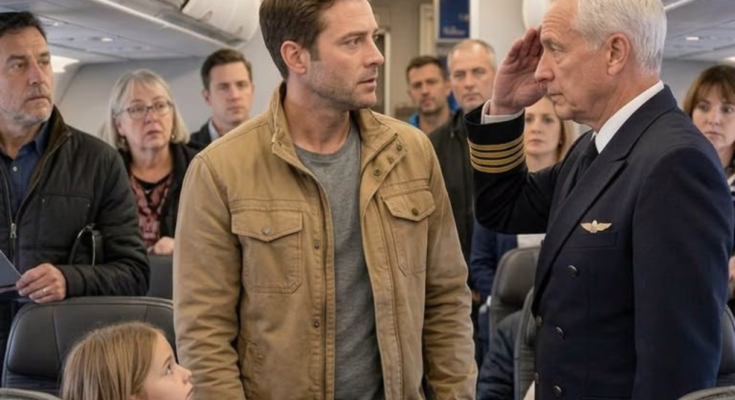
I simply took my sobbing child’s hand and began to walk away. But our quiet exit was instantly halted when the cockpit door flew open and the airline captain stepped out, snapping into a rigid, trembling salute that silenced the entire cabin.
The Silent Debt of the Clouds
Part One: The Geometry of Displacement
I have always believed that dignity is a quiet thing. It isn’t found in the loud proclamations of the powerful or the shimmering badges of the wealthy. For a man like me—a man who has left pieces of himself in the scorched dirt of a distant desert—dignity is found in the ability to stand straight when your body screams to buckle. It is found in the way you hold your daughter’s hand when the world is trying to tell her that she doesn’t belong.
That morning at the Salt Lake City International Airport, the air inside the terminal smelled of burnt coffee and recycled oxygen. My left leg, or rather the carbon-fiber and titanium construction that served as my left leg, was throbbing with a rhythmic, dull heat. The surgical steel in my lower back felt like a row of cold nails driven into my spine. It was one of the “bad days,” the kind where every step required a conscious negotiation with my nervous system.
I leaned heavily on my wooden walking cane, my fingers white-knuckled around the smooth handle. Beside me, my seven-year-old daughter, Nora, was a burst of color in her bright pink backpack. She was humming a song her mother used to sing, oblivious to the stares of the travelers around us. They saw a man in a faded flannel shirt, scuffed work boots, and a limp that made people instinctively step aside—not out of respect, but out of a desire to avoid the sight of struggle.
When we boarded the aircraft and found our way to the First Class cabin, I felt a brief, fluttering sense of accomplishment. I guided Nora into the wide, buttery leather of seat 2A. She gasped, her small hands stroking the armrest.
“Daddy, it’s like a sofa!” she whispered, her eyes wide. “Are we allowed to be here?”
“We are, sweetheart,” I said, easing myself into 2B with a stifled groan. “I promised you we’d travel like royalty this time.”
I reached into my carry-on bag, my hand brushing against the cold, heavy ceramic of the urn tucked securely between layers of soft clothing. My heart gave a painful tug. This wasn’t just a flight; it was a pilgrimage. We were carrying Clara, my late wife, back to the ocean she had loved so much.
But the peace lasted less than ten minutes.
The gate agent entered the cabin like a gust of cold wind. He was young, perhaps in his late twenties, with hair so perfectly gelled it looked like plastic. He wore a sharply pressed navy blazer and held an electronic tablet like a scepter. He didn’t look at our faces; he looked at his screen, then at my boots, then back to the screen.
“Sir,” he said, his voice loud enough to turn heads. “I’m going to need you and your young daughter to gather your personal belongings right now. We have to relocate you to the back of the aircraft.”
The cabin went silent. A businessman across the aisle lowered his Wall Street Journal. A woman in a pearl necklace paused with her espresso. I felt the heat rise in my neck.
“I beg your pardon?” I said, keeping my voice steady for Nora’s sake. “These are our assigned seats. I paid for them in full months ago.”
The agent offered a tight, rehearsed smile—the kind reserved for people who are viewed as a logistical error. “There has been a priority seating conflict, Mr. Barrett. We have a high-value passenger who requires this space. I’m sure you understand. We’ll get you settled in the main cabin.”
“I don’t understand,” I replied. “We are already settled. My daughter is comfortable, and I have a physical condition that—”
“Sir, don’t make this difficult,” he interrupted, his tone sharpening. “We need these seats for a priority traveler. Now, please. There are people waiting.”
I looked at Nora. Her lip was trembling. She clutched her light blue airline blanket to her chest, her eyes darting between me and the man with the tablet. She was learning, in real-time, that the world had a hierarchy, and we were currently at the bottom of it.
I could have fought. I could have demanded to see a manager. I could have made a scene that would have ended up on a dozen smartphones. But I looked at my daughter’s face and realized that a scene would only scare her more. I had learned long ago that a man can lose his seat and still hold onto his soul.
“It’s okay, Nora,” I whispered, forced a smile that felt like it was breaking my face. “You know what? I heard the very best seats are in the back. You can see the whole plane from there, like a captain.”
She didn’t believe me. Children are experts at detecting the scent of a lie wrapped in kindness. But she trusted me. She stood up, her small sneakers squeaking on the carpet.
I reached for our heavy bag—the one containing Clara. I stood up, the pain in my back sparking like a live wire. I gripped my cane, and with Nora’s small hand in mine, we began the long, humiliating walk down the central aisle.
Every step was a gauntlet. I could hear the whispers. I could feel the pity, which was worse than the indifference. We passed row after row of passengers who looked away as we approached. The rhythmic thump-clack of my cane and the whir of our rolling bag were the only sounds in the cabin.
We had almost reached the galley when the heavy door to the cockpit swung open.
A man stepped out. He was tall, his hair a distinguished silver at the temples, his uniform so crisp it seemed to hum with authority. This was the Senior Captain. He didn’t look at the gate agent. He didn’t look at the wealthy businessman waiting to take our seats.
His eyes locked onto mine.
For a heartbeat, the world stopped moving. The Captain’s expression shifted from professional curiosity to a profound, jarring shock. He stood perfectly still, his gaze traveling from my face to the small unit insignia pinned to my travel bag, and then to the way I stood—shoulders back, despite the cane.
Then, the Captain did something that made the entire aircraft catch its breath.
He snapped his heels together. He pulled his tall frame into a position of rigid attention. And then, in the middle of that crowded, silent plane, he raised his right hand in a slow, perfect, and unwavering military salute.
He didn’t move. He didn’t speak. He simply held the salute, his eyes fixed on mine with a respect so intense it felt like a physical weight.
The gate agent froze. The businessman in the navy suit dropped his briefcase. Nora tugged on my hand, her voice a tiny thread of sound in the absolute silence.
“Daddy? Why is the pilot doing that?”
I couldn’t answer. My throat had closed up entirely. I looked at the Captain, and for the first time in years, I didn’t feel like a limping man in a faded shirt. I felt like the man I used to be.
I let go of the rolling bag. I straightened my spine, ignoring the scream of my nerves. I stood as tall as a man with half a leg can stand, and I raised my left hand to return the salute.
Two men, bound by a code the rest of the cabin couldn’t begin to understand, stood frozen in the aisle. And in that moment, the power shifted. The air didn’t just feel different; it felt charged with the electricity of a debt that was about to be called in.
Captain Thomas Bennett lowered his hand, but his gaze remained fierce. He looked past me toward the gate agent, and his voice, when it finally came, was like a low roll of thunder.
“Sir,” the Captain said to me, his voice echoing through the cabin, “it is a profound honor to have you aboard my aircraft today. But there seems to be a grave misunderstanding about where you belong.”
He turned his eyes toward the gate agent, and the temperature in the plane seemed to drop twenty degrees.
“Explain to me,” the Captain whispered, “why this man is standing in the aisle.”
The gate agent began to stammer, his tablet shaking in his hands, but I barely heard him. My mind was already racing back to a different time, a different place, and a burning vehicle in a land of dust and blood.
I looked at the Captain’s name tag. Bennett.
And suddenly, the cliff of memory gave way, and I realized exactly who this man was.
Part Two: The Ghost of the Eastern Province
To understand the weight of that salute, you have to understand the weight of what I was carrying in that bag. You have to understand Clara.
Clara was the kind of woman who smelled like lavender and old books. She was the anchor that kept me from drifting away into the dark after I returned from my final tour. When the doctors told me they had to take the leg, Clara was the one who held my hand and told me I was still the most handsome man she’d ever seen. When the night terrors came, she didn’t ask questions. She just sat on the floor with me, her back against the bedframe, until the sun came up.
She was my world. And then, cancer took her.
It was fast and cruel. In less than a year, she went from a vibrant woman who loved the North Carolina surf to a shadow in a hospital bed. Her last wish was simple: “Take Nora to the beach. Let her see where we fell in love. And let me go home to the water.”
I spent two years saving for this trip. Every spare cent went into a metal coffee can on top of the fridge. I mended my own clothes, skipped meals, and took every extra shift my body could handle. I wanted Nora to have a moment of beauty in the middle of all this grief. I wanted her to sit in First Class, to feel special, to feel like the princess her mother always said she was.
Those tickets weren’t a luxury. They were a promise kept to a dying woman.
So, when Captain Bennett stood there in the aisle, he wasn’t just defending a passenger. He was defending the only thing I had left: my honor as a father.
“Captain, I—I was just managing the manifest,” the gate agent stammered. “We had a priority seating conflict with a Premier Diamond member. It’s standard protocol to move the lowest-fare tier in the cabin to accommodate—”
“Standard protocol?” Captain Bennett’s voice was dangerously quiet. He stepped forward, entering the gate agent’s personal space. “Do you know who this man is?”
“He’s… Mr. Barrett?”
“He is Sergeant Samuel Barrett,” the Captain corrected, his voice rising with a controlled fury. “He is a recipient of the Distinguished Service Cross. And if you had spent one second looking at his record instead of your ‘tiers,’ you would know that he has given more for this country than you will give in ten lifetimes.”
The cabin was so quiet you could hear the hum of the air conditioning. The businessman in the navy suit, who had been waiting impatiently to take our seats, suddenly looked like he wanted to vanish through the floor.
“I—I didn’t know,” the agent whispered.
“That is the problem,” Bennett said. “You didn’t care to know. Now, you are going to apologize to the Sergeant. Then you are going to apologize to his daughter. And then, you are going to find a seat for our ‘Premier’ guest in the very last row of this airplane, because Seat 2A and 2B are occupied by the most important people on this flight.”
The apology was hollow and shaky, but it didn’t matter. What mattered was the look on Nora’s face. She looked at me as if I had suddenly grown wings. The compassionate flight attendant, a woman with kind eyes and a silver wing pin, knelt down beside Nora.
“I’m so sorry for the mix-up, honey,” she said, pinning a pair of plastic pilot wings to Nora’s jacket. “Why don’t you get back in your big chair? I have some special chocolate chip cookies just for you.”
We moved back to our seats. The businessman slunk toward the back of the plane without a word. As I settled in, my body screaming from the exertion, Captain Bennett leaned over.
“Sergeant,” he whispered, “I need to speak with you once we reach cruising altitude. Please. It’s important.”
I nodded, exhausted. As the plane taxied toward the runway, Nora fell asleep, her head resting on my arm, her silver wings glinting in the morning sun. I looked out the window, watching the tarmac blur into a gray streak.
Clara, we’re doing it, I thought. We’re almost there.
Two hours later, the “Fasten Seatbelt” sign flickered off. The lead flight attendant approached me. “The Captain would like to see you in the galley, sir. I’ll stay right here with your daughter.”
I grabbed my cane and made my way to the front. The galley was a small, stainless-steel world of its own. Captain Bennett was standing there, his hat off, his face etched with an emotion that looked a lot like pain.
“Sergeant Barrett,” he began, his voice thick. “I’ve spent three years looking for you.”
I leaned against the bulkhead. “Looking for me? Why?”
He took out a wallet and pulled out a folded, weathered photograph. It showed a young soldier, barely twenty years old, grinning in front of a dusty Humvee. He looked strikingly like the Captain.
“This is my son, Leo,” Bennett said. “Three years ago, he was part of a convoy in the Eastern Province. They were hit by a coordinated IED strike. The lead vehicle was flipped and set ablaze. The men inside were trapped. The rest of the unit was pinned down by heavy small-arms fire.”
My heart began to hammer against my ribs. The smell of burning rubber and diesel flooded my senses. I could hear the pop-pop-pop of the AK-47s in the distance.
“The report said one man broke cover,” Bennett continued, his eyes wet. “He ran two hundred yards through a kill zone. He didn’t have a medivac call. He didn’t have backup. He just had a fire extinguisher and a pry bar. He pulled three men out of that burning wreck while taking fire. He stayed until the last man was out, even after he took shrapnel to his leg.”
The Captain stepped closer, his hand trembling as he touched my shoulder.
“My son was the last man you pulled out, Samuel. You carried him on your back to the extraction point. You saved his life. And I never got to say thank you.”
The silence of the galley was heavy, filled with the ghosts of a day I tried every night to forget. I looked at the man in front of me—a father who had his son because I had been too stubborn to let a boy die in the dirt.
“He’s okay?” I asked, my voice cracking.
“He’s more than okay,” Bennett smiled through his tears. “He’s a father now. I have two granddaughters because of you. When I saw your name on the manifest… I couldn’t breathe. And then to see that man treating you like a nuisance…”
He shook his head, his face hardening. “Not on my watch. Never again.”
He reached out and gripped my hand. It wasn’t a standard handshake. It was a lifeline.
“I’m going to fly you to North Carolina, Samuel. And I’m going to make sure the rest of your life is a little easier than the last few years have been. I promise you that.”
I thanked him, my mind spinning. I walked back to my seat and looked at Nora. She was still sleeping, her hand curled into a tiny fist. I realized then that the universe wasn’t just a series of random collisions. There was a thread, invisible and strong, that pulled us together.
I looked at the bag at my feet. Do you see this, Clara?
We landed in North Carolina as the sun began to dip toward the horizon. Captain Bennett was waiting at the gate. He didn’t just say goodbye; he walked us through the terminal, his hand on my shoulder, making sure every airport employee we passed knew exactly who I was.
But as we reached the exit, as the humid, salty air of the coast hit my face, a new fear took hold.
The mission wasn’t over. The hardest part was yet to come. I had to go to the shore. I had to say the final goodbye. And I didn’t know if I had enough strength left to let her go.
As we stepped into the rental car, Nora looked at me. “Daddy, why are you crying?”
“Because we’re home, Nora,” I said. “We’re finally home.”
But as I started the engine, I looked in the rearview mirror and saw a black sedan pull out of the airport parking lot, following us at a distance. My combat instincts, dormant but never dead, flared to life.
Someone was watching us. And I realized that the Captain wasn’t the only one who had recognized my name on that manifest.
Part Three: The Salt and the Soul
The drive to Emerald Isle was a blur of loblolly pines and weathered bait shops. The black sedan remained three cars back, a silent shadow in the twilight. I didn’t tell Nora. I didn’t want to stain this moment with the paranoia that had defined so much of my life.
We reached the beach just as the sky turned a bruised purple. The Atlantic Ocean was a vast, churning beast, its white-capped waves roaring onto the sand. The smell of salt was so thick I could taste it.
I helped Nora out of the car. I grabbed the bag. We walked toward the dunes, the sand shifting under my prosthetic, making every step a labor of love. We found the spot—a small outcrop of rocks where the tide pools gathered. It was where I had proposed to Clara twenty years ago.
“Is this it?” Nora asked, her voice hushed by the sound of the wind.
“This is it,” I said.
I opened the bag and pulled out the urn. It was heavy, cold, and final. I knelt in the sand, my bad leg locked out in front of me. Nora knelt beside me, her small hand resting on the ceramic.
“Mama,” she whispered. “We’re here.”
I struggled to find the words. How do you summarize a lifetime of love into a few sentences whispered to the wind? I told her I was sorry it took so long. I told her Nora was brave, just like her. I told her that I’d see her again, when my own watch was finally over.
I opened the lid. The ashes were silver-gray, like the underside of a cloud. Together, Nora and I held the urn and tilted it toward the retreating tide. The wind caught her, spinning her into a fine mist that settled onto the dark water.
For a moment, I felt a lightness I hadn’t felt in years. The weight in the bag was gone, replaced by a peace that radiated from the center of my chest.
“She’s swimming now, Daddy,” Nora said, a small, sad smile on her face.
I pulled her into a hug, my tears soaking into her hair. We sat there on the sand for a long time, watching the ocean swallow the remains of our old life.
But the peace was shattered by the sound of a car door closing.
I turned my head. The black sedan was parked at the edge of the dunes. A man stepped out. He wasn’t a soldier. He was older, wearing an expensive wool overcoat and carrying a briefcase. He walked toward us with a measured, respectful pace.
I stood up, gripping my cane, moving Nora behind me.
“Sergeant Barrett?” the man called out.
“Who wants to know?” I barked, the old edge returning to my voice.
The man stopped ten feet away. He looked at the urn in my hand, then at the ocean. He took off his hat.
“My name is Marcus Thorne,” he said. “I am the Chief Legal Officer for the airline you flew today. Captain Bennett called our CEO from the cockpit. He… he told us what happened at the gate in Salt Lake.”
I lowered my guard slightly, but my heart was still racing. “I’m not interested in a lawsuit, Mr. Thorne. I just wanted to get my daughter to the beach.”
“We’re not here to prevent a lawsuit, Sergeant,” Thorne said softly. “We’re here because we failed you. And more importantly, we failed the values our company claims to stand for.”
He opened the briefcase and pulled out a thick envelope.
“In here is a full refund for your travel. But more than that, the Board of Directors has authorized a lifetime travel pass for you and your daughter. Anywhere we fly, in any cabin. You will never have to worry about a ‘priority conflict’ again. You will always be our first priority.”
I looked at the envelope, then at the man. “I didn’t do it for the money.”
“I know,” Thorne said. “But there’s one more thing. Captain Bennett told us about the ‘Ocean Fund.’ The coffee can on your refrigerator.”
He reached into the briefcase again and pulled out a small, framed document.
“The airline has established a scholarship in your wife’s name. The Clara Barrett Foundation for Children of Veterans. We’re starting it with a half-million-dollar endowment. It will ensure that children like Nora never have to save their lunch money to honor their parents.”
I felt the air leave my lungs. I sank back down onto the sand, the cane falling to my side. I looked at Nora, who was looking at the ocean.
“Why?” I whispered.
“Because the Captain was right,” Thorne said. “Some debts can never be repaid, but that doesn’t mean we should ever stop trying.”
He placed the envelope and the document on a flat rock, tipped his hat, and walked back to his car. He didn’t wait for a thank you. He just left us there with the waves and the moonlight.
Nora came over and picked up the scholarship document. “Does this mean Mama is famous now?”
I laughed, a wet, ragged sound. “Yeah, Nora. Mama is famous.”
Epilogue: The View from the Front Row
It has been ten years since that flight.
Nora is seventeen now. She’s tall, with her mother’s eyes and a laugh that can brighten the darkest room. She’s getting ready for college—the University of North Carolina—where she plans to study marine biology. The scholarship handled everything, but she still keeps that old metal coffee can on her desk. She says it reminds her of what true love looks like.
We still travel. Every year, on the anniversary of Clara’s passing, we board a flight to the coast.
We always sit in First Class.
But I don’t sit there because of the leather seats or the free champagne. I sit there because of what it represents. It represents the day the world stopped looking past me and started looking at me. It represents the day a Captain reminded me that my sacrifice hadn’t been in vain.
Captain Bennett retired a few years ago. He lives in Florida now, not far from his son, Leo. We talk every month. He sent me a photo last Christmas of his granddaughters. The oldest one is named Clara.
Whenever I board a plane now, I don’t look at the gate agents with suspicion. I look at the people around me—the tired mothers, the limping old men, the quiet soldiers in the back rows. I try to see the stories they aren’t telling. I try to see the burdens they are carrying that nobody else can see.
Because that’s the real lesson I learned at thirty thousand feet.
We are all carrying something. We are all trying to get somewhere. And sometimes, the most heroic thing you can do is simply stand up for someone who is too tired to stand up for themselves.
I still have my cane. The pain in my back hasn’t gone away, and the prosthetic still chafes on humid days. But I don’t mind it so much anymore. Every ache is a reminder of the boy I pulled from the fire, and every step is a tribute to the woman I sent home to the sea.
As I sit here in Seat 2B, watching the clouds drift by outside the oval window, I feel a familiar presence. I look at Nora, who is reading a textbook beside me, her silver pilot wings—the real ones the Captain gave her on her sixteenth birthday—pinned to her bag.
I close my eyes and imagine Clara’s voice in the hum of the engines.
You did it, Sam. You brought her home.
And for the first time in a very long time, I am not a soldier, or a widower, or a casualty of war.
I am just a father. And that is the highest rank I will ever need.
If you want more stories like this, or if you’d like to share your thoughts about what you would have done in my situation, I’d love to hear from you. Your perspective helps these stories reach more people, so don’t be shy about commenting or sharing.