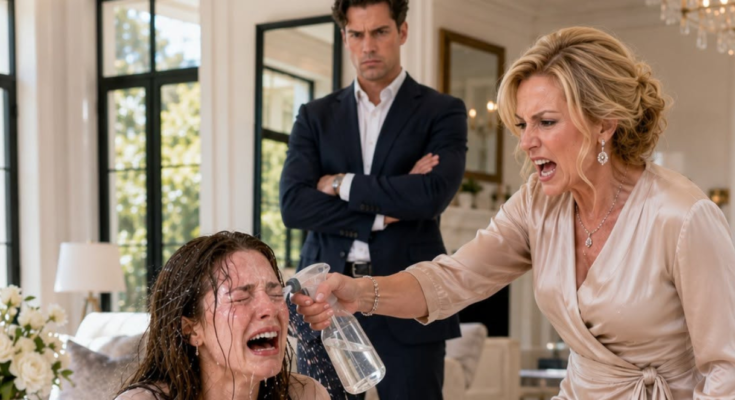
The story of my execution began less than twenty-four hours after I said, “I do.”
It did not begin with an exposed affair or a screaming confrontation. It began with the sharp smell of industrial disinfectant and the cold indifference of the man who had promised to protect me for the rest of his life.
“One day,” Lorraine Bishop hissed. “You have been married for one day, and already you behave as if this house belongs to you.”
She stood in the vast marble foyer of the Bishop family mansion, diamonds glittering around her neck. Her slender body seemed barely capable of containing the hatred in her voice.
“You track your cheap little life across my floors.”
I stood near the front door with one hand resting above the handle of my battered suitcase. Inside were the wedding photographs that had not yet been developed and the simple ivory dress Lorraine had mocked throughout the reception.
She had called my shoes humiliating.
My dress common.
My family provincial.
I had spent the first morning of my marriage trying to convince myself that patience would eventually soften her.
Then she raised the bottle.
I did not recognize it until she squeezed the trigger.
A pressurized stream of chemical cleaner struck directly across my face.
The liquid forced itself beneath my eyelids.
Fire exploded through both eyes.
My lungs emptied, and my hands flew toward my face as my knees struck the polished floor.
“Michael!” I screamed.
Someone grabbed my shoulders.
For one desperate second, I believed my husband had rushed forward to rescue me.
Michael Bishop did not pull me away.
His hands tightened around my upper arms, trapping them against my sides.
He held me still.
His mother adjusted the nozzle and sprayed me again.
“Stop being dramatic,” Michael muttered. “It is only disinfectant, Natalie. It is not acid.”
Through the blinding pain, I heard Lorraine laugh.
“A dirty, penniless girl like you never belonged in this family,” she said. “Consider this your first proper cleaning.”
I collapsed against my suitcase, gasping while the chemical burned into the delicate surface of my eyes.
My vision dissolved into gray shapes.
A pair of Italian leather shoes appeared in front of me.
Michael stepped over my body, carefully avoiding the tears and cleaner soaking into his mother’s white rug.
The emergency-room doctor did not call my reaction dramatic.
He diagnosed severe chemical burns to both corneas.
Nurses flushed my eyes repeatedly with saline. My head was wrapped in thick bandages, and every flicker of light felt like a blade passing through my skull.
Outside the curtain, Michael spoke calmly to hospital security.
“It was an unfortunate accident,” he explained. “My mother and Natalie disagreed about cleaning the foyer. Natalie grabbed the bottle, slipped, and sprayed herself. She has always been somewhat emotional.”
He sounded embarrassed.
Not concerned.
Ten minutes later, he left.
He did not complete my admission paperwork.
He did not ask whether I might lose my sight.
He did not sit beside the woman he had married the previous day.
My parents arrived forty-two minutes later.
When my mother, Katherine Bennett, entered the trauma room, she did not cry.
She studied the bandages around my head, the saline tubes, and my shaking hands.
Then she became perfectly still.
That stillness had terrified defendants, executives, and corrupt officials for more than thirty years.
My father, Thomas Bennett, came to my bedside. His warm hand gently touched the only part of my face that had not been burned.
He kissed my forehead.
Then he looked toward the nurse.
“Where are my daughter’s clothing and belongings?”
“They were sealed for hygiene purposes,” the nurse replied.
“Sealed for evidence,” my mother corrected.
She removed a pair of medical gloves from the wall dispenser and took possession of the plastic bag.
Michael believed my parents were retired public-school teachers from a quiet town in Pennsylvania.
I had encouraged that belief.
I had spent my adult life longing for one relationship untouched by my family’s wealth and influence. I wore inexpensive clothes, drove an old sedan, and worked under my middle name as a junior archivist at a municipal art museum.
I wanted someone to love Natalie.
Not the Bennett inheritance.
What Michael did not know was that Katherine Bennett had spent thirty-five years as a federal prosecutor specializing in organized financial crime.
He did not know that my quiet father was the managing partner of Bennett Ridge Capital, one of the largest private equity firms in the country.
Most importantly, Michael did not know that my father’s company was the only reason Bishop Imperial Hotels had not collapsed into bankruptcy eighteen months earlier.
Nor did he know that the decorative smart doorbell outside the mansion recorded in high-definition.
I had installed it after Lorraine repeatedly entered my apartment without permission and searched through my mail.
Every recording was automatically uploaded to an encrypted off-site server.
My mother leaned close to me.
“Did Lorraine spray you deliberately?”
“Yes.”
“Did Michael witness it?”
“He held my arms,” I whispered. “He stopped me from covering my face.”
The room seemed to become colder.
My father turned away, his jaw tightening.
Mother took my hand.
“Then we handle this carefully,” she said. “No threats. No emotional phone calls. We allow them to keep speaking until they bury themselves.”
The tears beneath my bandages stopped.
“Get the doorbell footage,” I said. “But do not tell them who you are yet.”
The following morning, Michael did not visit.
Instead, he sent a message.
Apologize to Mom, and we can forget this ugliness. I will collect you at noon.
I read it through medicated lenses that reduced the world to blurred colors.
My mother photographed the message, including the sender and timestamp.
“Respond calmly,” she instructed. “Ask him to explain.”
I typed slowly.
I’m confused. Why did your mother spray the chemical into my eyes, and why did you hold my arms so I couldn’t protect myself?
His response arrived almost immediately.
Because you humiliated her inside her own house. You should be grateful that people of our position allowed you into this family.
Mother saved several encrypted copies.
Lorraine was even more reckless.
Shortly before eleven, she left a voicemail.
I played it aloud.
“Listen carefully, Natalie,” she said. “Our attorney will send a statement confirming that yesterday was an accident caused by your carelessness. You will sign it. Michael’s reputation cannot be damaged because your eyes are unusually sensitive to household products. You entered this marriage with nothing. Remember your place, or I will make certain you leave with less.”
The call ended.
Every sentence strengthened the case my mother was building.
They believed poverty and powerlessness were the same thing.
They had never encountered people who did not need to display power in order to possess it.
By noon, my father’s security team had recovered the doorbell recording.
He opened the video on his laptop.
Even through my injured vision, the truth was unmistakable.
Lorraine shook the bottle, adjusted the nozzle, raised it directly toward my eyes, and sprayed continuously.
The footage also showed Michael gripping my arms and bracing his feet while I struggled.
The audio captured my screams.
Then his voice:
“Stop being dramatic.”
My father watched the recording once.
He closed the laptop.
“Eighteen months ago, I personally approved emergency financing for Bishop Imperial Hotels,” he said. “They had violated multiple loan conditions. I should have placed the company into receivership months ago.”
He looked at me.
“I delayed action because I believed my daughter loved their son.”
A terrible realization began forming inside me.
“Michael began rushing the wedding plans after the last debt extension,” I said.
My mother nodded.
“While you slept, I reviewed the metadata from the emails he voluntarily provided during negotiations for the prenuptial agreement. Three weeks before proposing, Michael searched your father’s full name, corporate ownership, and estimated net worth.”
I stopped breathing for a moment.
Our relationship had not become cruel after the wedding.
It had been fraudulent from the beginning.
I had never been Michael’s wife.
I had been leverage intended to guarantee another bailout.
At two that afternoon, Michael finally arrived.
He carried a wilted bouquet of carnations and brought an attorney wearing too much cologne.
His apology lasted less than fifteen seconds.
“Natalie, I’m sorry this became so unpleasant,” he said. “Mother reacted badly to the stress of the wedding. But involving the police would destroy everyone’s reputation.”
The attorney dropped a stack of papers onto my blanket.
“Sign this confidentiality agreement, and we can take you home,” Michael continued. “Then we move forward as a family.”
The agreement required me to waive criminal and civil claims against Lorraine.
It required me to describe the attack as self-inflicted.
Buried several pages later, it also transferred my rights to all wedding gifts and monetary contributions directly to Michael.
Their greed was almost breathtaking.
“I need time to read it,” I whispered, behaving like the frightened woman they expected.
Michael’s false tenderness vanished.
He leaned close enough for me to smell gin on his breath.
“You do not have options. Your museum salary will not cover your treatment. Sign the papers, Natalie. Do not make me angry.”
The hospital door opened.
My mother entered wearing a charcoal suit instead of the simple sweater Michael had seen at family dinners.
Beside her stood a city detective, the hospital’s chief ophthalmologist, and the director of legal affairs.
Michael looked confused.
“Katherine? Why are you dressed like an attorney?”
Mother did not answer him.
She placed her retired federal prosecutor’s badge on the bedside table.
The heavy silver shield struck the surface with a sharp metallic sound.
Then she handed a flash drive to the detective.
“Because unlike the gentleman you brought,” she said, glancing toward Michael’s lawyer, “I understand how digital evidence must be preserved for a felony prosecution.”
The detective stepped forward.
“Mr. Bishop, you need to come into the hallway with me.”
Michael’s face turned white.
His gaze moved from the badge to the detective and finally to me.
“Natalie, tell them it was an accident. Tell them you slipped.”
I removed my dark glasses.
My eyes were swollen, inflamed, and constantly watering.
But my gaze did not move.
“You told me to stop reacting,” I said. “So I did.”
I looked toward the detective.
“Now the law can react for me.”
Lorraine was arrested during lunch at her country club.
Police led her past the women whose approval she had spent decades purchasing.
She was charged with aggravated assault using a caustic substance.
Michael was arrested in the hospital parking garage after investigators reviewed the footage showing him restraining me during the attack.
By midnight, mother and son were sitting in nearby holding cells.
But the criminal charges were only the beginning.
Three days later, the Bishop family entered the glass-walled boardroom on the forty-second floor of Bennett Ridge Capital.
They believed they had been summoned by distant lenders to renegotiate the company’s debt following what they called an unfortunate public-relations issue.
Lorraine had been released on expensive bail. She hid behind enormous sunglasses.
Michael wore a wrinkled designer suit and the desperate confidence of a man who believed charm could erase evidence.
His father, Charles Bishop, placed his briefcase on the boardroom table.
“Let us avoid unnecessary discussion,” he said. “Tell us the penalty for extending the loans and keeping our hotels out of receivership.”
The doors opened.
I entered wearing a tailored black suit and medical lenses protecting my eyes from the city’s glare.
My parents walked beside me.
I passed the guest chairs and sat at the head of the table.
Michael stared.
“What are you doing here?”
My father placed a thick red-tagged file in front of Charles.
“Natalie is seated there because she is the primary beneficiary of the Bennett Family Trust,” he said. “That trust controls Bennett Ridge Capital.”
Silence filled the room.
Lorraine slowly lowered her sunglasses.
“But you drove an old car,” she whispered. “You said you were teachers.”
“My parents taught me many things,” I replied. “Including how to recognize parasites.”
Charles ignored us and opened the loan file.
His face turned gray as he read.
Bennett Ridge Capital was enforcing the default provisions the Bishops had violated months earlier.
All refinancing was canceled.
Personal guarantees were being called due immediately.
A court-appointed receiver would take control of all twelve Bishop hotels before the end of the day.
Michael jumped to his feet.
“You cannot do this. You are my wife. You cannot destroy my family because of one mistake.”
I removed my glasses.
The skin around my eyes remained bruised and peeling. My corneas were bright red.
“A mistake is spilling a drink,” I said. “Your mother aimed a chemical weapon at my eyes. You restrained me so she could continue.”
I held his gaze.
“Then you lied to hospital security, abandoned me in the emergency room, and tried to force me to surrender my legal rights.”
My mother slid another folder across the table.
“There is more,” she said.
Her investigators had reviewed communications stored on the Bishops’ private servers.
The messages revealed repeated discussions about my expected inheritance.
Michael and Lorraine had planned to isolate me after the wedding and pressure me into asking my father to rescue their failing hotels.
Investigators also uncovered offshore payments showing that Michael had stolen money from the hotel business to cover gambling debts.
Charles looked toward his son.
“Read page four,” Mother suggested.
His hands shook as he read Michael’s message aloud.
“Once she wears the ring, she is attached to our debt. If she runs to her father, he will pay to protect her reputation.”
Michael lowered his head.
I removed the wedding ring from my pocket and dropped it onto the printed evidence.
“My attorneys filed for annulment this morning on the grounds of fraudulent inducement,” I said.
The diamond made a small, final sound against the table.
“I am also filing a civil lawsuit against both Michael and Lorraine for physical and psychological damages. Every dollar recovered will fund treatment for survivors of domestic abuse and chemical assault.”
The boardroom doors opened again.
The same detective entered with two federal agents.
“Michael Bishop,” one agent announced, “you are under arrest for wire fraud, corporate embezzlement, and witness intimidation.”
Charles sank into his chair.
The hotel empire he had spent forty years building disappeared around him.
Lorraine began sobbing as the agents handcuffed her son.
The doorbell footage destroyed her claim that the attack had been accidental. She eventually accepted a prison sentence through a plea agreement.
Michael’s own texts, financial records, and emails left him nowhere to hide.
He pleaded guilty.
His tailored suits were replaced with prison clothing.
I did not remain in the boardroom to watch them beg.
I put my glasses back on and walked away.
Eight months later, the world was no longer a blurred painting.
My vision had returned to almost full capacity after repeated surgeries and months of specialized treatment.
I stood inside a bright new gallery in the downtown arts district.
Its walls were painted pure white.
The space had been funded by the civil settlement collected from the Bishop estate.
Every painting, photograph, and sculpture had been created by women rebuilding their lives after domestic abuse.
My annulment had been finalized.
The Bishop mansion was sold at auction.
A technology executive purchased it and removed nearly everything Lorraine had considered precious.
Bishop Imperial Hotels disappeared from the skyline. The remaining properties were absorbed into a larger hospitality company under new management.
For the first time, bright gallery lighting did not make me recoil.
It felt warm.
Clean.
Mine.
My father stood beside me, studying a large painting of sunrise over water.
“Do you regret hiding who we were?” he asked. “Pretending to be an ordinary archivist?”
I thought about the wedding, the attack, and the man who had believed my simple clothes made me disposable.
“No,” I said. “Money works like a filter.”
Father looked at me.
“Had Michael known from the beginning, he might have performed the role of a perfect husband for years. He would have hidden every ugly part of himself until he had access to the family accounts.”
I leaned against my father’s shoulder.
“When he thought I had no power, he showed me exactly who he was.”
Across the gallery, a young woman with a pale scar along her cheek stood before her own painting.
Slowly, she removed her dark sunglasses.
For the first time that evening, she looked at her artwork without shielding her eyes.
I smiled.
Michael and Lorraine had looked at my inexpensive clothes, quiet voice, and ordinary job and decided that I was dirty, weak, and insignificant.
They believed they were destroying a nobody.
Instead, they exposed themselves to the only people capable of dismantling everything they valued.
They gave me evidence.
They gave me clarity.
And when they attempted to bury me, they left behind the open ground where I built something far more beautiful than the life they had tried to steal.