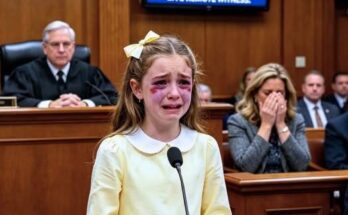
Three hours. One hundred and eighty minutes. Ten thousand, eight hundred seconds.
That is precisely how long my eight-year-old daughter sat huddled inside a concrete storm drain before a stranger’s flashlight cut through the torrential darkness. Three agonizing hours of freezing rain lashing against her fragile face. Of violent wind tearing through the thin cotton of her pajamas. Of thunder reverberating through the subterranean concrete beneath her fifty-two-pound frame.
My name is
Darcy Ingram
. I was thirty-two years old when my father,
Ray Ingram
, opened his heavy oak front door and shoved my child out into a severe Tennessee tempest, discarding her like a stray dog that had dared to knock over his garbage.
He executed this cruelty based entirely on a fabricated tale. A venomous little fiction spun by her ten-year-old cousin,
Tyler
. A fiction my parents swallowed whole without a solitary second of hesitation. Because to interrogate that lie would require them to examine the grotesque truth of who they had been sheltering all along. What transpired in that sterile emergency room three hours later, and the exact syllables that fell from my father’s mouth when he found me waiting by her bedside, fractured our reality forever. But what none of them comprehended as they walked into that hospital was that I had already orchestrated the legal demolition of their entire world.
I enlisted in the United States Army at eighteen. It wasn’t born from some profound patriotic calling or an infatuation with starched uniforms and crisp salutes. I signed my life over to the government because it was the sole escape hatch my father lacked the jurisdiction to bolt shut. Ray possessed a rigid, suffocating blueprint for the women in his bloodline. We were to marry young, remain tethered to our hometown, exude perpetual gratitude for the crumbs he provided, and maintain an absolute, submissive silence regarding his tyrannies.
My older sister,
Jenna
, was the crown jewel of that patriarchal blueprint. She wed
Derek Walsh
at twenty-one, birthed Tyler at twenty-two, and purchased a house a mere ten-minute drive from my parents’ driveway. At Jenna’s reception, my father beamed with the smug satisfaction of a man who had successfully bred compliance.
I, however, chose the Reserve Officers’ Training Corps. Then Officer Candidate School. Ultimately, I secured a logistics commission stationed out of
Fort Campbell, Kentucky
. With every geographical mile I placed between myself and my childhood bedroom, my father’s silent disapproval mutated into a deafening roar. By twenty-four, I was a First Lieutenant untangling complex supply chains for a mechanized brigade. By twenty-five, I was pregnant.
The father was a civilian contractor named
Marcus
. When my abdomen began to swell at the six-month mark, he evaporated. He left no forwarding address, no tearful voicemail. Just an empty apartment echoing with my heartbeat and a hastily scrawled note on the kitchen counter that read,
I’m not ready.
I birthed
Lily
into this world entirely alone. I raised her on military base housing, navigating subsidized meal plans and hoarding every miserable scrap of leave I could siphon from the brass. My mother,
Connie
, would dial my number once a week out of obligation. Ray called annually, perhaps monthly if he felt particularly magnanimous. And whenever his gravelly voice crackled through the receiver, the interrogation was identical.
“When are you abandoning this nonsense and coming home, Darcy?”
I never furnished the capitulation he hungered for. But I always answered Lily’s parallel question when she clutched my fatigues.
“Where are we going next, Mommy?”
“Wherever the Army sends us, baby,” I would whisper into her hair. “And we will build a fortress there. Just you and me.”
I was exceptional at fabricating stability out of chaos. I was tragically inept at spotting the rot festering in the shadows when my eyes were trained on the horizon.
When the brass handed down orders for a nine-month forward rotation in
Kuwait
, the clock began ticking. Seventy-two hours. That was my window to finalize an ironclad Family Care Plan. Every soldier with a dependent knows the suffocating weight of that Department of Defense paperwork. You designate a guardian. You sign away temporary legal custody. You deposit your absolute universe into someone else’s hands, board a transport plane bound for the other side of the globe, and pray to a god you barely believe in that you haven’t made a fatal miscalculation.
My parents volunteered before the ink on my orders was dry. Connie phoned me the very morning after I disclosed the deployment.
“She is our flesh and blood, Darcy. Don’t be absurd. Of course, she’ll stay with us.”
A wave of intoxicating relief washed over me. Lily would be ensconced in a sprawling suburban house with a manicured lawn. She would attend a public school boasting an eight-out-of-ten state rating. She would be nurtured by two grandparents who had successfully raised two children. The only alternative was the wife of my platoon sergeant—a well-meaning stranger Lily had interacted with exactly twice.
The logical path seemed blindingly clear. I signed the labyrinthine DOD forms, officially anointing Ray and Connie Ingram as Lily’s temporary legal guardians. I initiated a direct deposit funneling twelve hundred dollars on the first of every month directly into their checking account. Groceries, pediatric copays, winter boots. Ray never uttered a syllable of gratitude for the cash. He never even acknowledged its existence. I would later discover he intentionally concealed the financial arrangement from Jenna.
Jenna’s boy, Tyler, practically inhabited my parents’ residence already. He possessed his own curated bedroom at the end of the hall, complete with framed baseball memorabilia, a rocket-ship nightlight, and a dresser crammed with his garments. When my Lily arrived, dragging her little rolling suitcase, Connie ushered her into the drafty guest room. It featured a lumpy pullout couch and bare, staring windows devoid of curtains.
Tyler possessed a sanctuary. Lily was assigned a waiting room.
I was blind to this discrepancy at the time. Lily, conditioned to be invisible, never complained. And whenever I interrogated my mother about my daughter’s transition, Connie would offer a breezy, dismissive wave of her hand through the screen. “She’s adjusting just fine, Darcy. Stop hovering.”
That was the foundational lie. The first brick in a wall of deception.
The evening prior to my transatlantic flight, I perched on the edge of Lily’s bed in our cramped base apartment. I retrieved a rigid piece of plastic from my breast pocket—a standard military dependent identification card. Her solemn face was stamped on the front, my rank and name printed below, and a red emergency contact sequence plastered on the back. I meticulously safety-pinned it to the innermost lining of her purple canvas backpack.
“What is that for?” she asked, her brow furrowing.
“This is a shield,” I told her, cupping her cheek. “This tells anyone who finds you exactly who you belong to. No matter where I am. No matter how many oceans are between us. You show a grown-up this card, and they will summon me.”
She traced the embossed lettering with a tiny, trembling finger. “Even if you’re in the desert?”
“Even then.”
She fell completely silent. The air in the room seemed to thicken, pressing against my eardrums. Then, she murmured a sentence that should have paralyzed me.
“What if Grandpa gets mad again?”
Again.
I slowly set down the canteen I was screwing the lid onto. A cold dread coiled in my gut. “What do you mean, baby? Loud how?”
She picked at a frayed thread on her quilt. “Like… when Tyler breaks a toy. And Grandpa thinks it was my fault. His face gets really red and he yells so loud the walls shake. But then Grandma just says,
‘It’s fine.’
I dropped to my knees, leveling my eyes with hers. “Has Grandpa ever made you feel unsafe, Lily?”
She offered a quintessential eight-year-old shrug. The specific curvature of the shoulders that screams
yes
but lacks the emotional vocabulary to articulate the terror.
I filed that shrug away in the deepest vault of my mind. I rationalized it. I told myself I would maintain hawkish surveillance via Skype. I convinced myself that Ray was merely an archaic disciplinarian, not an active predator. I convinced myself my daughter was secure.
I was catastrophically wrong about one of those assessments. And by the time I unraveled the truth, Lily was bleeding onto wet asphalt four blocks from their front door.
I kissed her forehead, inhaling the scent of her strawberry shampoo one last time. “I will call you every single Sunday. I swear to you.”
“Promise?”
“On my life.”
I honored my vow. My parents shattered theirs.
Kuwait was an unforgiving expanse of baked sand, suffocating diesel fumes, and an eighteen-hour time distortion from Tennessee. My operational tempo demanded twelve to fourteen hours a day, untangling logistical nightmares for three forward operating bases in the theater. I rigorously scheduled my satellite video transmissions for zero-six-hundred local time, which perfectly aligned with noon stateside—Lily’s designated lunch hour at elementary school.
Except the digital rendezvous never materialized at the school cafeteria.
Connie relentlessly insisted on hosting the calls from her kitchen counter.
“The broadband is simply much stronger here, Darcy,”
she would claim. But the sinister architecture of her reasoning crystallized by the second week. Connie was a permanent fixture in the camera frame. She hovered directly behind Lily’s chair like a warden, micromanaging the angle, smiling with a stiff, brittle intensity.
“How are your classes, my love?” I’d ask through the static.
“Fine.”
“What did you learn about today?”
“Stuff.”
“Are you and Tyler having fun together?”
A suffocating pause. Lily’s eyes would dart off-screen. “I guess.”
This was a child who previously delivered twenty-minute monologues detailing the migratory patterns of a caterpillar she’d found on the sidewalk. She used to regale me with the politics of the playground. Now, she dispensed hollow, single-syllable rations. She stared through the lens as if perpetually awaiting authorization to breathe.
I attempted to ambush my mother with direct confrontation. “Is something deteriorating with Lily’s mood? Her spark is gone, Mom.”
Connie waved her manicured hand, swatting away my concern like a pesky gnat. “She is perfectly fine, Darcy. Children pout when their routine is disrupted. She simply requires time to acclimate.”
“Can I please speak with her privately next Sunday? Just the two of us?”
“The Wi-Fi is better in the kitchen, Darcy. You know this.”
I retreated. A tactical error that haunts me to this day.
A fortnight later, another symptom emerged. Lily systematically erased Tyler from her vocabulary. It used to be,
‘Tyler and I built a fort,’
or
‘Tyler showed me a frog.’
Now, invoking his name yielded a profound, desolate silence.
“Are you and your cousin getting along okay?” I pressed one morning, watching the pixelated feed stutter.
She stared down at her lap. “Yeah.”
“Are you positive?”
“Can I be excused now, Mom? Grandma says the soup is getting cold.”
I granted her permission to flee. I should have ordered her to stay.
The care package breached my barracks on a blistering Tuesday afternoon. It was a battered brown carton, the postage stamps glued at a chaotic slant. Inside nested two bags of imported gummy bears, a glossy photograph of Lily standing rigidly at a school assembly, and a folded quadrant of cheap, fibrous construction paper.
I unfolded the drawing under the harsh, humming fluorescent light of my quarters.
It was executed in waxy, violent crayon strokes. On the left hemisphere of the page stood a clustered collective. A towering, dominant male figure. A woman with tightly curled hair. A smaller female clutching the hand of a boy. They were anchored together, practically fused, their faces stretched into grotesque red-crayon smiles. The colors were vibrant, aggressive yellows and blues.
On the far right perimeter of the paper, separated by a vast, terrifying expanse of negative white space, stood a solitary figure. Minuscule. Brown hair. No smile. Her arms plastered firmly to her sides, untouched by anyone.
At the bottom edge, inscribed in the shaky, earnest penmanship of a child, were the words:
My Family.
I remained paralyzed on my scratchy military cot, the paper trembling in my hands. My own child had visually amputated herself from her own lineage.
I marched to the comms tent and demanded an immediate line stateside. Ray intercepted the call. I could detect the irritated friction in his voice; I had interrupted his evening television rituals.
“Put Lily on the phone,” I ordered, dispensing with pleasantries.
“She’s upstairs. What is the emergency?”
“I just opened her care package. She drew a family portrait. She segregated herself on the extreme edge of the paper, completely alone.”
A heavy, oppressive silence bled through the receiver, followed by a derisive snort. “Children scribble nonsense, Darcy. Do not psychoanalyze a piece of paper. She drew everyone else holding hands, didn’t she? She’s fine. Your mother bends over backwards for her.”
“She drew herself entirely isolated, Dad.”
“Perhaps if you were functioning as a mother instead of playing soldier in a sandbox across the ocean, your kid wouldn’t produce depressing artwork.”
The line went dead. The click echoed in my skull like a gunshot.
I returned to my bunk, retrieved a standard-issue green tactical notebook with an elastic binding, and clicked my pen. I logged the date. I transcribed his exact, venomous quote. I documented the spatial coordinates of the figures in the drawing. Then, I folded the construction paper into a tight square and shoved it into the breast pocket of my uniform. It rested there, a paper shield against my sternum, for four excruciating months.
I weaponized my logistical training. I began scrutinizing the peripheral data I had foolishly ignored. I accessed the elementary school’s parent portal—a digital ledger of attendance, behavioral notes, and dismissal logs. I began auditing it at zero-four-hundred every morning before my shift.
Tyler Walsh. Dismissed to Ray Ingram at 15:15 hours daily. Car pickup lane.
Lily Ingram. Enrolled in Extended Aftercare. Dismissed at 17:30 hours.
Ray retrieved his grandson at the bell. My daughter languished in the gymnasium for two additional hours, every single day. Furthermore, the emergency contact matrix listed Connie. Ray had deliberately excluded his own name from my daughter’s legal school file.
I phoned the administration office. The receptionist possessed a warm, sympathetic Southern drawl. “Lily is exceeding academic benchmarks, Lieutenant Ingram. But she is… intensely quiet. Almost a ghost.”
“Who picks her up?” I asked, my voice tight.
“She is in the extended program. Her grandmother signs her out around five-thirty. Sometimes closer to six.”
Tyler departed at three-fifteen. Lily waited.
In October, Jenna flooded social media with visual evidence of Tyler’s birthday. Fifteen screaming peers. An inflated bouncy castle dominating the backyard. A towering cake sculpted into a baseball diamond. My parents grinning triumphantly behind a mountain of wrapped gifts financed by their checking account.
January brought Lily’s eighth birthday. Connie texted me a singular, desolate image. Lily seated at the kitchen island, staring at a generic, plastic-housed supermarket cake. No candles. No party hats. No friends. Just my mother looming in the background and a flimsy paper plate.
“Why the stark contrast between her birthday and Tyler’s?” I demanded of Connie over the phone that night.
“We experienced a heavy financial month, Darcy,” she deflected, completely ignoring the twelve hundred dollars I wired her four weeks prior. “Besides, Lily didn’t express a desire for a spectacle. She is only eight.”
“What eight-year-old on the planet doesn’t want a party?”
“Tyler resides here permanently,” Connie snapped, her patience fraying. “Lily is… temporary.”
Temporary.
She wielded the adjective not as a logistical fact, but as a scalpel. It sliced straight to the bone. At that precise second, the illusion shattered. Within the walls of that house, my daughter was not family. She was an inconvenient guest. Tyler was the heir.
I marched into the command station at three in the morning and began aggressively hammering the keys of a terminal. I drafted a Hardship Reassignment Request. Two pages. Single-spaced. Devoid of emotion. Pure, lethal facts. Military protocol permits an early theater extraction when the conditions of a Family Care Plan degrade materially. I formally cited “documented, severe concerns regarding the emotional neglect and disparate treatment of a designated dependent.” I appended the school’s dismissal logs and a scanned rendering of the crayon drawing.
My commanding officer,
Colonel Barrett
, summoned me the following afternoon. He was a man carved from granite, but his eyes betrayed an unexpected softness as he evaluated me.
“Lieutenant Ingram,” he rumbled, leaning over his desk. “Look me in the eye. Is your child safe?”
“I do not know, sir,” I replied, my spine rigid. “And my ignorance is the critical failure.”
He signed the authorization with a violent flourish of his pen and expedited it up the chain of command.
Immediately, I dialed
Captain Elena Rivera
, JAG Corps. We had bled together through a grueling supply audit at Fort Sill three years prior. She was currently stationed at Campbell, and she owed me blood.
“Rivera. I require legal counsel. Deeply off the record.”
“I’m listening,” she said, the clatter of a keyboard echoing in the background.
“My parents are executing my Family Care Plan. I suspect systemic favoritism escalating into psychological neglect. I need to understand my arsenal.”
She didn’t miss a beat. Her voice transformed into ice. “Document every breath they take. Capture screenshots. Index school reports. Log dates. If this detonates into a legal theater, you need a paper trail that originates months before the inciting incident, not after.”
“There hasn’t been an explosive incident yet.”
“Then you hold the high ground,” she commanded. “Do not surrender it.”
I spent the subsequent eight weeks acting as a covert operative in my own life. Every phone call transcribed. Every text message archived into an encrypted folder titled
Vindication
. I informed absolutely no one of my impending stateside return. Not Connie. Not Ray. Not Jenna.
I waited in the shadows. And three weeks before my extraction orders cleared, Tyler Walsh manufactured the catastrophic lie that handed me the match to burn their kingdom to ash.
Tyler had been rehearsing his fabrications for months. The preliminary deceptions were minor incursions—a shattered television remote. Tyler had hurled it against the drywall during a video game tantrum. When Ray materialized, Tyler merely pointed a finger at Lily.
“She dropped it.”
Ray exiled Lily to her room without a trial.
The secondary lie involved a batch of snickerdoodle cookies Connie baked for a classroom gala. Half the pan vanished. Tyler swore Lily devoured them at midnight. The reality, I later learned, was that Tyler had smuggled them to a neighbor. Connie never even questioned Lily; she simply lectured her on gluttony.
Each incident cemented a terrifying algorithm in the Ingram household: Tyler spoke. The adults treated it as gospel. Lily denied it. The adults condemned her as a pathological liar.
I gleaned the anatomy of this psychological warfare from
Mrs. Patterson
, the counselor at Milbridge Elementary. She had been conducting weekly sanctuary sessions with Lily since November. Lily trusted the woman implicitly because Patterson never interrupted her furious scribbling.
Patterson initiated contact on a blistering Saturday. I was consuming a flavorless ration in the mess hall when an unrecognized Tennessee area code illuminated my personal cell.
“Lieutenant Ingram? This is Gail Patterson. I counsel Lily.”
I sprinted out of the mess tent, the desert wind immediately stinging my eyes. “Is my daughter injured?”
“Physically, no,” Patterson stated carefully. “But her psychological architecture is collapsing. She refuses to engage with peers. She cowers when a teacher raises their voice. And Lieutenant… yesterday, she told me something deeply alarming.”
My grip on the chain-link fence tightened until the metal bit into my skin. “Tell me.”
“She said her grandfather informed her she is not a ‘real Ingram.’ She quoted him directly. He told her that real Ingrams do not steal, and they do not lie.”
The desert heat vanished, replaced by a glacial chill spreading through my veins.
Not a real Ingram.
Ray had spat those exact syllables at me the day I packed my duffel bag for basic training.
You’re walking out on this dynasty. You’re no Ingram.
Now, he was unleashing that same toxic excommunication upon an eight-year-old.
“Forward your clinical notes to my encrypted military server by Monday,” I ordered, my voice vibrating with a terrifying new frequency.
I dialed my sister Jenna the next morning, foolishly hoping a maternal instinct might supersede her loyalty to the cult of Ray. It was a delusion. The call lasted exactly four minutes.
“Is Lily struggling at the house, Jen? Her counselor is alarmed.”
Jenna unleashed a theatrical, beleaguered sigh. “She is perfectly fine, Darcy. She simply refuses to learn her place. Tyler understands the hierarchy. He integrates. Your daughter just mopes.”
Learn her place.
I let the venom of that phrase linger in the digital static for three full seconds. “Clarify that, Jenna. Define her ‘place.’”
“She treats the house like a hotel. She doesn’t contribute. Tyler assists Dad in the garage. Lily hides.”
“She is eight years old. Tyler has two active parents and a heavily decorated bedroom. Lily sleeps on a folding couch out of a suitcase!”
“Honestly, Darcy,” Jenna countered, her voice plunging into a patronizing whisper, “I suggested to Mom and Dad that they just legally adopt Lily. You’re never present. You abandon her to play war. She requires a stable, authentic family environment.”
A fault line cracked open right through my chest. The audacity was breathtaking. My own sister viewed my motherhood as an expired lease they could simply foreclose upon.
“I’m coming home,” I didn’t say. I just severed the connection, opened my laptop, and initiated the drafting of a Sole Custody Review petition.
Three weeks later, I stood in Colonel Barrett’s office. He shoved the finalized transit papers across his mahogany desk. “Ingram. Whatever war is waiting for you back home, win it. Logistics can wait. Your blood cannot.”
I packed my existence into a duffel bag in forty minutes. The green tactical notebook. My laptop. The crayon drawing over my heart. The rest was government property.
Seventeen hours of violent turbulence and sterile layovers later, I breached the perimeter of Nashville International Airport. I flashed my military credentials at the Herz counter, commandeered a nondescript sedan, and navigated to a dismal Holiday Inn situated exactly twelve minutes from the Ingram residence.
I did not announce my arrival. I sat on the floral motel bedspread, the air conditioning rattling in the window, and phoned Rivera.
“I am stateside. Boots on the ground.”
“Excellent,” Rivera replied crisply. “Your Family Care Plan revocation is fully loaded. I can file it with the magistrate at dawn on Monday. The second it hits the docket, their guardianship is legally vaporized.”
“What if I breach the house right now?”
“Do not act like a fool, Darcy,” Rivera barked. “If you kick the door in tonight, they will immediately play the victims. Ray will paint you as an unstable, combat-fatigued lunatic. Jenna will testify you abandoned the child. Let the legal machinery crush them. Go to the school. Fortify your evidence. Strike in the daylight.”
She was a tactical genius. I forced my breathing to slow. I was not returning as the rebellious daughter. I was returning as an apex predator protecting its young.
The following morning, I parked my rental in the Milbridge Elementary lot. It smelled of wet mulch and exhaust. Mrs. Patterson was waiting in her office, a thick manila folder resting ominously on her desk. My daughter’s name was etched on the tab.
She opened the dossier. Six months of psychological erosion, documented in wax crayon.
September: Lily and Tyler, roughly equal in size, smiling.
November: Lily shrinking, the family towering over her, holding hands without her.
December: Ray rendered as a massive, screaming crimson circle. A microscopic Lily drowning in blue dots—tears.
January: Tyler engulfed in balloons. Lily banished to the corner, a violent black ‘X’ slashed across her own body.
And then, February. Just two figures. A tiny brown-haired girl clutching the hand of a tall woman adorned in Army green. The caption below read:
What I want.
I photographed every millimeter of those documents. I scanned the twelve pages of Patterson’s clinical observations. I transmitted the payload directly to Rivera’s server.
Then, I locked myself in the rental car, gripping the steering wheel so fiercely my knuckles turned ivory, and wept. It was a guttural, violent sobbing that tore upward from my diaphragm. Seven months of being told she was
adjusting fine
That afternoon, I conducted surveillance. I idled four blocks from my parents’ house. At three-fifteen, the yellow bus deposited Tyler. Ray bounded down the driveway, ruffled the boy’s hair, and ushered him inside, leaving the door wide open to the spring breeze.
Two hours later, the second bus arrived. Lily descended the steps alone. She trudged up the concrete. The front door was tightly shut. My eight-year-old daughter had to knock to gain entry to her own residence. Connie opened it, her face a mask of annoyance. No embrace. Just a sharp reprimand I could read on her lips before Lily disappeared inside.
I dialed
Phyllis Callaway
, the seventy-year-old matriarch who lived next door. She had baked pies for my family for three decades.
“Mrs. Callaway? It’s Darcy. I’m back.”
A sharp intake of breath. “Oh, honey. Thank the Lord. That precious girl… Darcy, she sits on the porch alone in the dark while they watch television. And your father… he screams at her through the walls. It sounds like he’s trying to break her spirit.”
I transcribed her testimony into the green notebook. Every syllable.
That evening, I drove past the house. The kitchen was illuminated. I rolled down my window. Ray’s voice violently pierced the quiet suburban air.
“I told you to clean this mess! You are a liar!”
“I didn’t do it, Grandpa,”
Lily’s voice, a terrified squeak.
“Get out of my sight!”
My hand clamped onto the door handle. Every maternal instinct screamed at me to storm the citadel, to drag my father out by his collar. But Rivera’s warning echoed in my skull.
You need the system.
I engaged the transmission. I drove away. I abandoned her to the lions for one more night.
I had no idea the storm was already gathering.
I pieced together the anatomy of that night later, stitching it from police reports, Tyler’s eventual confession, and Mrs. Callaway’s frantic 911 audio.
Around eight-thirty, as the barometric pressure plummeted and the sky bruised into a violent purple, Connie ascended the stairs. She intended to lay out her Sunday church attire, a ritual that required her grandmother’s heirloom pearl necklace. She prized those luminescent beads as the holy grail of our bloodline.
She opened the velvet box on her mahogany dresser. It was barren.
Panic ensued. Connie tore through the bedroom, frantically overturning drawers. She descended the staircase, wailing about the missing heirloom. Ray heaved his bulk from his leather recliner.
Tyler observed the escalating hysteria from the sofa for approximately ninety seconds. Then, he flawlessly executed his strike.
“Grandpa,” Tyler chirped, his voice dripping with fabricated innocence. “I saw Lily shoving something shiny into her backpack after school. She was acting super sneaky.”
Ray did not demand corroboration. He did not cross-examine the witness. He operated on a primal bias. He marched into the guest room, seized Lily’s purple backpack from the floor, and ripped open the main compartment.
The pearls cascaded out, gleaming damningly against the canvas.
Tyler had meticulously planted them there. He had pilfered the necklace while Lily was sequestered upstairs, casually slipping it into her bag before returning to his cartoons. He was ten years old, and he possessed the manipulative brilliance of a seasoned sociopath. He knew precisely what the discovery would trigger.
Ray’s face flushed to a terrifying, mottled crimson. “LILY! GET DOWN HERE!”
She crept down the hardwood stairs, clad in her thin cotton pajamas patterned with little stars. Her bare feet made no sound. She was entirely oblivious to the execution awaiting her.
Outside, the Tennessee thunderstorm finally fractured the sky. Rain began driving sideways, violently lashing against the siding. Wind gusts howled, threatening to tear the gutters from the roof.
Ray stood in the foyer, brandishing the pearls in his right fist and the backpack in his left. “You stole this from your grandmother! You little thief!”
Lily shrank against the banister. “I didn’t, Grandpa! I promise!”
Ray hurled the backpack violently to the floor. “Two years I have housed you! Two years of your insubordinate, lying attitude!”
Connie stood silently behind him, clutching the recovered pearls to her breast. She offered no defense. She asked no questions. She simply watched the slaughter.
Jenna, summoned by a frantic text from Connie moments earlier, burst through the side door. She took one glance at Lily cowering on the stairs and crossed her arms. “This is exactly what happens when a child lacks discipline, Dad. I warned you.”
Ray loomed over my daughter, his shadow engulfing her. “Tyler saw you.”
“I didn’t do it!”
“Tyler does not lie!” Ray roared, the volume vibrating the floorboards. It was his absolute truth. The gospel of Ray Ingram. “I am finished with you. You want to act like a criminal? You don’t belong in this house.”
Lily’s enormous, terrified eyes darted to Connie. Connie looked away. They darted to Jenna. Jenna checked her glowing phone screen.
Not a single adult in her bloodline offered her sanctuary.
Ray seized the backpack, shoved it into Lily’s chest, and marched to the front door. He twisted the deadbolt and yanked it open. The storm immediately invaded the foyer, spraying icy rain across the rug. He extended a rigid, trembling finger toward the darkness.
“Get out. I don’t need a lying granddaughter.”
It was eight-fifty-three in the evening. The temperature had plummeted. The rain was practically horizontal.
Lily did not weep. She did not beg. She was so thoroughly conditioned to subjugation that she simply slipped her tiny arms through the backpack straps, turned her back on her lineage, and walked barefoot into the howling tempest.
Ray slammed the heavy oak door shut, sealing her fate.
Next door, through the sheets of rain, Mrs. Callaway stood frozen at her kitchen sink. She watched, horrified, as a minuscule silhouette trudged down the flooded sidewalk, illuminated only by flashes of lightning. She lunged for her telephone and dialed 911.
Inside the house, Jenna casually slipped her coat back on. “I should beat the flooded roads. Come on, Tyler.” They exited through the garage. Nobody peered through the blinds. Nobody tracked the child.
Lily walked blindly for four agonizing blocks. The asphalt tore at the soles of her feet. Her lips turned a translucent blue. Desperate for shelter, she crawled into the opening of a massive concrete storm drain. She pulled her knees to her chest, draped the canvas backpack over her head to deflect the freezing water, and waited to die.
She remained entombed there until
Officer Gutierrez
, responding to Callaway’s dispatch, caught the reflective strip of her backpack in the beam of his Maglite. He pulled her from the concrete, her body convulsing with violent tremors, and wrapped her in a Mylar thermal blanket.
At
County General Hospital
, an emergency room nurse frantically searched the soaked backpack for a name. Tucked deeply into the innermost pocket—the exact pocket Tyler had utilized to frame her—the nurse extracted a laminated piece of plastic.
Military Dependent ID. First Lieutenant Darcy Ingram.
The nurse dialed the emergency contact.
I was staring at the popcorn ceiling of my motel room when my cell phone vibrated across the nightstand.
“Lieutenant Ingram? This is County General. We have your daughter. She was recovered by police in a storm drain.”
I don’t remember navigating the slick, flooded streets. I only remember the screech of my tires as I abandoned the rental car crookedly in the emergency bay. I sprinted through the sliding glass doors, my Army jacket clinging to my shoulders, my boots slipping on the polished linoleum.
“Room Four,” the triage nurse pointed.
I rounded the corner. The visual impact nearly dropped me to my knees. Lily was swallowed by a sterile, oversized hospital bed. An IV line snaked into her pale, bruised forearm, pumping warmed saline into her dehydrated veins. Heart monitors beeped in a frantic, irregular rhythm. Her hair was matted to her skull, still dripping onto the pillow.
I collapsed into the plastic chair beside her, seizing her freezing hand. “I’m here. Mommy’s here.”
Her eyelids fluttered open. The profound emptiness in them shattered me. “Mommy?”
“I’ve got you. I’m never leaving again.”
I noticed her other fist was clenched tight. I gently pried her tiny fingers open. Resting in her palm, crumpled and damp, was the drawing she had made of the two of us holding hands.
Twenty minutes later, a woman wielding a clipboard materialized in the doorway. She wore severe glasses and an aura of uncompromising authority. “I am
Nancy Odum
, hospital social worker. Are you the legal guardian?”
“I am her mother,” I stated, slapping my military ID onto the tray table.
Odum’s eyes flicked over the brass on my collar. “Lieutenant. I am legally obligated to initiate a severe neglect protocol with Child Protective Services. An eight-year-old was admitted with acute hypothermia and severe exposure, with no guardian attempting to locate her.”
“I absolutely understand,” I replied, my voice devoid of panic. I was operating in pure combat mode. “The individuals responsible for her care tonight are Ray and Connie Ingram. They are my designated caregivers via a military mandate. My neighbor, Phyllis Callaway, witnessed my father ejecting the child into the storm. She initiated the 911 dispatch.”
Odum paused, her pen hovering over the intake form. She looked at me, assessing my chilling composure. “CPS will dispatch an investigator by morning. Do you have anything to add?”
“I possess a six-month, meticulously documented dossier proving a pattern of psychological abuse, isolation, and neglect. I have sworn testimony from her school counselor. I will transmit the entire file to your agency immediately.”
“Please do,” Odum murmured, deeply unsettled by my efficiency.
An hour later, the door to Room Four swung open again.
Ray Ingram marched in, his face contorted into a mask of righteous indignation. But the moment his eyes registered the tiny, broken form of his granddaughter hooked to the monitors, the bravado fractured. All the blood drained from his face, leaving him a sickly, pallid gray.
Then, his gaze shifted to the chair. He saw me. Fully uniformed. Staring at him with the cold, dead eyes of an executioner.
His massive hands began to tremble violently against his thighs. He tried to speak, but his jaw merely worked uselessly. “You… you are in Kuwait.”
“I have been stateside for two days, Dad.”
Connie rushed in behind him, gasping dramatically. She rushed toward the bed, but I stood up, blocking her path. She burst into performative tears. “Darcy! If you had just been here, none of this—”
“Do not finish that sentence,” I whispered, the venom in my tone paralyzing her. “I entrusted my universe to you. You threw her into the gutter.”
Ray attempted to resurrect his authority, his chest puffing out. “The girl is a thief! She stole your mother’s heirloom! Tyler witnessed it—”
“Tyler is a ten-year-old sociopath who orchestrated a frame job,” I interrupted smoothly. “And we are not debating this in an intensive care unit.”
A nurse poked her head in. “I need to ask the visitors to lower their volume, please.”
I stepped closer to my father, invading his physical space. “CPS has already been activated, Dad. They will be knocking on your door at dawn. You should leave before I have military police escort you out.”
Ray’s eyes bulged. The reality of his vanishing control finally detonated in his brain. “You called the authorities on your own family?”
“No,” I replied softly. “The hospital did. Because that is the protocol when you try to kill a child.”
He opened his mouth to unleash hell, but the absolute void of fear in my eyes silenced him. He turned on his heel and fled. Connie trailed behind him, her sobs echoing down the corridor like a dying siren.
I dragged my chair back to Lily’s side. The ward plunged into a quiet, fluorescent hum. Around one in the morning, Lily’s grip on my fingers tightened.
“Am I going to jail?” she whispered into the dark.
“No, my brave girl. You are never in trouble.”
She swallowed hard. “Tyler put the pearls in my bag. I was sitting on the top stair. I saw him do it.”
“Why didn’t you tell Grandpa?” I asked, stroking her damp forehead.
“Because Grandpa never listens when it’s about Tyler.”
“I know,” I vowed, leaning down to kiss her cheek. “But I am going to make certain the entire world listens this time.”
As she drifted back to sleep, I opened my encrypted laptop. I attached the Patterson psychological reports, the timeline of dismissal logs, Mrs. Callaway’s testimony, and the horrific crayon drawings to an email. I routed it directly to Captain Rivera and the CPS intake portal.
Subject: Evidence of Severe Neglect – Ingram Case.
I hit send. The missile was launched.
The investigator assigned to the case was
Ms. Torres
. She was a fourteen-year veteran of the child welfare system, armed with a severe bun, non-nonsense posture, and a thick leather portfolio that commanded respect. She descended upon the Ingram residence at 0900 hours on Monday.
Torres ruthlessly dismantled their narrative. She interrogated Ray and Connie in separate, isolated rooms.
Ray’s sworn statement:
“The child was acting out violently. I ordered her to sit on the porch to cool off. She voluntarily ran away.”
Connie’s sworn statement:
“Ray was slightly elevated. Lily went outside to catch her breath. We assumed she would simply walk back in.”
Torres cross-referenced these blatant contradictions with Mrs. Callaway’s ironclad, time-stamped 911 audio.
“He shoved her out in her pajamas and screamed that he didn’t need a lying granddaughter.”
The trap was closing.
Simultaneously, a forensic child psychologist named
Dr. Kesler
interviewed Tyler at a neutral facility. Jenna was permitted in the room, but legally gagged from interfering.
Kesler placed a foam stress ball on the table. “Tyler, walk me through the necklace incident.”
“I saw Lily shove it in her bag from the kitchen,” Tyler recited mechanically.
“Where was Lily standing?”
“In the hallway.”
“Can you visually see the hallway from the kitchen angle?” Kesler pressed gently.
Tyler squeezed the foam ball, his eyes darting to Jenna. “I mean… I was in the living room.”
Kesler leaned forward. “Tyler, sometimes adults pressure us to say things. It is safe here. Tell me the truth.”
Tyler’s arrogance evaporated. He shrank into his chair. “Mom told me Lily needed to learn her place. She said if I got Lily in deep trouble, Grandpa would banish her, and I could have the house back.”
Jenna leapt from her chair, her face contorted in panic. “He is confused! He is a child making up fantasies!”
“Ma’am, sit down,” Kesler commanded, finalizing the destruction of their defense.
The climax occurred on Wednesday afternoon in the sterile, windowless conference room of the county CPS office. I sat on one side of a sprawling rectangular table, flanked by Captain Rivera in her razor-sharp dress blues. Across the expanse sat Ray, Connie, and their visibly sweating defense attorney,
Lester
. Jenna had cowardly refused to attend.
Torres stood at the head of the table. She didn’t mince words. She unleashed a barrage of authenticated evidence. The contradictory statements. The timeline of psychological abuse. Tyler’s full confession of the conspiracy. The horrifying medical documentation of Lily’s hypothermia.
Ray slammed his fist against the laminate table. “This is a private family disciplinary matter! You are overstepping—”
“Mr. Ingram,” Torres interrupted, her voice slicing through the room like a guillotine blade. “An eight-year-old child nearly died of exposure because you forcefully exiled her during a severe weather event based on a lie you refused to investigate. This is not discipline. This is a substantiated charge of severe criminal neglect.”
Connie buried her face in her hands, her shoulders heaving. “We love her! We made a singular misjudgment!”
I leaned forward, my voice carrying the dead weight of absolute finality. “You told me in the hospital that if I had been there, this wouldn’t have happened. You were right. My only mistake was believing you were capable of basic humanity. I have rectified that error.”
Rivera slid a stack of documents across the table. “The military Family Care Plan has been officially revoked. Custody has reverted entirely to Lieutenant Ingram. We have successfully petitioned the family court. You are stripped of all legal rights.”
Ray stared at the paperwork as if it were a venomous snake. His empire of control, built over decades, was burning to the ground in front of him. His hands began that familiar, pathetic tremor.
“Darcy,” he rasped, his voice finally breaking. “She is my flesh and blood.”
“She is,” I replied coldly. “Which is exactly why you will never have unsupervised access to her again.”
Torres delivered the final ruling. No unsupervised contact. Mandatory supervised visitations restricted to a monitored facility, twice a month, for two hours.
Lester quickly gathered his files, recognizing a massacre when he saw one, and ushered my devastated parents toward the exit. Ray paused in the doorframe. He looked back at me, his mouth opening to unleash one final command, one final desperate attempt to assert dominance. But he looked at the mountain of evidence, the military officer beside me, and the unyielding stone of my expression.
He closed his mouth. He walked away.
I exited the conference room, the scent of stale coffee hitting my lungs like the sweetest oxygen. In the lobby, Rivera’s paralegal was reading a picture book to Lily.
Lily dropped the book and sprinted across the linoleum, burying her face into my uniform jacket. “Are we going home, Mommy?”
“Yes, baby,” I whispered, lifting her into my arms. “Our real home.”
I noticed her purple backpack slung over the chair. The edge of the military dependent ID card was still visible, pinned securely to the fabric. I had attached it believing my parents would honor its weight. But in the end, it wasn’t family that saved my daughter from the storm. It was a piece of laminated plastic and a stranger who respected the uniform printed on it.
Three months later, the dust had settled into a profound, quiet peace.
Lily and I relocated to a secure two-bedroom apartment on base at Fort Campbell. Her new bedroom featured lavender curtains she had meticulously selected herself, and a sprawling oak desk where she spent her evenings painting—vibrant watercolors of castles and unbroken families. Colonel Barrett had permanently reassigned me to stateside logistics coordination. No deployments for the foreseeable future.
The family court formalized the custody slaughter in April. Sole physical and legal custody belonged to me.
My parents endure their supervised visitations every other Saturday at a sterile county facility twenty minutes from their residence. During their first session, Ray brought Lily a coloring book. He sat across from her at a plastic table, utterly neutralized. He spoke softly. He never mentioned the storm, the necklace, or Tyler. When the mandated two hours expired, he walked to his truck and sat behind the wheel for twenty minutes, staring blankly at the dashboard.
Jenna’s husband returned from his offshore rotation to discover his wife had conspired to ruin a child. Tyler was legally mandated into intense psychological counseling. In June, a handwritten letter arrived in our mailbox from Tyler.
I am sorry I lied to Grandpa about the pearls. I hope you aren’t mad forever.
I allowed Lily to dictate her response. Three days later, she mailed back a single sentence:
It’s okay, but I don’t want to play with you anymore.
My mother attempts to call me every Sunday evening. The conversations are brief, clinical, and strictly boundaried. I dictate the terms of our engagement now.
I spent my entire youth believing that protecting my family meant enduring my father’s tempests. I believed that providing a roof and a manicured lawn was the definition of sanctuary. I was fundamentally wrong.
Protecting my daughter meant ruthlessly purging the people who believed her existence was conditional. It meant having the calculated courage to detonate my own lineage, not with screaming tantrums or chaotic violence, but with terrifying precision, a stack of unassailable paperwork, and the absolute, unyielding truth.
The storm tried to swallow my daughter. But it forgot one crucial detail. I am the one who brings the thunder.