The absolute destruction of my civilian life didn’t begin with a screaming match. It began with the delicate tuning of a string quartet in the grand foyer, and the terrifying, wet rattle of my infant son’s failing lungs.
The sprawling estate in the exclusive gated community of
Oak Creek
hummed with a frantic, expensive energy. Caterers in crisp white uniforms glided across Italian marble floors, balancing silver trays of beluga caviar and truffles. Tonight was the highly anticipated VIP networking dinner hosted by my husband,
Richard
, a narcissistic, status-obsessed hedge fund manager who operated under the delusion that he was the master of his universe. He had married me,
Maya
, because I fit his perfectly curated narrative: a quiet, unassuming “freelance data analyst” from a working-class background whom he could rescue, mold, and ultimately control.
What Richard didn’t know, what nobody in this gilded cage knew, was that my maternity leave wasn’t from a tech firm. I was
Major Maya Hayes
, a highly decorated, active-duty commander within
JSOC
—the Joint Special Operations Command. I spent my twenties dismantling terror cells in the shadows of the Hindu Kush. I was a heavily armed, lethal military asset currently operating under a deep-cover civilian alias. But tonight, stripped of my body armor and tactical comms, I was just a terrified mother.
Upstairs in the dimly lit nursery, the air was thick and suffocating. I sat in the velvet rocking chair, clutching my premature son,
Leo
, to my chest. He had been born six weeks early, his tiny body fighting a daily war just to draw breath. Tonight, his chest heaved with an agonizing, erratic rhythm.
The nursery door swung open without a knock. My mother-in-law,
Eleanor
, swept into the room, bringing with her the stifling scent of Chanel No. 5 and dog dander. She was draped in a custom emerald silk gown, clutching her pampered, purebred Afghan Hound,
Duchess
, as if the dog were royalty. Eleanor was the archetypal old-money matriarch, a woman whose veins ran with icy condescension instead of blood.
“Keep that child quiet tonight, Maya,” Eleanor commanded, her nose crinkled in overt disgust as she peered at Leo’s struggling form. “The
Governor
is attending, and Richard cannot afford to have his evening ruined by the wailing of a sickly thing. Honestly, if you had any good breeding, he wouldn’t be so appallingly fragile.”
Richard leaned against the doorframe a second later, adjusting the cuffs of his bespoke tuxedo. He glanced at his Rolex, entirely indifferent to the frantic beating of his son’s frail heart. “Just give him some syrup, Maya. Don’t make a scene tonight,” he muttered, running a hand through his perfectly styled hair before turning his back on us.
I bit the inside of my cheek until a warm tide of metallic copper flooded my tongue.
Trigger discipline.
That’s what they called it in the sandbox. Here, they called it being a compliant wife. My eyes, normally softened by a weary mother’s exhaustion, momentarily hardened into the icy, calculating stare of a sniper dialing in a target. The urge to neutralize the threat in front of me was a physical ache in my knuckles.
Downstairs, the heavy oak front doors chimed softly. The first wave of luxury cars was pulling into the circular driveway. I looked down at the bundle in my arms. Leo let out a weak, agonizing gasp that seemed to tear his throat, and right before my eyes, his tiny, trembling lips began to take on a terrifying, dusky shade of blue.
Panic, raw and primal, clawed at my throat. Leo’s breathing didn’t just rattle; it stopped. One second. Two seconds. Three terrifying seconds of absolute stillness.
I bypassed the rocking chair and sprinted for the door. I didn’t care about my milk-stained sweatpants, my messy bun, or my bare feet slapping against the cold hardwood of the hallway. I was a medic who had stabilized amputees in active war zones, but the weight of this tiny, three-pound life in my arms was the heaviest burden I had ever carried.
I practically fell down the grand, sweeping staircase and surged into the dining room.
The scene was sickeningly pristine. A dozen billionaires and politicians, dripping in diamonds and bespoke silk, were seated around a massive mahogany table. The string quartet was playing Vivaldi. I shattered the tableau like a mortar shell.
“Richard!” I screamed, my voice tearing through the refined hum of conversation. “The baby isn’t breathing! I need the keys to the SUV, now! My car is boxed in by the valet!”
The string quartet skidded to a chaotic halt. The Governor lowered his crystal glass, staring at me with wide-eyed shock.
Richard’s face didn’t register fear for his son. It twisted into a mask of pure, humiliated, venomous rage. I was embarrassing him. I was ruining the optics.
Before Richard could even formulate a lie to excuse my behavior, Eleanor marched over. Her grip on my upper arm was surprisingly vicious, her manicured nails biting into my skin.
“You hysterical, low-class embarrassment,” Eleanor hissed under her breath, her eyes wide with a psychotic fury. She began dragging me backward, toward the heavy French doors that opened onto the expansive patio.
“Let go of me! He needs oxygen!” I pleaded, trying to shield Leo from her thrashing movements.
Richard crossed the room in three long strides. He didn’t reach for his dying son. He reached for the brass handle of the French doors and ripped them open. The freezing, torrential rain of the November storm immediately whipped into the dining room, extinguishing the warm glow of the candelabras.
With a synchronized, sickening shove, Eleanor and Richard forced me out into the blinding deluge. My bare feet hit the freezing, rain-slicked slate of the patio. I stumbled, curling my body entirely around Leo to protect him from the impact.
“Sleep in the shed, street trash,” Eleanor laughed, a high, brittle sound that barely carried over the roar of the wind. She was still clutching her pampered dog to her chest, safely insulated from the cold. “You are disturbing my guests.”
Richard stood beside her, his face a portrait of narcissistic triumph. He raised his crystal champagne flute, clinked it gently against his mother’s glass, and looked me dead in the eyes.
With a heavy, echoing
click
, he threw the deadbolt shut.
Standing barefoot in the freezing mud as the icy rain soaked instantly through Leo’s fragile blanket, I watched the billionaires laugh through the reinforced glass. I looked down at my son. His lips were no longer just blue; his entire face was taking on a horrifying, oxygen-starved violet hue. The frantic, terrified mother inside me died right there in the freezing rain. With a terrifying, profound calmness, the tears stopped falling. My spine snapped into strict, rigid military alignment, and I reached my numb fingers into the hidden, waterproof lining of my diaper bag.
Inside the dining room, the warm, golden light bathed the room in a sickening glow of privilege. Through the rain-streaked glass, I could see Eleanor holding court, regaling the Governor with a clearly fabricated story about her recent yacht trip to Monaco. The silver spoons resumed their rhythmic scraping against porcelain plates holding thousand-dollar caviar. They thought the problem was solved. They thought they had exerted ultimate power over a helpless nobody.
Outside in the freezing deluge, the frightened housewife they thought they knew ceased to exist.
Commander Hayes took the wheel.
My hands, steady and surgical despite the biting, sub-zero wind lashing my skin, bypassed the baby bottles, the pacifiers, and the spare swaddles. Deep in the false bottom of the bag, my fingers closed around a heavy, matte-black transponder.
It was a
JSOC Priority-One Encrypted Distress Beacon
This was a device forged for worst-case scenarios. It wasn’t meant for domestic emergencies. It was meant to be triggered only if a tier-one operative was compromised behind enemy lines, facing imminent execution or torture. Pulling the pin meant triggering a Level 5 domestic military intervention. It meant burning my classified cover identity to ash. It meant courts-martial inquiries and congressional oversight.
But as I looked down at my son, his tiny chest completely still, his life slipping away into the cold, the choice wasn’t a choice at all. Richard and Eleanor had just declared war on a mother, entirely unaware that the mother was a heavily armed apex predator of the United States military.
Without a microsecond of hesitation, I gripped the serrated metal ring. I braced myself against the freezing brick of the mansion, shielded Leo’s face with my shoulder, and yanked the pin.
The transponder vibrated once—a heavy, silent pulse. An encrypted, unjammable signal shot through the storm clouds, bouncing off a military satellite in low Earth orbit, bypassing all civilian law enforcement, and screaming directly onto the monitors of the JSOC Joint Operations Center.
I wrapped my body around Leo, creating a human incubator, slowing my own heart rate to conserve heat, and waited. I didn’t look at the window anymore. The people inside were already ghosts.
Inside the mansion, Eleanor poured another generous glass of vintage Dom Pérignon for the Governor, throwing her head back in a silent, aristocratic laugh. She was entirely oblivious to the fact that thirty miles away, crimson klaxons were suddenly blaring inside a highly classified, subterranean hangar. She couldn’t hear the frantic shouting of tactical coordinators, or the heavy, rhythmic thrum of
MH-60 Black Hawk
and
AH-64 Apache
attack helicopters spooling up on the tarmac, their twin rotor blades already tearing through the stormy night sky, painting a direct, unstoppable vector straight for her manicured front lawn.
I counted the seconds in my head.
Three hundred and twelve.
Inside the dining room, Richard was standing at the head of the table, mid-sentence, likely boasting about his latest ruthless stock acquisition, his champagne flute raised in a toast to his own brilliance.
Then, the crystal chandeliers began to violently, inexplicably shake.
It started as a low, bass-heavy vibration in the floorboards, an unnatural earthquake that rattled the expensive porcelain plates. Within seconds, the vibration escalated into a deafening, localized hurricane. The roar of military-grade turbine engines drowned out the storm, the string quartet, and the panicked shouts of the guests.
Through the pouring rain, the sky above the estate ignited. Searing, blinding white beams from tactical searchlights cut through the darkness, turning the night into an artificial, terrifying day.
Before Richard could even drop his glass to scream, the massive, floor-to-ceiling glass patio doors exploded inward.
It wasn’t a shatter; it was a detonation. Thousands of expensive glass shards rained down over the caviar and the silk gowns. The heavy oak front doors of the mansion were simultaneously blown off their hinges with a localized breaching charge, the shockwave knocking the waitstaff to the floor.
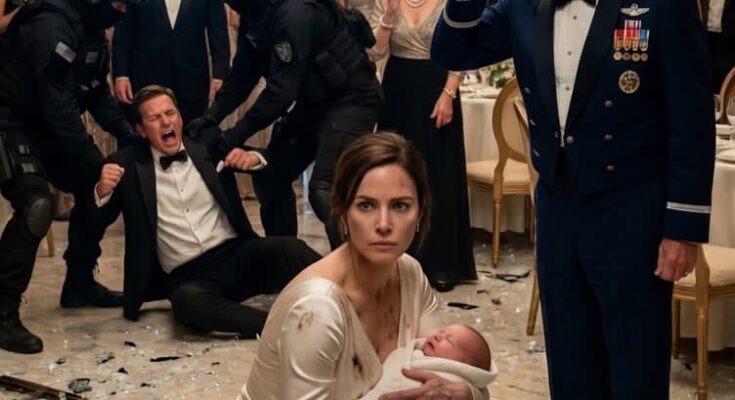
Dozens of operators clad in impenetrable black tactical gear, Kevlar vests, and quad-tube night-vision goggles flooded the dining room like a shadow tide. They moved with a terrifying, fluid violence, their suppressed M4 carbines raised and locked on targets. This wasn’t the local police department asking politely for compliance. This was an occupying force.
“Get on the ground! Face down! Hands behind your heads! Now!” a voice roared over an amplified tactical megaphone, echoing with absolute, unforgiving authority.
Richard froze in utter shock, his brain entirely incapable of processing the nightmare materializing in his dining room. He stood there, mouth agape, his Rolex catching the laser sights.
An operator didn’t repeat the order. A heavy, mud-caked combat boot kicked the back of Richard’s knees with brutal efficiency. Richard’s legs buckled, and his face crashed violently into the mahogany table, directly into his plate of beluga caviar. Blood spurted from his nose as the operator dragged his arms back, securing his wrists with thick, plastic zip-ties that bit deeply into his skin.
Eleanor shrieked—a high, piercing wail of pure terror. She dropped her purebred dog, scrambling backward against the wall, clutching her diamond necklace as two distinct red laser sights painted dead-center on her emerald silk chest.
“Don’t shoot! I’m personal friends with the Mayor! I know the Governor!” she screamed, pointing a trembling finger toward the politician, who was currently being shoved facedown onto the Persian rug by two heavily armed men.
Through the shattered remnants of the patio doors, ignoring the screaming billionaires and the chaos of the takedown, stepped a two-star General in full tactical dress.
General Sterling
was a man carved from granite, a legend within the JSOC community.
He didn’t spare a single glance at the weeping hedge fund manager or the terrified matriarch. He marched straight out into the freezing, torrential rain, his combat boots crunching over the broken glass. He stopped two feet in front of me—a soaking-wet woman in milk-stained sweatpants, holding a dying baby in the mud.
General Sterling snapped a crisp, rigid, mathematically perfect salute.
Richard, pinned to the floor with a bleeding nose, his cheek pressed against the cold marble, watched in absolute, mind-breaking confusion. Through the shattered door, he saw his “low-class,” helpless wife shift her weight, adjust the dying infant in her left arm, and with her right hand, return the General’s salute with terrifying, flawless military precision.
The General dropped his hand and keyed the radio on his shoulder. His voice carried over the rain, barking an order that would forever freeze the blood in Richard’s veins.
“Target secured. Medevac is zero-one minute out. Arrest the hostiles. If they resist, break their legs.”
The airspace above the estate was a chaotic symphony of rotor wash and strobing aviation lights. Before General Sterling had even finished his sentence, a specialized MH-6M Little Bird, retrofitted for trauma extraction, touched down brutally on Eleanor’s prized, manicured rose garden, completely shredding the landscaping.
Combat medics swarmed me like white blood cells rushing to an infection. They didn’t ask questions. They instantly placed a tiny, specialized oxygen mask over Leo’s blue face, hooking him to a portable ventilator. A medic wrapped a thermal foil blanket around both of us, and I felt the first, stuttering, mechanical breath force its way into my son’s lungs.
“I’ve got him, Commander. We’ve got him,” the lead medic shouted over the rotors, gently guiding me toward the idling chopper.
Inside the ruined mansion, the illusion of power had completely evaporated. Eleanor was sobbing hysterically, her expensive gown torn, her makeup running in thick, black streaks down her face. Duchess, the purebred dog, was cowering under a credenza.
“Do you know who I am?!” Eleanor screeched at the operatives, thrashing against the zip-ties. “I’ll have your badges! I’ll have you all court-martialed! Governor, do something!”
General Sterling stepped back through the shattered doorframe, wiping rain from his brow. He looked down at Eleanor with a level of absolute disgust usually reserved for war criminals.
“The Governor is currently being detained for questioning in the kitchen, ma’am, regarding his association with a domestic terror incident,” the General said, his voice a block of ice.
“Terror incident?!” Richard choked out, spitting blood onto the marble floor as an operator hauled him roughly to his knees. “She’s my wife! It was a domestic dispute! You have no jurisdiction here!”
General Sterling crouched down, bringing his face inches from Richard’s bleeding nose.
“You locked an active-duty Special Forces Commander and her critically ill dependent out in sub-zero temperatures, effectively denying life-saving medical care,” the General stated, reciting the charges with lethal calm. “Under Title 18 of the United States Code, endangering, assaulting, or attempting to assassinate a high-ranking military asset is a severe federal offense. You’re not going to a local police station to bail yourself out with daddy’s money. You are currently in the custody of the United States Military, and you are going to a federal black-site holding facility.”
Richard’s face drained of whatever color was left. The arrogant, untouchable hedge fund manager died in that exact second, replaced by a whimpering, broken boy facing the full, unforgiving crushing weight of the federal government.
As the medics guided me past the dining table toward the extraction point, Richard looked up. Tears and blood mingled on his face. He saw the cold, unfeeling void in my eyes—the eyes of the sniper he had never bothered to know.
“Maya… please…” he begged, his voice cracking, a pathetic, desperate plea for the docile woman he thought he had married. “I didn’t know… Maya, tell them…”
I paused, the warm air from the Medevac chopper washing over my back. I looked down at the man who had poured champagne while my son turned blue. There was no anger left, only the chilling, absolute detachment of an operator confirming a neutralized target.
“That’s Commander Hayes to you,” I whispered, the words cutting deeper than any blade.
I turned my back on him forever.
As the Medevac chopper lifted off, the G-force pushing me into the leather seat, I clutched Leo’s hand. The color was already returning to his tiny cheeks. Through the rain-streaked window, I looked down at the ruined estate. I watched as my husband and my mother-in-law were dragged out into the storm, shoved violently into the back of windowless, heavily armored military transport vehicles. Their wealth, their status, their arrogance—all of it meant nothing in the face of true power.
My moment of vindictive peace was suddenly interrupted. General Sterling, sitting across from me in the vibrating cabin, reached into his tactical vest. He pulled out a thick, classified satellite phone.
It was already ringing. He locked eyes with me and extended his hand, offering me the receiver.
Two years later, the humid, pine-scented air of the
Fort Liberty
training grounds was shattered not by gunfire, but by the sound of pure, unadulterated joy.
A laughing, fiercely energetic two-year-old boy in miniature camouflage overalls was chasing a yellow butterfly across the parade grass. I stood by the bleachers, dressed in my immaculate, pressed Class-A uniform, the silver oak leaf of a Lieutenant Colonel pinned to my collar. I scooped little Leo into my arms, pressing a kiss to his warm, healthy cheek as he giggled and squirmed. The fragile, suffocating, blue infant who had nearly died on a freezing patio was gone. In his place was a thriving, unstoppable force of nature.
“Okay, buddy, time for you to go with Mrs. Higgins. Mommy has to go to work,” I smiled, handing him over to the base childcare provider, who playfully saluted him.
Later that afternoon, sitting at my massive mahogany desk deep within the JSOC command center, the ambient hum of encrypted servers vibrating through the floor, I sorted through my morning briefings.
Near the bottom of the pile was a brief, unclassified legal memo forwarded from the Department of Justice. I picked it up, my eyes scanning the dense legal jargon.
Richard and Eleanor had just lost their final appeal.
The military tribunals and subsequent federal trials had been swift, quiet, and utterly devastating. Stripped of their assets to pay for federal restitutions, and abandoned by their elite social circles the very night the Black Hawks landed on their lawn, they had nothing left. They would spend the next fifteen years in separate, maximum-security federal penitentiaries. Richard was currently scrubbing toilets in a facility in Marion, Illinois, while Eleanor was learning the harsh realities of the pecking order at Aliceville.
They had worshipped superficial power their entire lives. They believed that wealth and cruelty were the ultimate shields. They never realized that true power doesn’t demand caviar at a networking dinner. True power doesn’t need to demean others to feel strong.
True power is the quiet, terrifying, world-ending lengths a mother will go to protect her child.
I smiled, a genuine expression of profound closure, and dropped the legal memo into the heavy-duty paper shredder beside my desk. The buzzing sound of the blades destroying the last remnants of my past blended seamlessly into the background.
Suddenly, the secure, electronic lock on my office door chimed.
My commanding officer stepped into the room. His face was entirely devoid of the usual relaxed base demeanor; it was set in a grim, stony mask of absolute seriousness. He didn’t speak a word of greeting. He walked directly to my desk and dropped a thick, heavily redacted black folder onto the polished wood. The seal on the front bore the insignia of the highest clearance level in the Pentagon.
“Lieutenant Colonel Hayes,” he stated, his voice tight with an urgency that made the hair on my arms stand up. “Your domestic leave is officially over. We have a rapidly deteriorating situation overseas, and you’re the only operator who can handle the extraction.”
I looked down at the black folder, the ghost of the sniper awakening once more in my blood.
If you want more stories like this, or if you’d like to share your thoughts about what you would have done in my situation, I’d love to hear from you. Your perspective helps these stories reach more people, so don’t be shy about commenting or sharing.