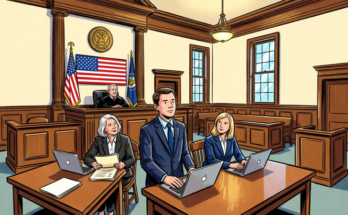
Men in suits stepped out first. Not just lawyers this time. One carried a leather folder. Another had a small case sealed with a government stamp. And behind them came Mr. Graves, Henry’s estate attorney, walking like someone who already knew the ending.
I went downstairs before they knocked. The dining room was still set from the night before. Prime rib untouched in memory. Crystal glasses aligned perfectly, catching the light like frozen fire.
Mr. Graves stopped when he saw me.
“Mrs. Whitmore,” he said quietly, “you should be resting.”
“I’ll rest after,” I replied.
Behind him, the notary opened the case.
And then I heard the front door open again.
Caleb walked in like he owned the air itself.
He paused when he saw the men.
Then he smiled.
“Oh,” he said, loosening his tie. “So this is what it is. You called lawyers.”
“I called your father’s legacy,” I said.
His eyes flicked to the table. “Still playing rich widow games, Mom? Setting the table like we’re a family again?”
“No,” I said calmly. “We stopped being a family when you raised your hand.”
For a split second, something changed in his face. Not guilt. Not regret.
Calculation.
Then he laughed.
“You think a few old men in suits scare me?”
One of the lawyers finally spoke. “Mr. Whitmore, please take a seat.”
Caleb ignored him and reached for a slice of meat with his bare hands again, tearing it like nothing mattered.
“That’s good,” he said through his mouthful. “You still cook like you’re useful.”
I didn’t move.
Mr. Graves opened the folder.
“Then let’s begin,” he said.
And that’s when Caleb finally noticed the second folder on the table.
The one marked with his full name.
Sealed.
Stamped.
Finalized.
His hand paused mid-air.
“…What is that?” he asked.
I looked at him.
“It’s everything your father warned me you would become,” I said. “And everything he made sure you could never take from us again.”
PART 4
The room changed when Mr. Graves began to read.
Not loudly. Not dramatically. Just clearly, like a man reading weather conditions before a storm hits land.
“Per the last will and testament of Henry Whitmore…”
Caleb scoffed at first.
Then he stopped chewing.
“…all controlling shares of Whitmore Logistics, all real estate holdings, and all financial instruments held under the Whitmore Trust…”
His expression tightened.
I watched it happen slowly—the realization creeping in like cold water.
“…are placed under irrevocable trust control, administered solely by the appointed trustee…”
Caleb leaned forward. “That’s me. I’m the son. I’m the—”
Mr. Graves didn’t look up.
“…with explicit exclusion of the beneficiary, Caleb Whitmore, effective immediately upon documented evidence of financial exploitation, coercion, or physical harm toward the trustee or any protected party.”
Silence.
The room stopped breathing.
Even Caleb.
Then Mr. Graves placed the second folder on the table.
“We have all three conditions,” he said.
He turned it slightly.
A printed frame of security footage.
Caleb’s hand.
My fall.
The staircase.
The timestamp.
Caleb’s face drained of color for the first time I had ever seen.
“That’s—” he started. “That’s not what it looks like.”
I almost smiled.
But I didn’t.
“Video doesn’t argue,” Mr. Graves said simply.
Caleb turned to me suddenly, voice rising. “You set me up.”
“No,” I said. “You did that yourself the moment you decided I was disposable.”
His chair scraped back violently.
“You can’t do this. I built connections. I have people—”
“You have debts,” one of the other lawyers said calmly. “Quite a lot of them.”
That shut him up.
For a moment.
Then he laughed again—but it was thinner now. Less confident. Like a crack in glass.
“You think disinheriting me fixes anything? I’ll come back. I always come back.”
I stood up slowly.
Every rib screamed.
But I stood anyway.
And I walked to the head of the table.
Right where my husband used to sit.
“Henry didn’t build Whitmore Logistics for you,” I said quietly. “He built it for discipline. For structure. For legacy.”
I looked at my son.
“You were never part of that equation.”
That hit harder than the legal documents.
He stepped forward suddenly—but two of the suited men moved instantly between us.
Not aggressive.
Just final.
“Mr. Whitmore,” one said, “you are no longer authorized on this property without notice.”
Caleb stared at me like I had turned into someone else.
“You’re really doing this?” he whispered.
I nodded.
“Yes.”
His jaw clenched.
For a second, I thought he might break something.
Instead, he backed away slowly, eyes locked on me the whole time.
“You’ll regret this,” he said quietly.
I didn’t answer.
Because I already knew the truth.
Regret only belonged to people who still had something left to lose.
Caleb turned and walked out.
The door shut behind him.
And for the first time in years, the house was silent in a way that felt… final.
Mr. Graves closed the folder.
“It’s done,” he said.
I exhaled slowly.
“No,” I replied.
“This is just the part where he realizes he doesn’t own us anymore.”
Three weeks passed.
The bruises faded first.
Then the fear.
Then the waiting.
Whitmore Logistics didn’t collapse without Caleb. It stabilized. Quietly. Efficiently. Like a machine finally losing a broken part.
I moved into Henry’s old office one afternoon and sat behind his desk.
For a long time, I just listened to the building breathe.
No shouting.
No demands.
No son expecting me to fix what he destroyed.
On the desk, I kept one thing from the dining room that night: a crystal glass. Empty. Clean. Unbroken.
A reminder.
Not of what I lost.
But of what I refused to break with him.
One evening, the security system flagged movement at the gate.
A familiar figure stood outside.
Caleb.
No car.
No suit.
No swagger.
Just standing there, hands in his pockets, staring at the house like it had betrayed him personally.
The guards didn’t let him in.
He didn’t ask them to.
He just looked up at the windows for a long time.
And then he left.
No words.
No threats.
Nothing left to take.
I watched him go from the same upstairs window where everything had started.
And I finally understood something Henry had written years ago in that private letter I once couldn’t fully grasp:
“Protection is not cruelty. Sometimes it is the only form of love that survives what people become.”
I folded the letter again and placed it back in the drawer.
Outside, the sun set over the estate.
And for the first time in a very long time, the house didn’t feel like it was holding its breath.
It felt like it was finally allowed to live.