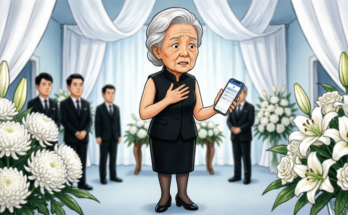
Mom… I heard his voice.
The old phone almost slipped out of my hands.
Derek took a step back.
He didn’t yell.
He didn’t deny it.
He just stood there staring at Mason like our son had just opened a grave.
—Whose voice, baby? I asked, even though part of me already knew.
Mason was shaking all over.
His lips were cracked, his eyes sunken, his fingernails black from scratching at wood.
—Dad used to come at night, he whispered. —He didn’t always come in. He’d stay downstairs. But I could hear him talking to Mr. Harold.
I felt the room tilt.
—No, I said.
Not to Mason.
Not to the truth.
Not to the world.
Derek gripped the phone so hard I thought he’d crack the screen.
—He’s confused, he said.
His voice didn’t sound desperate.
It sounded dangerous.
—Mason’s scared. They kept him locked up for a month. He doesn’t know what he’s saying.
My son pressed himself against the wall.
—Mom, don’t let him take me.
That was enough.
I stepped between them.
—Don’t touch him.
Derek looked at me like I’d just betrayed him.
Like he wasn’t the one standing in front of our missing son, holding the phone that condemned him.
Downstairs, Mrs. Ruth was screaming that we couldn’t be in her house, that this was private property, that she was calling the police.
I heard her and felt a fury so enormous it made me calm.
—Call them, I shouted. —Tell them you found the missing boy.
Mr. Harold appeared in the doorway of the room.
He no longer looked like a harmless old man.
His face was gray, his hands shaking, and he had the eyes of someone who had just run out of exits.
—Derek, he said, —this got out of hand.
The name landed clean.
Derek closed his eyes.
I looked at him.
—What did you do?
He tried to move toward me.
—Laura, listen to me—
That’s my name.
Laura.
For a month I had stopped being Laura and became only “the missing boy’s mother.” The woman from the flyers. The one who cried outside the school. The one who carried the same photograph to hospitals and police stations and sheriff’s offices where no one looked at her twice.
But in that moment I was myself again.
And I no longer believed him.
—Stay away from him, I said.
Mason started crying harder.
Lily, my five-year-old, was downstairs in the living room with a neighbor who had run over at the sound of screaming. Suddenly I thought of her. Of the message.
“If the little girl keeps looking at the window, we take her too.”
Terror went straight through me.
I carried Mason downstairs, pressed against my chest. He weighed less than before. So much less.
In the living room, Derek tried to take control.
—Nobody moves until we talk this through as a family.
Our neighbor Ray walked in just then with his phone in his hand.
—I already called 911, he said. —And the National Center for Missing and Exploited Children.
Derek stared at him with contempt.
—Stay out of this.
Ray pointed at Mason.
—A missing child just turned up in the house across the street. We’re all in it now.
Mrs. Ruth sat down hard on the couch.
—They told me it was only for a few days.
—Shut up! Derek snapped.
That wasn’t a husband’s outburst.
That was a man who’d been caught.
I held Mason tighter.
—Why?
Derek breathed in slowly.
—Because you left me no choice.
That sentence made me sick.
—I left you no choice to kidnap your own son?
—It was temporary!
Mason covered his ears.
I crouched beside him.
—Look at me. You’re with me now. No one is going to lock you up again.
He gripped my shirt.
—Dad said if I cried, you’d sign faster.
I felt something crack inside my chest.
—Sign what?
Derek looked away.
And then I remembered.
Three days after Mason disappeared, Derek slid a folder in front of me.
—It’s to transfer the house into a trust, he told me. —In case we need to liquidate quickly, hire investigators, pay whatever it takes.
I was shattered.
I couldn’t sleep.
I couldn’t eat.
I couldn’t think.
I picked up the pen.
But Lily started screaming in the hallway:
—Mason doesn’t want you to!
She banged her head against the wall until I put the document down.
That night I didn’t sign.
Derek went two days without speaking to me.
Now I understood.
The house.
The house we lived in wasn’t Derek’s.
It was an inheritance from my grandmother — a little craftsman bungalow in a neighborhood just outside Columbus, with a small backyard and a magnolia tree she’d planted herself. I had never wanted to sell it, even though Derek kept pushing to move somewhere “better.”
—You owed money, I said.
He didn’t answer.
Mr. Harold did.
—A lot.
Derek looked at him like he could have killed him right there.
—He gambled, the old man said. —Bad business deals. Loans. People he borrowed from in Dayton. People who don’t wait.
I looked at Derek and didn’t recognize him.
Derek, the father who cried in front of the cameras at press conferences.
Derek, the man who put up flyers with Mason’s face on every telephone pole.
Derek, the husband who held me in the dark and said:
—We’re going to find him.
He knew where he was.
He always knew.
The police arrived shortly after.
Everything became noise.
Red and blue lights on the wet street.
Neighbors watching from their front porches.
Mrs. Ruth weeping.
Mr. Harold handing over the keys to the room.
Derek repeating that it was a misunderstanding, that he’d only been trying to protect the family, that I was hysterical.
That word.
Hysterical.
They use it when a woman starts telling the truth too loudly.
Mason didn’t let go of me even when they loaded him into the ambulance. He was taken for evaluation, wrapped in a blanket. Lily got in with us. She didn’t understand everything, but she understood enough.
—I saw you, she told her brother.
Mason touched her hand.
—I saw you too.
Lily cried quietly.
—I waved at you really small so Mama would believe me.
Mason closed his eyes.
—I couldn’t yell back. They told me if I yelled, they’d take Sophie too.
—My name is Lily, she said, offended through her tears.
For the first time in a month, Mason smiled, just barely.
That smile kept me from falling apart completely.
At the hospital, the doctors spoke of dehydration, weight loss, anxiety, minor bruising, signs of prolonged confinement. I heard the words like stones being placed on me one by one.
Child Protective Services arrived.
The FBI.
A child psychologist.
A social worker.
The same detective who had told me for weeks that they were working every lead now moved quickly through the hallway, taking photographs, collecting statements, securing the old phone as evidence.
I wanted to scream at all of them that Mason had been right in front of us the whole time.
Right in front of everyone.
In the yellow house.
Behind a curtain.
But the rage could wait.
Mason couldn’t.
That night he slept with my hand in his.
Every time he closed his eyes he woke up screaming.
—Don’t turn off the light.
—I won’t.
—Don’t close the door.
—I won’t.
—Don’t let Dad in.
I swallowed the sob.
—Never again.
Derek was taken into custody that same night.
At first he denied everything.
Then he said Mr. Harold and Mrs. Ruth had acted alone.
After that he said it was a “family arrangement that was misunderstood.”
Finally, when investigators reviewed surveillance footage, bank transfers, deleted messages, and the prepaid phone, he started talking less.
He had planned all of it.
The delivery truck hadn’t taken Mason.
It was Derek.
He had waited on a side street in Mr. Harold’s minivan. He told Mason that I was at the hospital and he needed to get in quickly. Mason trusted him. How could he not? It was his father.
They brought him to the yellow house through a back entrance.
They left the bike.
Tossed the helmet.
Opened the backpack so it would look like a stranger had done it.
While I was screaming Mason’s name in the rain, Derek was half a block away, watching his own son cry in a locked room.
The motive came out in the court documents.
Gambling debts.
A compromised investment property.
A predatory loan with interest that had been compounding for years.
My signature was the key to selling the house, settling the debt, and “starting fresh,” as if a life could be reset after imprisoning a child.
Mr. Harold and Mrs. Ruth had agreed because Derek owed them money too, because he promised to pay them back, and because, according to their statements, “the boy wasn’t harmed that badly.”
When I heard that phrase read aloud in the DA’s office, I got sick in the bathroom.
My son spent thirty-one days locked up.
Thirty-one nights without his bed.
Without his books.
Without his sister.
Without me.
And someone had the nerve to say he wasn’t harmed that badly.
The first week after the rescue was a mix of miracle and horror.
The house filled with people.
Attorneys.
Therapists.
Family members.
Police for protective measures.
My mother-in-law arrived in tears.
—Let me see Derek, she begged me. —He’s your husband.
I looked at her from the doorway.
—Mason is my son.
I didn’t let her in.
My own mother drove in from Cincinnati with containers of food: chicken soup, casseroles, baked goods. She didn’t know how to heal what had happened, so she filled the refrigerator.
—Kids need to eat even when the world falls apart, she said.
She was right.
Mason ate very little.
Lily watched the windows.
I didn’t sleep.
Every sound from the street had me on my feet. Every car that slowed down in front of the house made me tremble. I had the locks changed, cameras installed, window locks added. I took down the curtains that faced the yellow house because I couldn’t stand to see that facade anymore.
The yellow house was eventually sealed.
With police tape.
With board-ups.
With neighbors whispering.
I wanted to burn it down.
But one day Mason asked to go look.
—I want to see it from outside, he said.
The therapist came with us.
We crossed the street.
Mason stood in front of the white door. Lily took his hand. He looked up at the second-floor window.
—That’s where I counted the days, he whispered.
I breathed as steadily as I could.
—How?
—With scratch marks on the wall. But then Mr. Harold painted over them.
Lily pressed her lips together.
—I saw you.
Mason looked at her.
—Yeah.
—I saved you.
He nodded.
—Yeah.
Lily stood up straighter.
—Then you owe me your fries.
Mason let out a small laugh.
It didn’t last long.
But it was a laugh.
And to me it sounded like a door opening.
The legal process was long.
Painful.
Ugly.
Derek tried to claim I was unstable, that Mason’s disappearance had made me paranoid, that he was only trying to “protect the family’s assets.” His attorney asked for supervised visitation. Talked about parental rights. Talked about family.
The judge listened to everything.
Then she asked to hear from Mason in a protected setting.
My son didn’t have to see him.
He made his statement with a child psychologist in the room, drawing first the yellow house, then the window, then Lily with a red crayon.
When they asked him who brought him there, he said:
—My dad.
He didn’t cry when he said it.
That hurt me more.
As if the tears had already been used up.
Derek lost parental rights. He was convicted on charges of kidnapping, unlawful imprisonment, child endangerment, and family violence. Mr. Harold and Mrs. Ruth were convicted as well.
The yellow house sold years later.
I never wanted to know to whom.
We had already left.
I sold my grandmother’s bungalow — not because Derek had won, but because I could not make my children heal while looking every day at the window where the nightmare had taken shape behind a curtain.
We moved to a small town east of the city.
A little house with a backyard and a view of the hills when the sky was clear. On weekends we’d go to the farmers market for apple cider donuts, and Mason would walk close beside me until gradually, slowly, he began to let go.
He never rode the blue bike again.
For months he wouldn’t even look at it.
I kept it in the garage, along with the new helmet someone sent us when the story came out. One day, almost a year later, Mason went in and brought it out.
—I want to repaint it, he said.
—What color?
He thought for a moment.
—Red.
We painted it in the backyard.
Lily ended up with more paint on her arms than on the bike. Mason got annoyed, then laughed. I sat on the ground with paint-covered hands and cried where they couldn’t see me.
The first time he rode it again was on our cul-de-sac, with me walking alongside him and Lily shouting instructions like a professional coach.
—Brake! Not so fast! Now go fast!
Mason stopped after thirty feet.
He was trembling.
—I can’t.
I walked over to him.
—You can. But you don’t have to do it today.
He looked at the red bike.
Then at me.
—Dad told me you’d forget about me if I took too long.
I felt something break inside me again.
I crouched down in front of him.
—Mason, I searched for you even when everyone told me there was nothing left to find. I would have searched for you my entire life.
—Even if I was gone?
—Even if the whole world told me to stop.
Lily wedged herself between us.
—Me too. I knew you were in there.
Mason hugged his sister.
This time not out of fear.
Out of gratitude.
The years passed.
Not magically.
Not like a movie.
Mason had nightmares. Lily was afraid of windows. I had panic attacks whenever a van slowed down on our street. We went to therapy. We learned new words: trauma, restoration, safety, boundaries.
We also learned simpler ones.
Bread.
Sun.
Laughter.
Home.
The day Mason turned twelve, he asked to go back to Columbus, to see his old elementary school.
I was scared.
But we went.
The school looked the same: the front gate, the murals, the hot dog cart on the corner, kids walking out with enormous backpacks. Mason stood and looked at the curb where his helmet had been found.
Then he reached into his own backpack and took out a folded piece of paper.
It was a drawing.
The yellow house.
The window.
And a small girl pointing.
Underneath he had written:
“My sister could see me when no one else could.”
Lily, nine years old now, turned red.
—Oh, Mason.
He handed her the drawing.
—It’s yours.
She hugged him hard.
In that moment I understood something that still holds me up.
Sometimes we adults demand enormous proof.
Video footage.
Signed documents.
Official statements.
Sworn testimony.
But the truth began with a five-year-old girl pointing at a window.
A little girl I almost didn’t believe because I thought her grief was making her see things that weren’t there.
Lily didn’t invent anything.
She saw what the rest of us were too worn down to look for.
Mason is fifteen now.
He rides his red bike through the neighborhood, always wearing his helmet even though he thinks it’s embarrassing. Lily still looks at windows, but not with fear anymore. She says she wants to be a detective or a psychologist, depending on the day.
I’m still their mom.
More guarded.
More careful.
But also more present.
I no longer dismiss a gut feeling.
I no longer let anyone call a mother’s instinct an overreaction.
Derek writes letters from prison.
At first I opened them.
Then I understood that not every voice deserves to come back inside a home. I keep them unread in a box for the legal file — not for the heart.
Mason has never asked to see them.
One day Lily asked:
—Did Dad love us?
I took a long time to answer.
I didn’t want to give her an easy lie.
—He wanted to possess us, I said. —That’s not the same as loving us.
She nodded.
Like she already knew.
The yellow house doesn’t exist on our street anymore.
But it still shows up in my dreams sometimes.
I’m standing outside, in the rain, looking at the curtain.
This time I don’t wait a month.
This time I cross the street in the very first second.
I wake up sweating.
Then I go to Mason’s room.
I watch him sleep.
Then to Lily’s.
I see her with her mouth open, one leg hanging off the bed, absolute ruler of her world.
And I breathe.
My son was missing for a month.
We searched far away.
In hospitals.
Bus stations.
Fields.
Back roads.
And he was right across the street.
Behind a curtain.
In the quiet house of the quiet neighbors.
Hidden by people who seemed incapable of doing harm.
Handed over by his own father.
Saved by his sister.
That is the complete truth.
The part that hurts and the part that heals.
Because my five-year-old daughter pointed at a yellow house and said:
—Mason is in there.
I thought it was grief talking.
But it wasn’t.
It was love looking where the adults no longer had the strength to look.
And because of that gaze, my son came home…….
Three weeks after Derek’s arrest, Mason stopped speaking.
Not completely.
He still answered questions.
Still said good morning.
Still thanked people.
But something had changed.
Every night he locked his bedroom door.
Every morning he checked every window in the house.
And every time anyone mentioned the yellow house, his hands began to shake.
His therapist said trauma often hid itself in silence.
I wanted to believe her.
Until I found the drawing.
It was tucked beneath Mason’s mattress.
Folded carefully.
Like a secret.
I opened it.
My stomach dropped.
It was a picture of the room where he had been kept.
The window.
The bed.
The locked door.
And standing in the corner…
A woman.
Not Mrs. Ruth.
Someone else.
Tall.
Dark hair.
Red coat.
Watching him.
Above her head Mason had written three words:
“SHE CAME TOO.”
I stared at the page.
Cold spreading through my chest.
Because nobody had ever mentioned a woman.
Not the police.
Not the FBI.
Not Mason.
Not Mr. Harold.
Not Ruth.
Nobody.
That night I waited until Mason finished dinner.
Then I sat beside him.
I placed the drawing on the table.
His face immediately lost color.
“Who’s she?”
He looked toward the front window.
Then toward Lily.
As if checking whether she could hear.
Finally he whispered:
“She wasn’t supposed to know I saw her.”
A chill ran down my spine.
“Who?”
Mason swallowed.
“The woman in the red coat.”
The room went silent.
Then he said something that made my blood freeze.
“She talked to Dad like she was the boss.”
For the first time since his rescue, Mason refused to meet my eyes.
The drawing sat between us.
His fingers trembled.
“The woman came every Friday.”
My heart pounded.
“How many times?”
“I don’t know.”
His voice barely existed.
“Maybe four.”
Four visits.
Four opportunities.
Four chances investigators somehow never discovered.
“What did she do?”
Mason looked down.
“Nothing.”
That answer scared me more.
“Nothing?”
He nodded.
“She just watched.”
The room felt colder.
“Watched what?”
“Me.”
A long silence followed.
Then:
“Sometimes she’d smile.”
I felt sick.
“Did she ever tell you her name?”
Mason shook his head.
“No.”
“Did Dad call her anything?”
Another pause.
Then he whispered:
“He called her Valerie.”
The cup slipped from my hand.
Coffee exploded across the kitchen floor.
Because I knew that name.
Valerie Shaw.
Derek’s former business partner.
The woman who disappeared three years ago after investors accused her of fraud.
The woman police never found.
The woman everyone assumed had fled the country.
The woman who apparently had been standing inside the yellow house.
Watching my son.
And according to Mason—
Giving orders.
The next morning I drove directly to the district attorney’s office.
I expected skepticism.
Instead, Detective Reynolds went pale.
“Valerie Shaw?”
I nodded.
The detective opened a folder.
Inside was a photograph.
The second Mason saw it, he pointed.
“That’s her.”
The room fell silent.
Reynolds cursed under his breath.
“What?”
He looked at me.
Then at Mason.
Then back at the file.
“We found evidence Valerie was communicating with Derek.”
My heart stopped.
“But there was one problem.”
“What?”
The detective swallowed.
“Valerie Shaw died eighteen months ago.”
Nobody spoke.
Not me.
Not Mason.
Not Reynolds.
Because according to official records—
Valerie was dead.
But according to my son—
She stood inside that room every Friday.
Watching him.
Smiling.
And somehow…
Still alive.
Nobody moved.
Detective Reynolds slowly slid the photograph closer to Mason.
“You’re sure?”
Mason stared at the woman.
His face turned white.
“That’s her.”
The detective exchanged a look with another agent.
Not a skeptical look.
A worried one.
I noticed.
“What aren’t you telling us?”
Reynolds opened another folder.
Inside was a crime scene photograph.
A burned SUV.
A wooded area outside Dayton.
Yellow police tape.
“We found Valerie’s vehicle eighteen months ago.”
My stomach tightened.
“And?”
“No body.”
The room went silent.
My pulse thundered.
“What do you mean no body?”
“We found blood.”
He paused.
“A lot of blood.”
Mason grabbed my hand.
“But no body.”
The detective nodded.
“Legally she was declared dead.”
Then he looked directly at me.
“That doesn’t mean she actually is.”
For the first time since Derek’s arrest, I felt genuine fear again.
Because dead people don’t visit kidnapped children.
Three days later, something arrived in my mailbox.
No stamp.
No return address.
Just a plain white envelope.
Addressed to me.
My hands started shaking before I even opened it.
Inside was a single sheet of paper.
One sentence.
Nothing else.
STOP ASKING ABOUT VALERIE.
My knees nearly gave out.
No signature.
No fingerprints.
No explanation.
Just the message.
I immediately called Detective Reynolds.
Within an hour, FBI agents were in my kitchen.
One of them studied the paper.
“Who knows you’re investigating this?”
“Almost nobody.”
The agent nodded slowly.
“Then whoever sent this is close.”
That night I checked every lock twice.
Mason slept with a baseball bat beside his bed.
And Lily refused to let go of her flashlight.
None of us slept.
Because someone knew where we lived.
Again.
Two weeks later, Derek requested a meeting.
I almost refused.
Almost.
But Detective Reynolds convinced me.
“Maybe he’s scared.”
“Good.”
“Scared people talk.”
The prison visitation room smelled like disinfectant.
Derek looked older.
Thinner.
His hair was turning gray.
Good.
I sat across from him.
Neither of us spoke at first.
Then he leaned forward.
“You’re making a mistake.”
I laughed.
The sound shocked even me.
“A mistake?”
“Looking for Valerie.”
The smile vanished from my face.
“You know she’s alive.”
Derek closed his eyes.
For a second he looked genuinely terrified.
“I know what she can do.”
Cold flooded through me.
“What does that mean?”
His voice dropped to a whisper.
“Laura…”
The fear in his eyes was real.
“Take the kids and leave Ohio.”
For the first time in years—
Derek wasn’t lying.
The next clue came from an unexpected source.
Mr. Harold.
The old man had agreed to cooperate with prosecutors.
In exchange for a reduced sentence.
I hated him.
But I listened.
During an interview he revealed something investigators didn’t know.
“There was a storage unit.”
Detective Reynolds immediately looked up.
“What storage unit?”
Harold swallowed.
“Valerie paid for it.”
“Where?”
“South Columbus.”
The search warrant was signed that same day.
When investigators opened the unit, they found boxes.
Hundreds of documents.
Fake identities.
Bank accounts.
Cash.
Photographs.
And one thing that made the room go silent.
A wall covered with pictures.
Families.
Children.
Homes.
Dozens of them.
Every photograph marked with notes.
Schedules.
Addresses.
Routines.
Like someone had been studying them.
Hunting them.
My family’s picture was there too.
Pinned directly in the center.
A red circle around Mason.
PART 10: THE VOICE
Mason stopped eating again.
The nightmares returned.
One evening I found him sitting on the back porch alone.
The sunset painted the yard orange.
For a moment he looked peaceful.
Then I noticed he was crying.
“Mason?”
He quickly wiped his face.
“What happened?”
He hesitated.
Then whispered:
“I remembered something.”
Fear settled into my stomach.
“What?”
He stared into the distance.
“The last day.”
“The last day in the yellow house?”
He nodded.
I sat beside him.
Neither of us spoke.
Finally he looked at me.
“When Dad came for me…”
His voice cracked.
“…he wasn’t alone.”
I felt my heart stop.
“Mason…”
He started shaking.
“The woman was there.”
“The woman in red?”
He nodded.
Then he whispered something that made every hair on my body stand up.
“She knew my name.”
A pause.
Then:
“And Lily’s.”………
THE GIFT
The package arrived on a Tuesday morning.
No return address.
No postage.
No fingerprints.
Just a small cardboard box sitting on our front porch.
I almost threw it away.
Then I saw the name written across the top.
MASON.
My blood turned cold.
Detective Reynolds arrived twenty minutes later.
The bomb squad opened it.
Inside was a single item.
A green T-shirt.
The same shirt Mason had been wearing when he disappeared.
The shirt police had never recovered.
The shirt everyone assumed had been destroyed.
Mason took one look at it and burst into tears.
Tucked inside the collar was a note.
Three words.
MISS ME YET?
Nobody spoke.
Because whoever sent it knew exactly how to hurt us.
And they were still out there.
END OF PART 11
PART 12: THE CAMERA
The FBI installed additional security around our house.
More cameras.
More patrols.
More protection.
It didn’t help.
Three days later, an officer found a hidden camera attached to a tree across from Lily’s elementary school.
The device had been recording for weeks.
Hundreds of hours of footage.
Almost all of it focused on one person.
Lily.
The camera wasn’t pointed at the entrance.
Or the parking lot.
Or the playground.
It followed Lily.
Only Lily.
When Detective Reynolds showed me the footage, my knees nearly gave out.
Someone had been watching my daughter.
Again.
END OF PART 12
PART 13: THE MEMORY
That night Mason woke up screaming.
I rushed into his room.
He was sitting upright in bed.
Sweating.
Shaking.
Terrified.
“Mason?”
He grabbed my arm.
Hard.
“I remember.”
My heart stopped.
“What do you remember?”
His eyes filled with tears.
“The woman.”
I sat beside him.
“What about her?”
He swallowed.
“She used to bring me puzzles.”
I frowned.
“Puzzles?”
He nodded.
“She’d sit on the chair and watch me solve them.”
That sounded strange.
But not terrifying.
Then Mason whispered:
“If I got one wrong…”
He began crying.
“…she wouldn’t let me eat.”
END OF PART 13
PART 14: THE FILE
A week later the FBI called.
They wanted us downtown immediately.
When we arrived, Detective Reynolds looked exhausted.
He placed a thick folder on the table.
“We identified one of Valerie’s aliases.”
My stomach tightened.
“And?”
He opened the file.
Inside were photographs.
Dozens of children.
Different states.
Different cities.
Different years.
All boys.
All between eight and ten years old.
Every picture had notes.
Handwriting.
Observations.
Schedules.
Favorite activities.
School information.
Mason wasn’t the first child.
He wasn’t even the fifth.
I felt sick.
“What is this?”
Reynolds looked grim.
“We think Valerie has been studying children for years.”
END OF PART 14
PART 15: THE NAME
That evening I sat with Mason in the backyard.
The sun was setting.
For the first time all week he seemed calm.
Then he asked a question.
“Mom?”
“Yeah?”
“What if Valerie wasn’t her real name?”
I looked at him.
“What do you mean?”
He stared at the grass.
“Mr. Harold called her something else once.”
My pulse quickened.
“What did he call her?”
Mason thought for a moment.
Then answered.
“Grace.”
I froze.
Because Valerie Shaw’s middle name wasn’t Grace.
Nobody in her records was named Grace.
Yet somehow the name felt important.
Very important.
END OF PART 15
PART 16: THE PHOTOGRAPHER
The FBI traced one of Valerie’s fake identities.
A photographer.
Traveling across Ohio.
Working school events.
Sports tournaments.
Community festivals.
Places where children gathered.
Places where nobody would question a camera.
Places where she could watch.
When agents searched the old storage unit again, they discovered thousands of photographs.
Most appeared innocent.
Until they noticed something.
The same children appeared repeatedly.
Years apart.
Different locations.
Different clothing.
Someone had been tracking them.
For a very long time.
END OF PART 16
PART 17: THE MAN IN THE VAN
Two days later Lily came home from school unusually quiet.
At dinner she barely touched her food.
Finally I asked.
“What’s wrong?”
She hesitated.
Then said:
“I saw a van.”
The fork slipped from my hand.
“What kind of van?”
“White.”
My chest tightened.
“Where?”
“Near the playground.”
The room became silent.
Then Lily added:
“The driver took pictures.”
END OF PART 17
PART 18: THE DRAWING RETURNS
The next morning Mason left something on my kitchen table.
A drawing.
Another one.
Just like before.
The yellow house.
The upstairs room.
The window.
But this time there was something new.
A second child.
Standing beside him.
I stared at the page.
“Mason?”
He looked away.
“There was another boy.”
My heart stopped.
“What?”
“He wasn’t there long.”
“Who was he?”
Mason shook his head.
“I never learned his name.”
The room suddenly felt very small.
Because if Mason was telling the truth—
Someone else had been trapped there too.
END OF PART 18
PART 19: THE BASEMENT
Investigators returned to the yellow house.
For the third time.
This time they used ground-penetrating radar.
Hours later they found something.
A hidden room beneath the basement.
A room nobody had mentioned.
A room hidden behind concrete walls.
Inside were old toys.
Blankets.
Children’s books.
And scratch marks.
Hundreds of scratch marks.
The discovery made national news.
But one detail never reached the public.
Someone had written a single word into the wall.
HELP.
END OF PART 19
PART 20: THE PHONE CALL
At exactly 2:17 a.m., my phone rang.
Unknown number.
I almost ignored it.
Almost.
Then I answered.
Silence.
For several seconds nobody spoke.
Then a woman whispered:
“He’s remembering.”
My blood turned to ice.
“Who is this?”
A soft laugh answered.
The same laugh Mason had described during therapy.
The same laugh from his nightmares.
Then the voice said:
“Tell Mason I’m proud of him.”
The call disconnected.
And for the first time, I knew with absolute certainty.
Valerie was alive.
PART 21: THE RECORDING
The FBI traced the phone call.
Nothing.
The number didn’t exist.
The signal bounced through multiple states before disappearing completely.
Whoever Valerie was, she knew how to hide.
Three days later, Detective Reynolds showed up at my door carrying a sealed evidence bag.
“We found something in the hidden basement.”
My stomach tightened.
Inside the bag was an old cassette tape.
The label read:
SESSION 12
No date.
No names.
No explanation.
An audio technician restored the recording.
When they played it, everyone in the room froze.
A woman’s voice.
Calm.
Patient.
Controlled.
Valerie.
“Tell me your name.”
A little boy answered.
“My name is Ethan.”
“Good.”
A pause.
Then Valerie asked:
“And who do you belong to?”
The child began crying.
END OF PART 21
PART 22: THE LIST
The tape changed everything.
The FBI reopened multiple cold cases.
Children who had disappeared.
Children who had been found.
Children nobody connected before.
One week later Reynolds called.
“We found a list.”
“What kind of list?”
“A target list.”
My heart nearly stopped.
When he arrived, he opened a folder.
There were names.
Addresses.
Photographs.
Twenty-three children.
Most had never been harmed.
Most never knew they had been watched.
But one photograph made me feel sick.
Mason’s picture.
Taken six months before he disappeared.
Someone had chosen him long before Derek got involved.
END OF PART 22
PART 23: THE TEACHER
The investigation uncovered another surprise.
One of Valerie’s aliases had been working inside a school.
Not Mason’s.
A different school two counties away.
She volunteered there for nearly a year.
Nobody suspected anything.
Parents loved her.
Teachers trusted her.
Children adored her.
The photograph from her employee file looked different.
Different hair.
Different glasses.
Different name.
But it was her.
The same eyes.
The same smile.
The same woman who stood in the yellow house.
The same woman who called at 2:17 a.m.
END OF PART 23
PART 24: THE BOY NAMED ETHAN
The FBI identified the child from the recording.
Ethan Mercer.
Nine years old.
Missing for four days in 2017.
Then mysteriously returned home.
Everyone assumed he had run away.
They were wrong.
Reynolds visited Ethan, now sixteen.
At first he denied remembering anything.
Then investigators played the tape.
The color drained from his face.
And he whispered:
“She found me again.”
END OF PART 24
PART 25: THE SECRET ROOM
Ethan agreed to talk.
His testimony shocked everyone.
According to Ethan, the yellow house wasn’t the only location.
There was another place.
A farmhouse.
Remote.
Abandoned.
Far from any town.
Far from any neighbors.
Far from help.
“How do you know?” Reynolds asked.
Ethan stared at the table.
“Because that’s where she took me first.”
The room fell silent.
For years investigators believed Mason was Valerie’s first victim.
Now they knew the truth.
He wasn’t.
Not even close.
END OF PART 25
PART 26: THE FARMHOUSE
The farmhouse sat nearly forty miles outside Dayton.
Hidden behind dead trees.
Surrounded by overgrown fields.
The property had been abandoned for years.
At least that’s what everyone thought.
Federal agents searched it for three days.
On the fourth day they found something.
A locked cellar.
Buried beneath the kitchen floor.
Inside were photographs.
Toys.
Children’s clothing.
And a notebook.
Hundreds of pages.
Every page written by Valerie.
END OF PART 26
PART 27: THE NOTEBOOK
The notebook became the most important piece of evidence.
It wasn’t a diary.
It was a study.
Page after page described children.
Their fears.
Their habits.
Their personalities.
Their families.
Valerie observed them like a scientist studying experiments.
Then agents found Mason’s section.
Twenty-seven pages.
The final entry read:
“Subject 18 displays unusual resilience. Strong attachment to younger sister. Separation ineffective.”
My hands shook reading it.
To Valerie, my son wasn’t a child.
He was a subject.
END OF PART 27
PART 28: THE VISITOR
One evening someone knocked on our door.
When I opened it, a teenage boy stood there.
Sixteen.
Dark hair.
Nervous eyes.
A backpack slung over one shoulder.
“I need to talk to Mason.”
I frowned.
“Who are you?”
The boy swallowed.
Then answered:
“My name is Ethan.”
END OF PART 28
PART 29: THE SURVIVORS
Mason and Ethan sat on the back porch for hours.
Talking.
Laughing.
Sometimes crying.
Neither wanted adults nearby.
So I watched through the kitchen window.
Eventually Ethan came inside.
He looked at me.
Then said something unexpected.
“There are more of us.”
I froze.
“What?”
He nodded.
“Four.”
The room became silent.
“Four what?”
“Kids she took.”
My pulse thundered.
Until that moment everyone believed there had only been Ethan and Mason.
Now there were six.
And maybe more.
END OF PART 29
PART 30: THE PHOTOGRAPH
The next morning Ethan returned carrying an envelope.
Inside was an old photograph.
Six children.
Standing in front of a building.
Smiling.
Normal.
Happy.
But written across the back was a sentence in Valerie’s handwriting.
“All successful subjects.”
My blood ran cold.
Because Mason was one of the children in the picture.
And according to the date stamp—
The photograph was taken two months before his disappearance.
PART 31: THE SIXTH CHILD
The photograph sat on my kitchen table all night.
I couldn’t stop staring at it.
Six children.
Six smiling faces.
Six lives connected by something none of them understood.
By morning, the FBI had identified five of them.
Mason.
Ethan.
Two boys from Kentucky.
One girl from Indiana.
The sixth child remained unknown.
No name.
No records.
Nothing.
Detective Reynolds enlarged the image.
Then he noticed something.
The mystery child wasn’t looking at the camera.
He was looking behind it.
Looking directly at whoever took the picture.
And he looked terrified.
END OF PART 31
PART 32: THE SYMBOL
Investigators searched Valerie’s notebook again.
This time they found a strange symbol.
A circle.
Inside it, three lines crossing through the center.
The same symbol appeared dozens of times.
Always next to certain children’s names.
Including Mason’s.
Nobody knew what it meant.
Until Ethan saw it.
His face instantly lost color.
“I’ve seen that before.”
Reynolds leaned forward.
“Where?”
Ethan swallowed.
“On the woman’s necklace.”
The room went silent.
Because nobody had ever mentioned a necklace.
END OF PART 32
PART 33: THE NECKLACE
The symbol changed everything.
Agents reviewed years of surveillance footage connected to Valerie’s aliases.
Thousands of hours.
Hundreds of photographs.
Then finally—
They found it.
A silver necklace.
Tiny.
Barely visible.
But unmistakable.
The symbol matched perfectly.
The image was enhanced.
The necklace wasn’t homemade.
It belonged to an organization.
A real one.
And when investigators traced it—
Their expressions changed immediately.
END OF PART 33
PART 34: THE FILE THEY WOULDN’T SHOW ME
Three days later I arrived at the FBI office.
Nobody wanted to talk.
Nobody wanted to answer questions.
Something was wrong.
Finally I cornered Reynolds.
“What aren’t you telling me?”
He looked exhausted.
“Laura…”
“What?”
His jaw tightened.
“The symbol belongs to a group.”
My stomach dropped.
“What kind of group?”
He hesitated.
Then answered.
“A child behavior research network.”
That sounded harmless.
Until he added:
“It was shut down twenty years ago.”
“Why?”
The detective looked away.
“Multiple children disappeared.”
END OF PART 34
PART 35: THE NAME GRACE
Mason’s memory returned unexpectedly.
During therapy.
He was drawing.
Nothing unusual.
Then suddenly he froze.
The crayon slipped from his fingers.
His therapist called me immediately.
When I arrived, Mason was pale.
“What happened?”
He looked at me.
And whispered:
“Grace wasn’t Valerie.”
I felt cold.
“What do you mean?”
“Valerie worked for Grace.”
Every hair on my arms stood up.
Because that meant Valerie wasn’t the person in charge.
She was following orders.
END OF PART 35
PART 36: THE WOMAN IN THE HAT
Ethan remembered something too.
A memory buried for years.
A woman.
Older than Valerie.
Always wearing a black hat.
Always standing nearby.
Watching.
Never speaking.
Ethan called her:
“The Observer.”
When agents showed him photographs from old investigations—
He pointed immediately.
One picture.
One woman.
One name.
Grace Holloway.
Officially deceased.
For twenty-two years.
END OF PART 36
PART 37: THE GRAVE
Grace Holloway’s grave sat in a cemetery outside Cleveland.
Agents obtained permission.
The body was exhumed.
DNA testing began.
Everyone waited.
Two weeks later the results arrived.
The body buried beneath the headstone wasn’t Grace.
It never had been.
The grave was a lie.
Grace Holloway was alive.
END OF PART 37
PART 38: THE LETTER UNDER THE DOOR
That same night I found an envelope under my front door.
No stamp.
No address.
Just my name.
Inside was a handwritten note.
One sentence.
“Stop digging before another child disappears.”
I nearly collapsed.
At the bottom was the same symbol.
The circle.
The three lines.
The necklace symbol.
Someone was watching us again.
END OF PART 38
PART 39: THE SECURITY FOOTAGE
Police pulled footage from our neighborhood.
At 2:11 a.m., a figure approached our house.
Female.
Average height.
Black coat.
Wide-brimmed hat.
The camera captured only two seconds before she stepped into a blind spot.
But those two seconds were enough.
Ethan saw the footage.
And immediately started shaking.
“That’s her.”
The room became silent.
“The Observer.”
Grace.
END OF PART 39
PART 40: THE FINAL PAGE
Agents returned to Valerie’s notebook.
One page remained sealed.
The last page.
The page investigators couldn’t open without damaging the evidence.
A forensic team carefully separated it.
Inside was a list.
Names.
Dates.
Photographs.
Future targets.
Children who had not yet been taken.
At the very top of the list was a name that made my blood run cold.
Not Mason.
Not Ethan.
Not any of the survivors.
The name was:
LILY ANDERSON.
My daughter……
THE SAFE HOUSE
The moment Lily’s name appeared on that list, everything changed.
Within hours, FBI agents surrounded our home.
By sunset, we were gone.
No warning.
No time to pack properly.
Just clothes, medication, and essentials.
A black SUV drove us to a secure location outside Columbus.
A safe house.
Mason sat silently in the back seat.
Lily tried to act brave.
But I saw her trembling.
“Mom?”
“Yeah?”
“Am I going to disappear too?”
The question nearly broke me.
I reached back and squeezed her hand.
“No.”
But for the first time, I wasn’t completely sure.
END OF PART 41
PART 42: THE MISSING AGENT
Three days after we entered protective custody, one of the FBI agents assigned to our case vanished.
Special Agent Thomas Grant.
Forty-three years old.
Married.
Two children.
No history of misconduct.
No warning signs.
No explanation.
His vehicle was found abandoned near a highway rest stop.
His phone was discovered inside.
His badge remained on the dashboard.
But Grant himself was gone.
When Reynolds heard the news, he looked terrified.
“Why?”
I asked.
The detective swallowed.
“Because Grant had access to our safe house location.”
END OF PART 42
PART 43: THE DREAM
That night Mason woke screaming.
Again.
The nightmares had mostly stopped.
But this one felt different.
I rushed into his room.
He was sitting upright.
Pale.
Shaking.
“Dad?”
“No.”
“The yellow house?”
He shook his head.
Then whispered:
“Grace.”
The name chilled me.
“What about her?”
Mason stared into the darkness.
“She told Valerie something.”
“What?”
His voice barely existed.
“She said I wasn’t the important one.”
I froze.
“What do you mean?”
Mason looked toward Lily’s room.
And started crying.
END OF PART 43
PART 44: THE PHOTOGRAPH WALL
Investigators searched another property connected to Valerie.
An abandoned office building.
Most of it was empty.
Dust.
Broken furniture.
Water damage.
Then agents found a hidden room.
The walls were covered in photographs.
Hundreds.
Maybe thousands.
Children.
Families.
Schools.
Parks.
Birthday parties.
Everywhere.
And in the center of the room was one giant picture.
Lily.
Eight feet wide.
Pinned directly to the wall.
END OF PART 44
PART 45: THE REASON
Nobody could understand it.
Why Lily?
Why not Mason?
Why not one of the other children?
Then Ethan remembered something.
A conversation he overheard years ago.
He met with investigators immediately.
“I heard Valerie arguing.”
“With who?”
“Grace.”
The room went silent.
“What were they arguing about?”
Ethan took a deep breath.
Then answered.
“Valerie wanted Mason.”
My stomach dropped.
“And Grace?”
Ethan looked sick.
“Grace wanted Lily.”
END OF PART 45
PART 46: THE BOOK
The breakthrough came from an old library archive.
One of Grace Holloway’s former research papers surfaced.
Written twenty-seven years earlier.
Before she disappeared.
Before Valerie.
Before everything.
The paper discussed child cognition.
Memory.
Observation.
Pattern recognition.
Most of it seemed harmless.
Until investigators reached the conclusion.
One paragraph had been highlighted repeatedly.
“The rarest children are those who perceive what others ignore.”
Everyone thought the line was academic.
Until Reynolds looked at me.
Then at Lily.
Then back at the report.
And suddenly nobody was smiling anymore.
END OF PART 46
PART 47: LILY’S MEMORY
Lily remembered something.
Something she had never told anyone.
Not me.
Not Mason.
Not her therapist.
Not the FBI.
We were eating breakfast when she suddenly spoke.
“I’ve seen her before.”
The room froze.
“Seen who?”
Lily looked confused.
“The lady in the hat.”
Every hair on my neck stood up.
“When?”
She shrugged.
“Before Mason disappeared.”
My heart nearly stopped.
“What?”
Lily nodded.
“At the park.”
END OF PART 47
PART 48: THE BENCH
Investigators took Lily through her memory carefully.
Slowly.
Patiently.
Eventually she remembered more.
A bench.
A playground.
A woman wearing a black hat.
Watching children.
Watching Lily.
Then Lily said something that silenced the room.
“She knew my name.”
I couldn’t breathe.
“How?”
“I don’t know.”
“What did she say?”
Lily stared at the table.
Then whispered:
“She said I was special.”
END OF PART 48
PART 49: THE MESSAGE
At 3:07 a.m., the safe house alarm activated.
Agents flooded the property.
Nobody was inside.
Nobody had entered.
Nothing was stolen.
Then one officer noticed something.
A note taped to the outside of Lily’s bedroom window.
Nobody understood how it got there.
The window was twenty feet above the ground.
The message contained only five words.
SHE IS READY TO LEARN.
Signed with the same symbol.
The circle.
The three lines.
Grace.
END OF PART 49
PART 50: THE FACE
The next morning, investigators reviewed traffic cameras.
Hundreds of hours.
Thousands of vehicles.
Finally they found something.
One image.
One frame.
One face.
A woman standing across the road from the safe house.
Watching.
Smiling.
The image quality was poor.
But not poor enough.
Ethan saw it first.
Then Mason.
Then me.
And every one of us said the same thing.
“That’s Grace.”
The room went silent.
Because for the first time in twenty-two years—
They finally had her face.
And she had been standing less than one hundred yards from my daughter.
PART 51: THE TEST
The image of Grace spread through every federal database available.
Within hours, analysts were searching old records.
Photographs.
Security footage.
Driver’s licenses.
Passports.
Anything.
Then they found something strange.
The same woman appeared in photographs taken over twenty years apart.
And she barely looked older.
Detective Reynolds stared at the images.
“That’s impossible.”
But it wasn’t impossible.
The photographs were real.
The timestamps were verified.
And Grace looked almost exactly the same in every one.
END OF PART 51
PART 52: THE FILE ROOM
A retired investigator contacted the FBI after seeing Grace’s photograph on the news.
He asked for a meeting.
Immediately.
When Reynolds arrived, the old man led him into a storage room filled with dusty boxes.
“I investigated her in 2004.”
Reynolds froze.
“You knew Grace?”
The man nodded.
“I tried to stop her.”
Then he handed over a file.
Across the cover someone had written:
PROJECT OBSERVER.
END OF PART 52
PART 53: PROJECT OBSERVER
The file contained hundreds of pages.
Most were heavily redacted.
But one section remained readable.
According to the documents, Grace spent years studying children with extraordinary observational abilities.
Children who noticed details adults missed.
Children who remembered things others forgot.
Children who saw patterns.
Children exactly like Lily.
At the bottom of the page was a handwritten note.
Grace’s handwriting.
“The girl surpasses expectations.”
END OF PART 53
PART 54: THE DRAWING TEST
The FBI asked Lily to participate in a simple exercise.
Nothing invasive.
Nothing frightening.
Just drawings.
Photographs.
Memory games.
At first she thought it was fun.
Then one agent accidentally dropped a stack of pictures.
Lily immediately pointed at one image.
“That’s fake.”
The room went silent.
The photograph was part of a test.
It had been digitally altered.
Nobody had told her.
Nobody expected her to notice.
Yet she spotted it instantly.
END OF PART 54
PART 55: THE SECOND NOTE
Security around the safe house doubled.
Then tripled.
It didn’t matter.
A week later another note appeared.
This one was inside.
Inside.
Nobody could explain it.
The paper sat on Lily’s pillow.
Three words written in elegant handwriting.
VERY GOOD, LILY.
I nearly collapsed.
Because someone had entered the safest location we had.
Or wanted us to believe they had.
END OF PART 55
PART 56: THE TRAITOR
The investigation turned inward.
Every agent.
Every officer.
Every employee.
Everyone with access to information was reviewed.
Eventually they discovered something.
Agent Grant—the missing agent—had not been abducted.
He had been helping Grace.
For months.
Maybe years.
The room went silent.
Because Grace hadn’t found us.
Someone had been guiding her.
END OF PART 56
PART 57: THE MESSAGE FROM GRANT
Three days later Grant surfaced.
Not in person.
Through a video.
The recording was sent directly to the FBI.
Grant looked exhausted.
Terrified.
As if he hadn’t slept in weeks.
“I made a mistake.”
His voice cracked.
“You don’t understand who Grace is.”
Then he looked directly into the camera.
“If Lily stays with you, she’ll never be safe.”
The recording ended.
No location.
No clues.
Nothing.
END OF PART 57
PART 58: THE MEMORY BOX
While cleaning the garage of our old house, investigators discovered a box hidden behind a wall panel.
The box didn’t belong to me.
It didn’t belong to Derek.
It belonged to someone else.
Inside were photographs.
Notes.
Sketches.
Every single one focused on Lily.
The oldest photograph had been taken when she was two years old.
Two.
Grace had been watching my daughter for years before Mason disappeared.
END OF PART 58
PART 59: THE VISITOR AT SCHOOL
Lily’s old school principal called unexpectedly.
“There is something you need to see.”
The FBI immediately responded.
Security footage from four years earlier showed a woman attending a school event.
Smiling.
Talking to parents.
Watching children.
Nobody noticed her at the time.
But now everyone recognized her instantly.
Grace.
She had been standing less than twenty feet from Lily.
Years before the kidnapping.
Years before anyone knew her name.
END OF PART 59
PART 60: THE TRUTH ABOUT MASON
That night Mason couldn’t sleep.
Around midnight he came into the kitchen.
I was sitting there alone.
Thinking.
Worrying.
Trying not to panic.
“Mom?”
“Yeah?”
He sat across from me.
Then quietly said:
“I think I know why she took me.”
My heart stopped.
“What do you mean?”
He stared at the table.
“Grace never wanted me.”
The words hit like ice water.
“What?”
Mason looked up.
Tears filled his eyes.
“I wasn’t the target.”
A long silence followed.
Then he whispered:
“I was bait.”
PART 61: THE PHONE
Nobody slept after Mason’s confession.
I sat in the kitchen until dawn.
Bait.
My son had spent thirty-one days imprisoned because someone wanted access to his sister.
The thought made me sick.
At 6:14 a.m., Lily’s phone buzzed.
Unknown number.
The FBI immediately traced it.
Nothing.
The call lasted exactly four seconds.
Just enough for one sentence.
A woman’s voice.
Soft.
Calm.
Almost kind.
“Hello, Lily.”
Then the line went dead.
Lily slowly lowered the phone.
Her face had gone completely white.
“That’s her.”
END OF PART 61
PART 62: THE QUESTION
The call shook everyone.
Especially Lily.
For two days she barely spoke.
Then during a meeting with her therapist she revealed something unexpected.
“She asked me a question.”
I frowned.
“When?”
“At the park.”
Years ago.
Before Mason disappeared.
Before anyone knew who Grace was.
“What question?”
Lily looked down.
Then whispered:
“She asked me what I see.”
The room fell silent.
“See where?”
Lily shook her head.
“She didn’t say.”
END OF PART 62
PART 63: THE TEST RESULTS
The FBI completed their analysis of Lily.
Memory.
Pattern recognition.
Visual observation.
Spatial awareness.
Every category produced the same conclusion.
Extraordinary.
One expert compared her results to adults with decades of investigative experience.
Another called her abilities statistically rare.
When Reynolds heard the report, he looked troubled.
Not impressed.
Troubled.
“Why?”
I asked.
He sighed.
“Because Grace knew.”
END OF PART 63
PART 64: AGENT GRANT RETURNS
Three months after disappearing, Agent Grant walked into an FBI field office.
Alone.
Unarmed.
Exhausted.
He surrendered immediately.
Reynolds flew out that same day.
The interview lasted nine hours.
When he returned, his face was pale.
“What happened?”
He stared at me.
Then answered.
“Grace let him leave.”
My blood ran cold.
Nobody escaped Grace.
Yet somehow Grant had.
Unless she wanted him to.
END OF PART 64
PART 65: THE WARNING
Grant finally talked.
According to him, Grace wasn’t hiding.
She was preparing.
Preparing for what?
Nobody knew.
But before the interview ended, Grant handed investigators a notebook.
Inside were dozens of observations.
All about Lily.
At the very back was a handwritten warning.
NOT THE LAST CHILD.
The words hit like a punch.
Because it meant Grace’s plan wasn’t ending with Lily.
It was only beginning.
END OF PART 65
PART 66: THE CABIN
Grant led agents to a remote cabin in West Virginia.
The location had appeared repeatedly in Grace’s notes.
The property looked abandoned.
Dust.
Broken windows.
Rotting wood.
Then agents discovered a hidden basement.
Inside stood a wall covered with maps.
Colored pins.
Photographs.
School districts.
Youth programs.
Summer camps.
Every location connected to children.
Grace wasn’t studying one child.
She was building something.
END OF PART 66
PART 67: THE RECORDING
Among the evidence was a digital recorder.
The FBI restored the files.
Hundreds of recordings.
Most were interviews.
Tests.
Conversations.
Then they found one labeled:
LILY — FUTURE.
The room became silent.
The recording began.
Grace’s voice filled the speakers.
“If you’re hearing this, then I was right about you.”
My heart stopped.
Because the recording had been made years before Grace ever contacted us.
END OF PART 67
PART 68: THE MESSAGE TO LILY
Everyone expected Lily to panic.
Instead, she listened carefully.
The recording continued.
“You notice details other people ignore.”
A pause.
“You see patterns.”
Another pause.
“You ask questions.”
The voice almost sounded proud.
Then Grace said something terrifying.
“One day they’ll need you.”
Lily looked at the investigators.
“What does that mean?”
Nobody had an answer.
END OF PART 68
PART 69: THE LOCATION
A breakthrough came from an unexpected place.
Lily.
She asked to see the maps recovered from the cabin.
At first the agents hesitated.
Then they agreed.
She studied them for nearly twenty minutes.
Quietly.
Carefully.
Finally she pointed.
“There.”
Reynolds frowned.
“Why there?”
Lily traced several lines connecting pins.
“Because it’s the only location that matches all the patterns.”
The room fell silent.
Hours later agents searched the location.
And found evidence proving Grace had been there recently.
Very recently.
END OF PART 69
PART 70: THE EMPTY CHAIR
The location was an abandoned observatory deep in the mountains.
Agents moved in before dawn.
Room by room.
Floor by floor.
They searched everything.
Then they found the central chamber.
A single chair sat in the middle of the room.
Facing a wall covered with photographs.
Thousands of photographs.
Children.
Families.
Schools.
Communities.
And pinned directly in the center—
A recent picture of Lily.
Taken less than a week earlier.
But that wasn’t what terrified the agents.
On the chair sat a note.
Addressed to Lily.
The handwriting belonged to Grace.
It contained only one sentence:
YOU FOUND ME FASTER THAN I EXPECTED.
END OF PART 70
The note from the observatory sat inside an evidence bag.
YOU FOUND ME FASTER THAN I EXPECTED.
Nobody liked it.
Not Reynolds.
Not the FBI.
Not me.
Because it meant Grace had anticipated everything.
Even failure.
Even discovery.
The observatory was searched for three days.
No fingerprints.
No DNA.
No useful surveillance footage.
Nothing.
It was as if she had vanished into the mountains.
Again.
On the fourth day, Lily received a letter.
Not through the mail.
Not by courier.
Someone slipped it beneath the door of the safe house.
The same safe house guarded twenty-four hours a day.
The same safe house nobody was supposed to know existed.
My hands shook as agents opened it.
Inside was a single sheet of paper.
Written in elegant handwriting.
Dear Lily,
Everyone keeps asking the wrong questions.
You already know that.
You always notice things others miss.
That is why I chose you.
Not because you’re special.
Because you’re honest.
At the bottom was a simple signature.
—Grace
Lily stared at the page.
Then quietly said:
“She’s lonely.”
Every adult in the room froze.
Because none of us saw loneliness.
We saw danger.
But somehow Lily saw something else.
END OF PART 71
PART 72: THE DRAWING ON THE BACK
Agents examined the letter for hidden messages.
At first they found nothing.
Then a forensic analyst noticed faint pencil marks.
Almost invisible.
On the back of the page.
The writing had been erased.
Special equipment restored it.
Slowly.
Line by line.
Word by word.
Until a drawing appeared.
A child’s drawing.
A small house.
A large tree.
A swing hanging from one branch.
And beneath it:
I USED TO LIVE HERE.
Nobody understood.
But Reynolds immediately ordered a search.
Because for the first time—
Grace hadn’t given them a threat.
She’d given them a clue.
END OF PART 72
The drawing led investigators to a property outside Akron.
An old farmhouse.
Long abandoned.
The swing still hung from the tree.
Exactly like the picture.
Agents searched every inch of the place.
Most of the house was empty.
Dust.
Cobwebs.
Broken furniture.
Then they discovered a hidden compartment beneath the stairs.
Inside was a small metal box.
And inside the box—
Hundreds of childhood photographs.
All of Grace.
From age six.
To age fourteen.
For the first time, investigators were looking at the child who would become Grace Holloway.
And every photograph showed the same thing.
She was always alone.
END OF PART 73
The farmhouse revealed another clue.
An elementary school.
A tiny rural school that no longer existed.
The building had been demolished years ago.
But archived records remained.
One teacher’s notes stood out immediately.
The student name:
Grace Holloway.
The comments:
The unidentified child from the old photograph was finally identified.
Not through DNA.
Not through records.
Through Lily.
She was staring at the picture when she suddenly pointed.
“His shoe.”
Reynolds frowned.
“What about it?”
“Look closer.”
The logo on the shoe had only been sold in one regional chain of stores.
One chain.
One state.
One year.
The clue eventually led investigators to a man named:
Nathan Cole.
Twenty-three years old.
Alive.
Missing from public records for nearly a decade.
And nobody knew where he was……..
THE MAN WHO DISAPPEARED
Nathan Cole was alive.
That alone shocked everyone.
For years, investigators believed the sixth child was either dead or permanently missing.
Instead, they found him living under a different name in Montana.
Twenty-three years old.
No criminal record.
No social media.
No driver’s license.
No photographs.
It was as if he had erased himself.
When FBI agents finally met him, Nathan took one look at Grace’s photograph and immediately stood up.
His chair crashed backward.
His face turned white.
“She’s looking for Lily now, isn’t she?”
The room fell silent.
Because nobody had told him about Lily.
END OF PART 76
PART 77: NATHAN’S STORY
Nathan agreed to talk.
The interview lasted nearly seven hours.
According to him, Grace never saw children as victims.
She saw them as “candidates.”
Candidates for what?
Nathan didn’t know.
But he remembered the tests.
Memory tests.
Observation tests.
Problem-solving exercises.
Pattern recognition games.
Exactly the same abilities Lily possessed.
Then Nathan revealed something terrifying.
“There were twelve of us.”
Reynolds froze.
“Twelve?”
Nathan nodded.
“I only met five.”
The room went silent.
Because until that moment investigators believed there were only six.
Now there were twelve.
Maybe more.
END OF PART 77
PART 78: AGENT GRANT’S CONFESSION
Grant finally told the full truth.
Years earlier, while investigating Grace, he discovered something strange.
Many of the children connected to Project Observer became remarkably successful adults.
Scientists.
Engineers.
Investigators.
Researchers.
Analysts.
People whose careers depended on noticing details others missed.
“I became obsessed,” Grant admitted.
“With Grace?”
He nodded.
“At first I thought she was creating victims.”
A long pause followed.
“Then I started wondering if she was creating something else.”
The confession disturbed everyone.
Because for the first time, someone was suggesting Grace believed she was helping.
END OF PART 78
PART 79: THE SECOND LETTER
Another letter arrived for Lily.
This one contained no threats.
No clues.
No games.
Only a single question.
Written across the center of the page.
WHAT IS THE DIFFERENCE BETWEEN SEEING AND UNDERSTANDING?
Lily stared at the words for nearly ten minutes.
Finally she picked up a pen.
Without asking permission.
Without hesitation.
And wrote her answer.
Then she handed the page to Reynolds.
“I think she wants this.”
The detective read Lily’s response.
His expression changed immediately.
“What?”
I asked.
Reynolds looked up slowly.
Then whispered:
“Grace has been testing her.”
END OF PART 79
PART 80: THE SHOCK
Nathan requested a private meeting.
Just him.
Reynolds.
And me.
The moment the door closed, Nathan slid an old photograph across the table.
I recognized Grace instantly.
But that wasn’t what made my blood run cold.
Standing beside Grace was another woman.
Younger.
Smiling.
Familiar.
Very familiar.
I grabbed the picture.
My hands started shaking.
“No.”
Nathan nodded grimly.
“I’m sorry.”
Because the second woman wasn’t Valerie.
And she wasn’t a stranger.
She was my mother.
END OF PART 80
PART 81: THE PHOTOGRAPH
I couldn’t stop staring at the photograph.
My mother.
Standing beside Grace.
Smiling.
As if they were friends.
As if they belonged together.
“This has to be a mistake.”
Nathan slowly shook his head.
“It isn’t.”
My hands trembled.
“When was this taken?”
“Twenty-seven years ago.”
Twenty-seven years.
Long before Mason.
Long before Lily.
Long before I even knew Grace existed.
Yet somehow my mother had known her.
And never said a word.
END OF PART 81
PART 82: THE CONFRONTATION
I drove straight to my mother’s house.
The photograph sat on the passenger seat.
The entire drive I prayed for an explanation.
Something simple.
Something innocent.
Something normal.
The moment she opened the door and saw the photograph, she went pale.
Not confused.
Not surprised.
Terrified.
“Mom.”
Her eyes filled with tears.
“You know who she is.”
A long silence followed.
Then she whispered:
“Come inside.”
END OF PART 82
PART 83: THE SECRET
My mother sat at the kitchen table for nearly ten minutes before speaking.
Finally she looked up.
“I met Grace in college.”
The words hit like a hammer.
“What?”
She nodded.
“We studied together.”
My pulse thundered.
“Why didn’t you tell me?”
Her face crumpled.
“Because I thought she was dead.”
I nearly laughed.
Everyone thought Grace was dead.
That was becoming a pattern.
Then my mother said something worse.
“We were part of the same research program.”
END OF PART 83
PART 84: PROJECT OBSERVER
For the first time, someone explained Project Observer from the beginning.
According to my mother, it started as a university study.
A legitimate one.
Researchers wanted to identify children with extraordinary cognitive abilities.
Nothing criminal.
Nothing secret.
At first.
Then Grace became obsessed.
The project stopped being academic.
Stopped being ethical.
Stopped being safe.
She believed certain children represented the future.
And she became determined to find them.
No matter the cost.
END OF PART 84
PART 85: THE LIST
My mother disappeared upstairs.
When she returned, she carried a dusty folder.
“I kept this.”
Inside were documents.
Research notes.
Photographs.
Evaluations.
Names.
Dozens of names.
Then I saw one that made my blood freeze.
LILY ANDERSON.
The document was dated six years before Lily was born.
END OF PART 85
PART 86: IMPOSSIBLE
I stared at the page.
The date was clear.
The ink was real.
The records were authentic.
Yet it made no sense.
“Mom…”
My voice barely worked.
“How can Lily be listed before she existed?”
My mother looked terrified.
“Because it wasn’t Lily.”
The room fell silent.
“What?”
She pointed toward another name.
A name crossed out years earlier.
A child Grace originally believed would fit her theories.
Then my mother whispered:
“When Lily was born, Grace changed the file.”
END OF PART 86
PART 87: THE OTHER CHILDREN
The remaining Project Observer children were finally located.
One by one.
Across the country.
A software engineer.
A surgeon.
A cybersecurity analyst.
A detective.
A mathematician.
Every one of them displayed the same unusual traits.
Exceptional observation.
Exceptional memory.
Exceptional pattern recognition.
And every one had encountered Grace during childhood.
Every single one.
END OF PART 87
PART 88: THE TRUTH ABOUT VALERIE
Another mystery finally unraveled.
Valerie had never been Grace’s equal.
She had been her student.
Her most devoted follower.
Years earlier Valerie attended one of Grace’s lectures.
Became fascinated.
Then obsessed.
Eventually she gave up her own life to help continue the project.
For Valerie, Grace wasn’t a mentor.
She was a prophet.
END OF PART 88
PART 89: THE FINAL OBJECTIVE
The FBI pieced together Grace’s ultimate goal.
For decades she had been searching for children with rare abilities.
Not to hurt them.
Not to ransom them.
Not for money.
She genuinely believed society was failing.
And that these children would someday solve problems ordinary people couldn’t.
Her methods were monstrous.
Her reasoning was warped.
But her objective was real.
She wanted to build a network.
A generation.
A hidden community of observers.
And Lily was supposed to become its center.
END OF PART 89
PART 90: THE INVITATION
Three days later, a package arrived.
Inside was a notebook.
Handwritten.
Bound in black leather.
The first page contained only one sentence.
For Lily.
No one else.
The second page contained coordinates.
A date.
A time.
And a message.
I felt my blood turn to ice as I read it aloud.
“Come meet me.”
Signed:
Grace.
END OF PART 90
PART 91: THE DECISION
Nobody agreed on what to do.
The FBI wanted to use the coordinates as bait.
The psychologists wanted Lily nowhere near Grace.
The prosecutors wanted more evidence.
And I wanted Grace caught.
But one fact remained.
Grace had asked for Lily.
Only Lily.
That night, Lily sat beside me on the porch.
The notebook rested between us.
“Mom?”
“Yeah?”
“What if she actually comes?”
I looked at my daughter.
The little girl who had once pointed at a yellow house and saved her brother.
The little girl who had somehow become the center of a mystery decades in the making.
Then I answered honestly.
“Then we’re ready.”
END OF PART 91
PART 92: THE PLAN
The meeting location was an old botanical garden outside Cleveland.
Closed for years.
Overgrown.
Silent.
Perfect for an ambush.
The FBI spent days preparing.
Agents hidden throughout the property.
Snipers in position.
Drones overhead.
Cameras everywhere.
The plan was simple.
Lily would arrive.
Grace would appear.
The FBI would move in.
Everyone knew one thing.
Nothing involving Grace had ever been simple.
END OF PART 92
PART 93: THE MEETING
The day finally arrived.
My heart pounded so hard I thought I might faint.
Lily sat beside me on a park bench.
Agents surrounded the area.
Invisible.
Waiting.
Watching.
Minutes passed.
Nothing happened.
Then Lily suddenly looked up.
“Mom.”
“What?”
“She’s here.”
Every muscle in my body tightened.
I looked around.
Saw nothing.
Then a voice spoke behind us.
Soft.
Calm.
Familiar.
“Hello, Lily.”
END OF PART 93
PART 94: GRACE
I turned.
For a moment I couldn’t breathe.
Grace stood ten feet away.
Older than her photographs.
But unmistakably Grace.
The black hat.
The calm eyes.
The faint smile.
She didn’t look like a monster.
She looked like a retired teacher.
Which somehow made everything worse.
Her eyes never left Lily.
Not once.
“You’re exactly as I expected.”
Lily stood.
And before anyone could stop her, she asked:
“Why me?”
Grace smiled sadly.
Because she had clearly been waiting years for someone to ask.
END OF PART 94
PART 95: THE ANSWER
Grace sat on a nearby bench.
No fear.
No attempt to run.
No sign of panic.
“You see people.”
The words were directed at Lily.
“Everyone sees faces. Everyone sees movement. Everyone sees objects.”
She pointed gently.
“But you notice truth.”
The garden became silent.
Grace looked toward me.
“Your daughter saw her brother when trained investigators could not.”
Then back to Lily.
“You pay attention.”
A long pause followed.
Then Grace whispered:
“And the world desperately needs people who pay attention.”
END OF PART 95
PART 96: THE CHOICE
The conversation lasted nearly thirty minutes.
Grace never denied anything.
Never excused anything.
Never apologized.
Finally Lily asked:
“Do you regret it?”
For the first time, Grace hesitated.
The silence stretched.
Then she answered.
“Every day.”
The words surprised everyone.
Even me.
Grace lowered her head.
“I was so convinced I was protecting the future…”
Her voice cracked.
“…that I forgot the children were living in the present.”
END OF PART 96
PART 97: THE GUNSHOT
Then everything went wrong.
A single gunshot echoed across the garden.
Agents immediately moved.
People screamed.
Birds exploded from the trees.
I grabbed Lily.
The FBI rushed toward Grace.
For one terrifying second everyone believed Grace had attacked someone.
But she hadn’t.
The shot came from somewhere else.
Someone else.
A man burst from the trees holding a handgun.
One of Valerie’s remaining followers.
END OF PART 97
PART 98: MASON
Chaos erupted.
Agents tackled the gunman.
People shouted.
Someone fell.
Then I heard Lily scream.
I turned.
The follower was running directly toward her.
Everything happened at once.
Before I could move—
Before any agent could react—
Mason stepped in front of his sister.
Without hesitation.
Without fear.
Without thinking.
The same little boy who once sat trapped behind a curtain now stood protecting someone else.
Protecting Lily.
Just as she had once protected him.
END OF PART 98
PART 99: THE END OF GRACE
The gunman was arrested within seconds.
Nobody was seriously hurt.
The danger was over.
For real this time.
Grace watched everything.
Then quietly stood.
She looked at Mason.
Then Lily.
Then me.
Her eyes filled with tears.
“I was wrong.”
No excuses.
No speeches.
No manipulation.
Just four simple words.
Agents placed her in handcuffs.
Grace offered no resistance.
As she was led away, she turned back one final time.
And smiled sadly at Lily.
The hunt was over.
END OF PART 99
PART 100: THE WINDOW
Five years later.
Mason was twenty.
Lily was seventeen.
The nightmares were gone.
The panic attacks were rare.
Life wasn’t perfect.
But it was ours again.
One summer evening we sat together on the porch of our home.
The sun was setting.
The air smelled like fresh-cut grass.
And for the first time in a very long time, nobody was afraid.
Mason laughed at something Lily said.
She rolled her eyes.
I smiled.
Then Lily pointed toward a nearby house.
For one terrible second my heart stopped.
The old memory flashed through me.
The yellow house.
The curtain.
The window.
Then Lily grinned.
“Mason’s in there.”
We all looked.
Through the open window we could see Mason’s reflection in the glass from where he sat on the porch beside us.
For a moment nobody spoke.
Then Mason started laughing.
Lily joined him.
And eventually I did too.
Because this time he wasn’t trapped.
This time he wasn’t missing.
This time he was home.
The world had searched for answers in files.
In evidence.
In investigations.
But the truth began years ago with a little girl who simply paid attention.
A little girl who looked across the street and said:
“Mason is in there.”
And because she did—
Her brother came home.
END