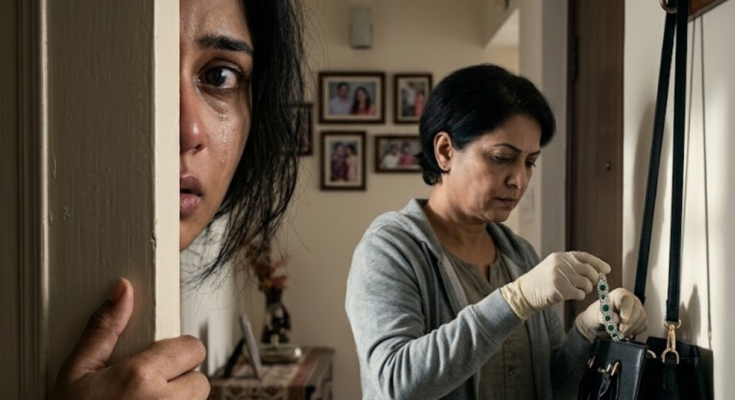
Her own temple bag.
The red velvet one she carried every Tuesday to the Hanuman mandir.
The same bag she had left hanging behind our kitchen door two nights ago when she came “just to check on us.”
I had not put it there to frame her.
I had put it there because Uncle Harish said, “Beta, evidence must stay safe, not inside your trembling hands.”
So we wrapped the bracelet in a clean handkerchief, placed it in a transparent plastic cover, and slipped it into the red temple bag only after recording everything on his phone.
Then Uncle Harish locked his door, called his lawyer nephew, and told me one thing.
“When police come, you don’t cry first. You speak first.”
But when I saw Mummy entering the lane with tired feet and the police walking toward her, every brave sentence ran away from my mouth.
“Mummy!” I screamed from the window.
She looked up.
Her face had confusion first.
Then fear.
Not for herself.
For me.
Because mothers think of daughters even when police reach for their bags.
One constable caught her wrist.
“Meera Sharma?”
“Yes,” Mummy said, breathless. “What happened?”
Poonam Maasi rushed forward, crying like some old film heroine.
“Didi, why did you do this? You could have asked me for money. Why steal?”
Mummy stared at her.
“Steal?”
The inspector took the black office bag from her shoulder.
“Madam, we have information that stolen jewellery from the South Extension exhibition is in this bag.”
Mummy’s face went white.
“What? No. This is my office bag. I came straight from work.”
Poonam sobbed louder.
“Search it, sir. I am ashamed, but truth is truth.”
Truth.
That word in her mouth sounded dirty.
The inspector unzipped the bag.
Tiffin cloth.
Old purse.
Bus pass.
Small bottle of pain balm.
One packet of glucose biscuits.
Nothing.
He searched again.
Nothing.
Poonam’s crying stopped.
Completely.
Her eyes flew to the third-floor window.
To me.
And in that one second, she knew.
I knew.
She stepped back.
The inspector turned.
“Where is the jewellery?”
Poonam swallowed.
“I… I was told…”
“By whom?”
She looked at Mummy.
Then at me.
Then at Uncle Harish, who had just come down the stairs holding a pen drive, his phone, and Poonam’s red temple bag.
My aunt’s face lost every drop of blood.
Uncle Harish stood beside the inspector.
“Sir, before you arrest an innocent woman, please see this.”
Poonam lunged.
“No!”
That one word finished her.
Nobody innocent screams before evidence is opened.
The inspector took the phone from Uncle Harish.
On the screen, Poonam entered our flat at 11:18 a.m.
Grey hoodie.
Gloves.
Spare key.
Seven minutes later, she came out smiling.
The inspector watched without blinking.
Mummy watched too.
Her lips parted.
She looked at her sister like she was seeing a stranger wearing a familiar face.
“Poonam,” she whispered. “You came into my house?”
Poonam folded her hands instantly.
“Didi, I can explain.”
But Uncle Harish had already opened the red temple bag.
Inside was the bracelet.
White gold.
Emerald stones.
Diamond pattern.
Even under the weak staircase bulb, it looked like something from another world.
A neighbour gasped.
Someone whispered, “Hai Bhagwan.”
The inspector’s eyes hardened.
“Whose bag is this?”
Poonam said nothing.
Mummy said softly, “Hers.”
The word broke more than the silence.
The inspector turned to Poonam.
“You filed the complaint?”
Poonam shook her head too fast.
“No, sir, I only informed. I only got information. Someone told me—”
“Who gave you the bracelet?”
She stepped back.
“I don’t know.”
My voice came before fear could stop it.
“Maasi said on the phone that today Mummy’s saint act would end.”
Everyone looked at me.
I wanted to hide behind Mummy.
But then I saw her wrist.
The same wrist that had carried shopping bags, gas cylinders, school bags, and our whole life.
That wrist was shaking.
So I walked down the last few steps.
“I heard her,” I said. “She said Mummy would be dragged out in handcuffs in front of me.”
Poonam’s eyes sharpened.
“You little liar.”
Mummy moved so fast I almost didn’t see it.
She stepped between us.
“Do not call my daughter a liar.”
For years, Ma had spoken softly.
To neighbours.
To shopkeepers.
To relatives.
To Poonam.
That evening, her voice sounded like a locked door finally bolting from inside.
The inspector nodded to the constable.
“Take her.”
Poonam began screaming then.
Not crying.
Screaming.
“You think I did this alone? Ask your saint mother why everyone hates her. Ask her why Papa left the house papers to her. Ask her why your Nana trusted only Meera. She took everything!”
Mummy froze.
The neighbours leaned closer.
Poonam laughed wildly.
“Yes, Didi. Now act innocent. You always acted innocent. Papa gave you the Lajpat Nagar flat. He gave you the locker key. He gave you Maa’s bangles. What did I get? Lectures? Leftover sarees? Your pity?”
Mummy’s face changed.
Pain.
Old pain.
The kind I had never seen because she had hidden it behind routine.
“You wanted me arrested because of property?” she asked.
Poonam spat near her feet.
“I wanted you ruined.”
The inspector held her arm.
She twisted away.
“No! Ask her about the locker. Ask her what is inside.”
Mummy’s eyes went to the red temple bag.
Then to me.
For the first time, I saw fear in my mother’s face that had nothing to do with police.
The inspector noticed too.
“What locker?”
Mummy did not answer.
Poonam smiled.
There it was again.
Poison finding air.
“The locker our father left. The one Meera Didi has hidden for thirteen years.”
Thirteen years.
My age.
A cold feeling moved through my stomach.
“Mummy?” I whispered.
She closed her eyes.
“Kavya, go upstairs.”
“No.”
Her eyes opened.
I had never said no to her like that.
Not seriously.
Not with my whole body.
“I am not going upstairs.”
The inspector looked from Mummy to Poonam.
“This matter will be handled at the station.”
Poonam laughed.
“Good. Take me. But if I go, Didi comes too. The bracelet was stolen from a jewellery exhibition, yes. But ask who knew the owner’s locker schedule. Ask who worked as cashier near the vault desk last week. Ask who signed the temporary access register.”
Mummy turned pale.
“I signed because my manager asked me to collect cash slips.”
Poonam tilted her head.
“And now the bracelet appears in your house. Very convenient.”
Uncle Harish stepped forward.
“Inspector sahib, there is video of this woman planting it.”
“Yes,” the inspector said. “And now we need to know where she got it.”
Poonam’s smile disappeared.
For the first time, she looked truly afraid.
Not because she had tried to destroy my mother.
Because someone bigger than her had not expected failure.
At the police station, Mummy sat on a wooden bench with me holding her hand.
Her palm was cold.
Poonam sat across the room, bangles removed, hair messy, eyes full of hatred.
She did not look like my Maasi anymore.
She looked like a crack in our bloodline.
The inspector played the CCTV again.
Then he opened the bracelet packet.
Then he called the jewellery store owner.
Within an hour, a large man in a cream kurta arrived with two security guards and a lawyer.
Mr. Dhanraj Bedi.
Owner of Bedi Jewels.
He saw the bracelet and almost cried.
“This belonged to my mother,” he whispered.
Then he looked at Mummy.
“You work at Pacific Mall?”
Mummy nodded.
“Yes.”
“Did anyone approach you last week?”
She looked confused.
“Many customers approach the cash counter.”
“No. Someone from my staff?”
Mummy thought for a moment.
Then her eyes narrowed.
“A man asked if I could keep one envelope in my bag until evening. I refused.”
The inspector leaned forward.
“What man?”
Mummy swallowed.
“I don’t know his name. But he was with Poonam once.”
All eyes turned to Poonam.
She looked away.
The inspector slapped the table.
“Name.”
Poonam said nothing.
Mr. Bedi’s lawyer opened a file and placed a photo on the table.
“Was it him?”
Mummy stared.
Then nodded.
“Yes.”
My aunt shut her eyes.
Mr. Bedi whispered, “Rohit Bedi. My nephew.”
The room shifted.
Not stolen by strangers.
Family again.
Always family.
The inspector looked at Poonam.
“You and Rohit Bedi planned to frame Meera Sharma?”
Poonam broke then.
Not with guilt.
With panic.
“He said nobody would get hurt! He said only Meera Didi would be questioned. The bracelet would be recovered. Insurance would pay. He would give me twenty lakh.”
Mummy’s hand left mine.
Slowly.
As if even touching family had become painful.
“You sold me for twenty lakh?”
Poonam looked at her.
“You already had everything.”
Mummy stood.
“No, Poonam. I had responsibility. You mistook it for wealth.”
Poonam laughed through tears.
“You always talk like some devi. Always sacrifice, sacrifice. I wanted to see you fall once.”
Mummy’s voice became soft.
“I fell many times. You were only too jealous to notice.”
That silenced her.
For one second.
Then Poonam leaned forward and whispered, “Ask your daughter why Nana wrote her name in the locker papers.”
Mummy went still.
I felt her whole body freeze beside me.
“My name?” I asked.
The inspector looked at Mummy.
“What is she talking about?”
Mummy sat again.
Her lips trembled.
“When my father died, he left a locker. I never opened it.”
Poonam screamed, “Liar!”
“I didn’t,” Mummy said. “Because the instruction said it was for Kavya when she turned eighteen.”
My heartbeat changed.
“For me?”
Mummy looked at me with eyes full of things she had swallowed for years.
“I wanted you to have something no one could take.”
Poonam started laughing.
A terrible laugh.
“You still don’t know, Didi. You think Papa left jewellery? Money? Blessings? He left proof.”
Mummy’s face changed.
“What proof?”
Poonam smiled slowly.
“The proof of who Kavya’s father really is.”
The room went silent.
My ears began ringing.
Mummy’s hand flew to her mouth.
I stepped back.
“What does that mean?”
No one answered.
Not fast enough.
So I looked at Ma.
“Mummy. What does she mean?”
Mummy turned toward me.
Tears filled her eyes.
“Kavya…”
That one word told me my life was about to split.
The inspector cleared his throat.
“This is not the place—”
“No,” I said.
My voice shook, but I did not stop.
“Everyone keeps saying I’m a child. But today I saved my mother from prison. So someone will tell me the truth.”
Mummy closed her eyes.
Poonam watched us with cruel satisfaction.
She had lost tonight, but she had found one more knife.
Mummy opened her eyes again.
“Your father did not die before you were born,” she said.
I felt the floor vanish.
All my life, I had been told Papa died in an accident when Ma was pregnant.
A photo on the shelf.
A garland every year.
A few stories.
A man turned into absence.
“He is alive?” I whispered.
Mummy began crying.
“I don’t know.”
“What do you mean you don’t know?”
She reached for me.
I stepped back.
It hurt her.
It hurt me more.
Poonam spoke from across the room.
“She knows. She always knew.”
Mummy turned on her.
“No. You don’t get to speak now.”
Then she looked at me again.
“When I was pregnant, your father disappeared after exposing a money laundering scheme involving Bedi Jewels and some mall contractors. Police found his scooter near Yamuna bridge. Blood. Wallet. Phone. No body.”
My mouth went dry.
“No body?”
“They declared him dead after months. Your Nana never believed it. He collected papers. Recordings. Names. He put everything in that locker. He said if anything happened to him, I must keep you away from that fight until you were old enough.”
The bracelet on the table glittered under the tube light.
Suddenly, it no longer looked like jewellery.
It looked like a key.
Mr. Bedi stood abruptly.
“This is irrelevant. My bracelet was recovered. I want my property and action against the accused.”
The inspector looked at him.
“You will get both. After we ask why your nephew gave stolen jewellery to this woman and why your name keeps appearing in an old missing-person matter.”
Mr. Bedi’s face hardened.
“My lawyer will respond.”
The inspector smiled without warmth.
“I was hoping he would.”
At midnight, Rohit Bedi was picked up from his farmhouse road.
By morning, the police had found burner phones, insurance documents, and a photo of my mother’s office bag taken two days before the trap.
Poonam signed a statement.
Not because she repented.
Because Rohit had already blamed everything on her.
That is how cowards love.
By pushing women first into fire.
Mummy and I returned home at 5 a.m.
The sky was grey.
Our lane smelled of wet dust and early tea.
For the first time, our house did not feel small.
It felt like it had survived a storm with broken windows but standing walls.
Mummy went straight to the cupboard and took out a small steel key taped behind an old framed photo of Nana.
She placed it in my palm.
“Locker 47. Punjab National Bank. Chandni Chowk branch.”
My fingers closed around it.
“Why now?”
She touched my face.
“Because after tonight, hiding will not protect us.”
At ten that morning, we reached the bank with Uncle Harish and the inspector.
The manager was old enough to remember Nana.
He looked at the key, then at me.
“So the child has come.”
I hated that word now.
Child.
The locker room was cold.
The metal door opened with a sound like a secret clearing its throat.
Inside was no jewellery.
No cash.
No gold.
Only a brown folder, three pen drives, a faded diary, and one photograph.
I picked up the photograph first.
A man stood beside Mummy.
Young.
Tall.
Smiling.
His hand rested on her pregnant stomach.
My throat closed.
“My father?”
Mummy nodded, crying silently.
“Arjun Sen.”
His eyes looked like mine.
Not the dead man in the garlanded photo at home.
The garlanded photo was blurry, old, distant.
This man was alive in the paper.
Behind us, the inspector opened the folder.
His face changed by the second page.
“What is it?” Mummy asked.
He did not answer immediately.
He placed one document on the table.
It was a hospital birth record.
My name.
My birth date.
Mother: Meera Sharma.
Father: Arjun Sen.
Then a second line written later in red ink.
**Witness protection request rejected.**
I looked at Mummy.
“What witness protection?”
Before she could answer, the bank manager returned hurriedly.
“Madam, someone is asking for you outside.”
The inspector frowned.
“Who?”
The manager looked at me.
“A man. He says his name is Arjun Sen.”
My body stopped breathing.
Mummy gripped the table.
“No,” she whispered.
The inspector pulled his gun halfway from his holster.
Uncle Harish stood in front of me.
The manager swallowed.
“He said to tell Kavya one thing.”
My voice barely came out.
“What?”
The manager looked terrified.
“He said, ‘Tell my daughter the bracelet was not stolen for money. It was stolen to bring her to the locker.’”
Mummy turned toward me, white as paper.
The door outside the locker room creaked.
Footsteps came closer.
And for the first time in thirteen years, the man everyone had called dead was walking toward the daughter who had just found his name.
If Kavya’s courage, Meera’s betrayal, and the truth behind the stolen bracelet shook your heart, write what you feel in the comments and follow the page—because the aunt’s trap has opened Nana’s locker, and the father who was supposed to be dead has finally returned.