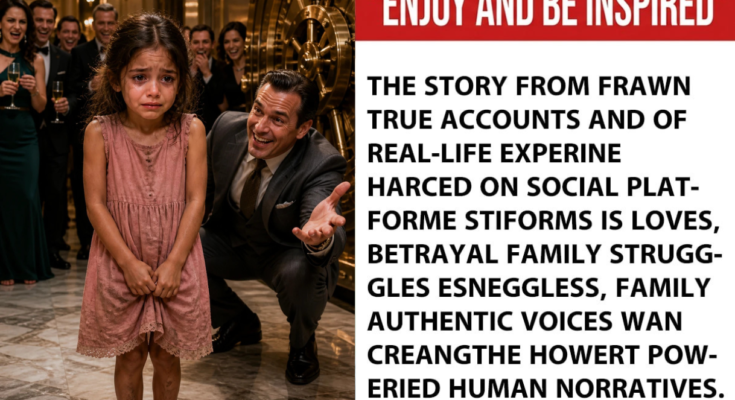
The first thing everyone noticed about the girl was that **she did not belong
In the Grand Dominion Bank, where the marble floors gleamed like still water and chandeliers spilled **golden light** over velvet ropes and polished brass, everyone belonged to money. The men wore suits that looked stitched from power itself. The women smelled of expensive perfume and carried laughter that floated easily, lightly, cruelly. Even the waiters moved with the quiet precision of people who knew their place in a world ruled by wealth.
Then there was **the little girl**.
Barefoot. Thin. Her faded pink dress hung loosely from her shoulders, washed so many times it had nearly lost its color. Dust marked her ankles. Her dark hair was tangled, as if someone had tied it back in a hurry and never bothered to smooth it down. She stood before the largest vault in the city with her eyes lowered and her hands trembling, like a mistake that had wandered in from the street.
People stared.
Some with amusement.
Some with irritation.
Some with the same cold disgust reserved for things that made them uncomfortable simply by existing.
And beside her stood **Victor Hale**, the bank’s wealthiest client and the evening’s loudest voice, dressed in a sharp gray suit with silver cufflinks and a smile that always looked one second away from becoming a sneer.
He crouched beside the girl and spread his arms theatrically toward the private audience gathered in the hall.
“Ladies and gentlemen,” he announced, grinning, “**one hundred dollars if she opens it!**”
The crowd erupted.
Champagne glasses lifted. Laughter rang out beneath the chandeliers. A woman in emerald silk covered her mouth as she giggled. Another looked openly at the girl’s dirty feet as though they offended the marble itself.
Victor patted the child’s shoulder.
She flinched.
That tiny movement should have shamed him.
Instead, it made them laugh harder.
“Look at her,” a man muttered. “Does she even know where she is?”
“She probably thinks it’s a church,” someone else whispered.
“No,” said the woman in emerald, smiling thinly. “A church would have let her in.”
The girl’s fingers twisted into the hem of her dress. Her lips quivered. For a moment, everyone thought she would cry. Victor’s smile widened, delighted by the possibility. Humiliation always looked cleaner when the victim was too small to fight back.
But then the child lifted her eyes.
Not toward Victor.
Not toward the crowd.
Toward **the vault**.
The giant brass door stood at the end of the hall like a monument, engraved with the crest of the bank: a crown above a lion, beneath it the words *Security. Legacy. Permanence.* It took six codes, two biometric keys, and a timed lock to open. No one in the room had ever seen it opened by hand.
The girl took one small step forward.
The laughter thinned.
Then she took another.
Her bare feet made almost no sound, yet somehow the whole room heard them. The hush that followed spread so fast it felt physical, as if silence itself had stepped into the hall. Even the security guard near the vault stiffened, hand hovering near his radio.
Victor stood up too quickly. “All right, that’s enough—”
But the girl kept walking.
She stopped inches from the vault and stared at it with an expression no one understood. Not fear. Not wonder. Something older. Something painfully familiar.
Then she raised one small hand and placed it on the brass locking wheel.
**Clink.**
The sound was sharp and metallic and impossibly loud.
A tremor ran through the mechanism.
Victor’s face changed first. The amusement left it in an instant. “What did you do?”
No one answered.
The vault shuddered.
A deep internal rumble rolled through the brass, through the floor, through the bones of every person in the hall. Guests stumbled backward. One woman dropped her glass. It shattered across the marble.
And then, in full view of everyone, **the giant locking wheel began to turn by itself**.
A collective gasp tore through the room.
The guard stumbled back. “That’s impossible.”
The girl’s eyes filled with tears, but her face stayed calm. Calm in a way that made the adults around her suddenly look absurd, fragile, temporary.
She leaned close to the vault and whispered, almost too softly to hear, “**It remembers me.**”
The brass door cracked open.
A seam of **warm golden light** spilled through the darkness and painted her face in a glow so rich, so alive, that several guests instinctively shielded their eyes.
Victor grabbed her arm.
“Who are you?” he snapped.
The girl looked at his hand on her skin.
Before she spoke, the entire bank lost power.
The chandeliers died.
The music stopped.
The electronic security screens blinked black.
Only the light from inside the vault remained, pouring across the hall in molten gold.
And in that light, hidden details rose from the walls like ghosts. The bank’s crest shimmered, then shifted. Beneath the lion and crown, beneath the carefully preserved symbol of wealth, another emblem emerged—faint, older, nearly erased.
A child’s handprint.
A woman near the back gasped. “My God…”
The bank manager, pale and sweating, stepped forward. “That mark—that was removed from the original plans.”

Victor turned sharply. “What are you talking about?”
The manager’s voice shook. “This building wasn’t always a bank.”
The room listened.
Forty years of polished lies suddenly felt thin.
“It was once the **Aureline House**,” the manager said. “A private sanctuary. Built by Elias Aureline. He was one of the richest men in the country, but after his wife died, he gave away most of his fortune. He turned this estate into a refuge for abandoned children. He believed no wealth mattered unless it protected the forgotten.”
The hall seemed to draw in a breath.
Victor’s jaw tightened. “And?”
“And when he died, there was a legal war over his assets. Investors took the property, destroyed the records, and built this bank over it. The sanctuary was erased.”
The little girl stared into the opening vault.
Victor laughed, but there was fear beneath it now. “A bedtime story. Wonderful. Move the child away.”
No one moved.
The golden light intensified.
Inside the vault, where rows of deposit boxes should have been, there was only a single pedestal of dark wood. Resting on it was an old iron key and a sealed leather ledger.
The girl stepped toward them.
Victor lunged first.
“Don’t touch anything!” he barked, pushing past her.
The moment his fingers reached the pedestal, the light vanished.
Not dimmed.
Vanished.
The hall plunged into blackness so total that several people screamed. A violent metallic shriek echoed from the vault, and Victor cried out, stumbling backward as though burned. When the emergency lights flickered on seconds later, his hand was red and blistered.
The girl was untouched.
She reached into the vault and lifted the ledger with both hands.
On the cover, embossed in fading gold, were the words:
**For Her Bloodline Only.**
Victor stared. “That means nothing.”
But the bank manager looked at the child’s face, then at the old handprint on the wall, then back again.
His lips parted.
“No,” he whispered. “It means everything.”
He knelt before the girl as if before royalty. “What is your name?”
She hesitated.
Then, softly: “Mara.”
The manager closed his eyes. “Aureline,” he said. “Your name is Mara Aureline.”
A murmur rippled through the crowd.
Victor barked a laugh. “Ridiculous.”
But the manager was already opening the ledger with trembling hands. Inside were pages of signatures, property seals, photographs, and a final notarized declaration from Elias Aureline himself. It stated that the entirety of the hidden estate—land, assets, trusts, and the contents of the concealed vault—would remain inaccessible to all institutions, boards, or investors unless claimed by a direct descendant of his only daughter, who had disappeared with her infant child during the hostile takeover.
A child no one had ever found.
Until now.
Victor’s face lost all color.
The manager turned pages faster, reading aloud as the room leaned in.
There were account numbers. Deeds. Names of shell corporations. Ownership structures.
Then came the line that changed everything.
The sanctuary had never been sold.
It had been **stolen**.
And every bank board member who had profited from it—every executive, every benefactor, every investor tied to the conversion—was listed in the ledger along with evidence of fraud, coercion, and unlawful seizure.
Victor took a step back.
Because his name was there.
Not just his.
His father’s.
His grandfather’s.
Three generations of wealth built on the theft of a home meant for abandoned children.
“This is fake,” Victor said, but his voice cracked.
The security guard looked at the pages.
Then at Victor.
Then unclipped his radio and called the authorities.
Panic broke across the hall like shattered glass. Guests who had mocked the girl minutes earlier now looked at her with terror, awe, calculation. Several began quietly slipping toward the exits.
But Mara wasn’t watching them.
She was staring at a photograph tucked into the ledger’s final page.
A woman held a baby in a faded pink blanket.
Behind them stood the original Aureline House, bright and open, with children smiling on the steps.
On the back was a handwritten note:
**For my granddaughter, if the world ever becomes cruel enough to forget her.
This house will remember.**
Mara’s tears finally fell.
The bank manager swallowed hard. “Where did you come from?”
She touched the photograph with shaking fingers. “My grandmother used to tell me there was a place that belonged to us. A place that would know me. She said if I ever had nowhere left to go, I should find the golden lion and put my hand where the door could feel my heart.”
Silence.
All around her stood people who had money, influence, status.
And none of it had saved them from the truth.
Sirens began to rise outside.
Victor turned, desperate now, and made one final move toward Mara, toward the ledger, toward anything he could still control.
But before he could reach her, the security guard stepped in front of him.
“No,” the guard said.
The word landed like a verdict.
Victor froze.
And in that moment, with red-blue lights flashing through the tall windows and the stolen kingdom of polished marble collapsing around him, he looked smaller than the child he had tried to humiliate.
Mara stood in the golden spill of the open vault, barefoot, trembling, luminous.
Not a stray.
Not a joke.
Not a mistake.
**The rightful heir.**
As officers rushed in and the guests scattered, the manager turned to her with tears in his own eyes.
“What would you like us to do now?”
Mara looked around the hall—at the marble, the brass, the chandeliers, the people who had laughed.
Then she looked back at the old photograph.
When she answered, her voice was soft.
But it shook the room more than the vault ever had.
“Open it,” she said. “Open all of it.”
The manager frowned. “The accounts?”
She lifted her chin.