1. The Breach Detection
The digital clock in the corner of my right monitor flipped to 11:45 PM. The low, blue glow of three high-resolution screens illuminated my face in the otherwise dark, silent office.
I am Natalie Vance. My official title is Senior Director of Incident Response and Threat Mitigation for a global cybersecurity firm. My professional existence revolves entirely around building impenetrable digital walls, identifying malicious intrusions, neutralizing hostile threats, and executing absolute, uncompromising lockdown protocols for Fortune 500 companies. I am paid an exorbitant amount of money to be ruthless.
Yet, as my personal smartphone buzzed violently on the desk, the harsh, jarring vibration cutting through the quiet hum of the servers, I felt a familiar, sickening spike of anxiety that no firewall could stop.
I glanced at the screen. The notification banner read:
Family Group Chat (24 Members).
My stomach dropped. I picked up the phone, my thumb hovering over the screen, hesitant to unlock it. I knew exactly what was happening. It was mid-July, and the annual “Vance Family Beach Invasion” was looming.
Three years ago, after grueling eighty-hour work weeks and a massive IPO payout, I bought a sprawling, magnificent, five-bedroom luxury beach house on the coast of South Carolina. It was my sanctuary. A quiet, secluded fortress where I could watch the ocean and escape the digital wars.
But my family didn’t see a sanctuary. They saw a free, fully-staffed resort that they believed they were entitled to simply because we shared a bloodline.
I took a slow breath and opened the chat. It was a torrential downpour of demands.
Uncle Richard: Heading down Friday morning! Need to make sure the boat is fueled up, Nat.
Cousin Sarah: Claiming the guest room with the balcony! Can you make sure the hot tub is turned up to 102?
And then, the anchor dropped. It was a message from my mother, Eleanor.
Eleanor: Natalie, honey, make sure to fully stock the main fridge before we get there. The kids only drink organic apple juice now. Your father requires the primary master bedroom for his back. And please, let’s not make a scene or be dramatic this time when everyone arrives. Family is family.
The words radiated a toxic, suffocating entitlement that made my jaw clench so hard my teeth ached.
“Let’s not make a scene this time.”
The sheer, breathtaking audacity of the statement sent a flash of hot anger through my chest. My mind violently snapped back to the “Labor Day Incident” ten months ago.
They had shown up uninvited with three extra families. They had tracked mud across the imported hardwood floors. My cousins had shattered two expensive, custom landscape lights in the backyard with a football and laughed about it. When I finally snapped and asked them to clean up the kitchen, my father, Arthur, had stood up in front of the entire extended family, his face red with beer and unearned authority.
“You think having a little money makes you better than us, Natalie?”
Arthur had bellowed, pointing a thick finger in my face.
“You think this big, empty house makes you important? You’re a lonely, stressed-out girl who works too much. You should be grateful we’re here to fill this place with life. Stop being a selfish brat.”
I had swallowed the humiliation. I had cleaned the kitchen. I had let them stay. Because that was the role I had been assigned since childhood: the reliable, successful scapegoat whose only value was her utility and her silence.
“You okay, Nat?”
My husband, Noah, stepped quietly into the home office. He was holding two mugs of tea. He saw my rigid posture, the white-knuckle grip I had on my phone, and the familiar, defeated look in my eyes. He set the mugs down and stood behind my chair, resting his hands gently on my shoulders.
“They’re coming, aren’t they?” Noah asked softly.
“Friday,” I whispered, staring at the screen. “Twenty-four of them. They’ve already assigned themselves the master bedroom. Mom wants me to go grocery shopping.”
Noah’s grip on my shoulders tightened slightly. He was a brilliant software engineer, a man of infinite patience, but his patience for my family had evaporated after Labor Day.
“What’s the plan?” Noah asked.
I looked at the group chat. I looked at the demands, the casual disrespect, the absolute certainty that I would simply bow my head and absorb the invasion because “family is family.”
Suddenly, the terrified, people-pleasing daughter inside me went completely silent. The anxiety evaporated, replaced by a cold, hard, and terrifyingly clear logic.
I looked at my computer monitors. I looked at the complex intrusion detection software mapping a simulated cyber-attack.
My eyes hardened. The transformation was instantaneous. I was no longer a wounded daughter. I was a top-tier cybersecurity expert facing an active, hostile breach.
“In my world,” I said, my voice dropping to a clinical, icy chill that made Noah pause, “when a secure system is compromised by a malicious entity, you don’t negotiate with the intruder. You don’t ask them nicely to stop deleting files. You don’t try to make them comfortable.”
I spun my chair around to face Noah.
“You isolate the infected area,” I stated firmly. “You close the ports, you revoke access, and you terminate the connection. Permanently.”
I turned back to my phone. I didn’t type a long, emotional paragraph explaining my feelings. I didn’t ask for respect. I simply typed two words into the group chat of twenty-four people.
Not happening.
Almost instantly, my phone began to vibrate violently. The response was immediate and furious.
Eleanor: Excuse me? What do you mean ‘not happening’? We have already packed!
Arthur: Stop acting like a spoiled child, Natalie. We are coming whether you like it or not. The door code is still 1984, I assume.
I stared at my father’s message. He genuinely believed that because he knew the old PIN code, my boundary was completely irrelevant. He believed his physical presence would simply override my refusal.
I didn’t reply to the bait. I didn’t argue.
I toggled my phone’s settings, switching it to absolute ‘Do Not Disturb.’ I tossed the device onto the desk.
I opened a new, secure window on my laptop and accessed the master administrative dashboard for the beach house’s integrated smart-home network.
My fingers began to fly across the illuminated keyboard. The time for talking was over. I was preparing to deploy a defense system my family couldn’t even begin to comprehend.
2. The Architecture of the Trap
For the next three days, my phone was a silent, vibrating beacon of mounting familial hysteria.
The group chat pinged endlessly, a chaotic mix of demands, guilt trips, and outright threats. My mother sent long, emotional messages about how I was breaking her heart. My aunts sent passive-aggressive quotes about the importance of family loyalty. My father sent short, aggressive texts demanding to know what brand of scotch I had stocked in the liquor cabinet.
I didn’t open a single message. I didn’t reply once.
Instead, Noah and I orchestrated a masterclass in domestic fortification.
The beach house was already equipped with a robust security system, but it was designed to keep out common burglars, not a coordinated, aggressive invasion of twenty-four entitled relatives who believed they had a divine right to the property.
I accessed the remote administrative panel for the heavy-duty, commercial-grade smart deadbolts I had installed on all exterior doors.
First, I executed a complete, systemic purge. I scrubbed the memory banks of the locks, permanently deleting my father’s old access code (1-9-8-4, my birth year), my mother’s code, and the various temporary PINs I had foolishly handed out to cousins over the years.
I didn’t replace them with new codes. I completely disabled the keypad entry function. The doors could now only be opened via an encrypted, biometric dual-authentication ping from my personal smartphone or Noah’s.
Next, I turned my attention to the perimeter.
I accessed the network of 4K, night-vision security cameras surrounding the property. I adjusted the motion-tracking sensitivity, ensuring every square foot of the driveway, the wrap-around porch, and the beach access stairs were covered.
Then, I integrated the camera software with the house’s exterior lighting and alarm systems. I programmed a highly specific, aggressive, automated ‘Active Breach’ protocol. If I triggered the protocol remotely, it would activate the blinding, 5000-lumen strobe floodlights and a 120-decibel siren system I had originally installed as a hurricane warning measure.
But physical and digital security wasn’t enough. I needed legal fortifications. My father was the kind of man who would break a window and claim he had “permission” to be there.
On Wednesday afternoon, I called the local police precinct covering the coastal district where my beach house was located. I spoke directly to the desk sergeant.
“My name is Natalie Vance. I am the sole owner of the property at 44 Oceanview Drive,” I stated formally. “I need to file a preemptive, highly specific trespassing notice for this coming weekend.”
I provided the sergeant with the exact names of my parents, my uncles, and several prominent cousins. Crucially, I provided the make, model, and license plate numbers of my father’s massive Chevrolet Suburban and my uncle’s Ford F-250—vehicles I knew they would be driving.
“These individuals have explicitly threatened to arrive at my property on Friday morning without my consent or permission,” I explained. “The house is fully secured and monitored remotely. If the alarm is tripped, or if I call to report a breach, please treat it as a hostile trespassing event. They do not have keys, and they do not have my authorization to be on the premises.”
The sergeant took the information, noting the absolute, unwavering seriousness in my tone. “Understood, Ms. Vance. We have the vehicles flagged in the system. If they show up and refuse to leave, we will dispatch units immediately.”
The perimeter was officially, legally, and digitally locked down tight.
By Thursday evening, as the sun began to set, Noah and I were not in the city. And we were certainly not at the beach house.
We had packed a weekend bag and driven three hours in the opposite direction. We checked into a stunning, serene, five-star luxury resort nestled high in the Blue Ridge Mountains, entirely undiscoverable by my family.
We sat on the private balcony of our suite, the cool mountain air incredibly refreshing. Noah poured two glasses of an exceptional, vintage Cabernet Sauvignon. He handed me a glass and glanced at the encrypted, military-grade tablet resting on the small table between us.
The screen displayed a flawless, high-definition, four-way split feed of the empty, quiet beach house driveway and porches.
“They still think you’re bluffing, you know,” Noah noted, taking a sip of his wine. “Your dad texted my phone an hour ago asking if the grill propane was full. He genuinely believes you’re just throwing a tantrum and you’ll be standing on the porch with a towel over your arm when they pull up tomorrow.”
I took a slow, deep sip of the heavy red wine, feeling the warmth spread through my chest. I kept my eyes glued to the dark, silent security feed on the tablet.
“I know he does,” I replied softly, my voice devoid of any anxiety, filled only with the cold, absolute certainty of an engineer watching a perfect system operate. “Malware never believes it’s going to be deleted until the firewall goes up and the quarantine protocol initiates.”
I set my glass down.
“Tomorrow morning, they are going to hit a wall they can’t scream their way through.”
3. The Impenetrable Fortress
Friday morning arrived bright, sunny, and deceptively beautiful.
Noah and I were sitting on the balcony of our mountain resort, enjoying a quiet, lavish room-service breakfast of eggs benedict and fresh coffee. My phone remained on ‘Do Not Disturb,’ hidden away inside my luggage.
The encrypted tablet, however, sat prominently on the table next to my coffee cup, the screen alive and active.
At exactly 10:14 AM, the notification chime cut through the peaceful mountain air.
Motion Detected: Front Driveway Camera 01.
I set my fork down. I didn’t feel the familiar, sickening knot of panic that usually accompanied my family’s arrival. I felt the cool, detached adrenaline of an operator watching a simulation become a reality.
“Showtime,” Noah murmured, leaning closer to the screen.
On the high-definition feed, the visual of my quiet, pristine beach house driveway was suddenly shattered. A massive, black Chevrolet Suburban—my father’s vehicle—turned aggressively onto the white gravel, kicking up dust.
Following closely behind it was a chaotic convoy of five other vehicles, including my uncle’s heavy-duty truck, two minivans, and a flashy sports car belonging to my cousin.
They parked haphazardly, taking up the entire driveway and spilling onto the manicured grass I paid a premium to maintain.
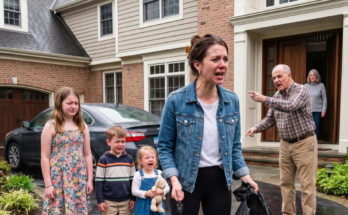
The doors of the vehicles burst open. Twenty-four people spilled out into the bright sunshine. The scene was an immediate, loud, entitled circus. Kids were shouting, aunts were dragging heavy coolers full of cheap beer onto the pavement, and uncles were stretching their legs, looking at the massive, three-story oceanfront property as if it were a hotel they had just conquered.
My father, Arthur, stepped out of the driver’s side of the Suburban. He was wearing khaki shorts, a golf polo, and an expression of supreme, absolute arrogance. He looked around, seemingly annoyed that I wasn’t standing on the steps waiting to greet him and carry his bags.
He waved a hand at my mother, Eleanor, who was struggling with a heavy tote bag. “Grab the bags, El! Let’s get inside. I want the AC cranked up.”
Arthur marched purposefully up the wooden stairs to the main wrap-around porch. He didn’t bother knocking. He didn’t ring the doorbell. He walked directly to the heavy, reinforced glass front door.
He approached the sleek, black digital keypad mounted on the doorframe.
Through the crystal-clear audio feed of the camera, I could hear him muttering to himself about my “disrespectful attitude.”
He raised his thick finger and aggressively punched the four-digit code into the pad.
The keypad didn’t emit the pleasant, ascending chime of a successful unlock.
Instead, a harsh, flat, red LED light flared across the display, accompanied by a sharp, digitized
Arthur stopped. His brow furrowed in confusion. He stared at the keypad as if it had just spoken to him in a foreign language. He muttered a curse word, leaned closer, and punched the buttons again, harder this time.
“What the hell is wrong with this thing?” Arthur growled loudly, smacking the side of the keypad with the palm of his hand.
Eleanor, having finally hauled the heavy tote bag up the stairs, stopped behind him, panting slightly in the heat. “Arthur, what’s taking so long? Open the door, it’s hot out here.”
“The damn code isn’t working!” Arthur snapped, his frustration quickly morphing into anger. He grabbed the heavy brass handle of the door and jiggled it violently. The deadbolt held firm, the reinforced glass barely rattling.
The rest of the extended family began to gather at the bottom of the porch stairs, holding luggage and coolers, the joyful vacation atmosphere shifting rapidly into confused irritation.
“Uncle Arthur, did Natalie change the code?” one of my cousins called up, whining loudly. “My kids need to use the bathroom!”
“Natalie! Open this door right now!” Eleanor suddenly shrieked, dropping her bag and pounding both of her fists aggressively against the thick glass of the front door. “We know you’re in there! Stop playing these stupid, childish games!”
Arthur’s face, visible in perfect 4K resolution on my tablet, turned a dangerous, mottled shade of purple. His authority was being challenged in front of the entire extended family. He was being made to look foolish, impotent, and locked out of the castle he believed he had a right to occupy.
“She’s playing games with me!” Arthur roared, spinning around to face the crowd of relatives, spittle flying from his lips. The mask of the benevolent patriarch completely shattered. “I told her we were coming! She thinks she can disrespect me like this?! In front of my family?!”
He marched aggressively away from the front door, stalking toward the side of the wrap-around porch where a heavy, wrought-iron patio dining set sat overlooking the ocean.
He grabbed one of the heavy, iron chairs by the backrest.
“Arthur, what are you doing?!” Eleanor gasped, taking a step back.
“I’ll show this ungrateful, arrogant little brat what happens when you lock your own blood family out of the house!” Arthur bellowed, lifting the heavy iron chair high above his head. He turned back toward the reinforced glass of the custom front door, his eyes wide with a violent, unhinged rage.
He was fully prepared to shatter a three-thousand-dollar custom glass door to force entry into my home, entirely convinced that his status as my father shielded him from any legal or financial consequences.
I sat on the balcony of the mountain resort, staring at the screen. I didn’t flinch. I didn’t gasp in horror.
I calmly reached out with my index finger.
I hovered over a single, large, pulsing red icon on the master administrative dashboard of my tablet. The icon was labeled
INITIATE ACTIVE BREACH PROTOCOL.
“Goodbye, Dad,” I whispered softly.
I tapped the screen.
4. The Active Breach
Before the heavy iron chair could even begin its downward arc toward the glass, the beach house violently, explosively erupted into life.
The quiet, sunny Friday morning was absolutely shattered.
From four hidden, commercial-grade speakers mounted beneath the eaves of the roofline, a 120-decibel, high-pitch, oscillating siren shrieked into existence. It was a sound designed for industrial emergency evacuations—a noise so loud, so physically painful and disorienting, that it rattled the bones in the chest and forced a primal, immediate physiological panic.
Simultaneously, the six massive, 5000-lumen LED strobe floodlights I had installed around the perimeter of the property flared to life. Even in the bright daylight, the rapid, blinding, aggressive flashing created a disorienting, strobing nightmare effect across the driveway and the porch.
Arthur physically recoiled, letting out a yell of pure shock. He dropped the heavy iron chair; it crashed onto the wooden decking, missing the glass door by inches. He immediately clapped both of his hands over his ears, his face contorted in agony as the siren tore through his eardrums.
Eleanor shrieked, collapsing to her knees on the porch, dropping her purse and covering her head as the strobe lights blinded her.
Down in the driveway, the extended family descended into absolute, unmitigated chaos.
The children began screaming and crying hysterically, terrified by the sudden noise and lights. The aunts and uncles dropped their heavy coolers, the cheap beer spilling onto the gravel. People were shouting, colliding with each other, desperately scrambling to get back into the perceived safety of their vehicles.
And then, cutting clearly through the wailing sirens, an automated, booming, mechanized voice echoed across the property from the security system.
“WARNING. WARNING. UNAUTHORIZED BREACH DETECTED. THIS PROPERTY IS SECURED. LOCAL LAW ENFORCEMENT HAS BEEN AUTOMATICALLY DISPATCHED. VACATE THE PREMISES IMMEDIATELY.”
The message repeated, a cold, relentless, and terrifyingly official declaration of their impending doom.
Arthur, stumbling blindly down the porch stairs, his hands still clamped over his ears, looked wildly around the driveway. The arrogant, untouchable patriarch had been reduced to a terrified, disoriented intruder fleeing a digital fortress.
“Get in the cars! Get in the cars!” my uncle yelled, trying to herd his crying children into his truck, completely abandoning the luggage on the lawn.
But they weren’t fast enough.
Less than sixty seconds after I initiated the protocol, the wail of approaching police sirens joined the chaotic symphony of my home security system.
Two local police cruisers, moving with aggressive, high-speed urgency, tore around the corner of Oceanview Drive. They didn’t park politely on the street. They turned sharply, screeching into the gravel driveway, effectively and completely boxing in the convoy of family vehicles, trapping them on the property.
Four uniformed police officers stepped quickly out of the cruisers. They didn’t look like community helpers dealing with a noise complaint; they looked like officers responding to a felony-in-progress alert triggered by a high-end security system, precisely as I had arranged with the desk sergeant the day before.
They rested their hands cautiously near their holsters.
“OAKHAVEN POLICE! EVERYONE STEP AWAY FROM THE RESIDENCE AND KEEP YOUR HANDS VISIBLE!” the lead officer barked over the PA system of his cruiser, his voice easily cutting through the strobing chaos.
Arthur, standing near his Suburban, froze in absolute terror. His hands shot up into the air. Eleanor, weeping hysterically, leaned against the side of the car, her pristine vacation outfit ruined by sweat and panic.
At that exact moment, my personal cell phone, which I had finally taken off ‘Do Not Disturb,’ began to ring violently on the table next to the tablet.
The caller ID displayed:
DAD.
I picked up the phone. I hit the green button and answered the call, keeping it on speakerphone so Noah could hear.
“NATALIE! WHAT DID YOU DO TO THE HOUSE?!”
Arthur’s voice was a frantic, breathless, hysterical scream, barely audible over the roaring sirens and the shouting police officers in the background. The mask of patriarchal dominance was entirely annihilated. He was begging.
“The alarm won’t stop! The police have us blocked in! They’re treating us like criminals! Natalie, turn this off right now! Call the police off! Tell them we’re your family! This isn’t funny!”
I listened to the absolute, chaotic destruction of his arrogance for exactly one second. I didn’t feel a shred of pity. I felt the immense, profound satisfaction of a master architect watching a meticulously designed trap snap perfectly shut around a pest.
“You are criminals, Arthur,” I said, my voice completely devoid of emotion, as cold and hard as glacial ice. “You are trespassing on private property, and you attempted to destroy a glass door to force entry. The police have the video feed.”
“Natalie, please!” Arthur sobbed, the reality of his situation finally crushing his ego. “We’re your parents! You can’t let them arrest us!”
“Enjoy your vacation,” I whispered.
I pressed the red button, terminating the call.
I picked up my phone, navigated to the settings, and permanently blocked his number. I blocked my mother’s number. I blocked the numbers of the aunts and uncles currently crying in my driveway.
I looked down at the tablet.
The police officers were systematically moving through the crowd, separating the adults from the crying children, demanding identification. I watched as the lead officer pulled out a thick pad of citations, pointing aggressively at Arthur and the heavy iron chair lying on the porch.
The invasion was over. The hostiles had been neutralized. The infection was purged.
I reached out and gently tapped the tablet screen, remotely deactivating the sirens and the strobe lights. The sudden silence that fell over the beach house driveway, save for the hum of the police cruisers, was the most beautiful sound I had ever heard.
I closed the tablet, the black screen reflecting my calm, steady face.
I leaned back in my plush, comfortable resort chair, looking out at the serene, majestic view of the Blue Ridge Mountains. I took a slow, deep breath of the crisp, clean air, and finally, for the first time in my entire adult life, let out a long, unburdened sigh of absolute, profound relief.
5. The Aftermath of the Storm
A week later, the contrast between my reality and the reality of the people who had tried to invade it was absolute and staggering.
The fallout from the “Beach House Incident” had been nuclear, detonating the entire fragile, toxic ecosystem of my extended family.
I had heard the updates through the unavoidable, gossipy grapevine of a distant, estranged cousin who wasn’t involved in the invasion.
The local police hadn’t arrested them, primarily because I hadn’t pushed for felony charges for the attempted property damage, choosing instead to let the humiliation be their primary punishment. However, the police
had
issued formal, incredibly expensive, heavily documented trespassing citations to every single adult in the six-vehicle convoy.
Worse, Arthur had been slapped with a massive $2,500 municipal fine for triggering a false emergency response and attempting to damage private property, captured perfectly on the 4K security footage the police reviewed on the scene.
But the legal and financial penalties were nothing compared to the social destruction.
Because the entire extended family had driven six hours to the coast, assuming they had free lodging, and were subsequently banned from the premises by armed police officers under threat of arrest, they were suddenly stranded in a high-priced coastal tourist town on a peak summer weekend.
They were forced to desperately scramble, eventually shelling out thousands of dollars for the only accommodations available: a series of miserable, low-quality, bedbug-infested motels miles away from the beach.
The family group chat, once a place dedicated to demanding my servitude, had violently imploded. Aunts and uncles were furiously demanding that Arthur and Eleanor reimburse them for the exorbitant motel costs, screaming that they had been lied to and humiliated. The parents, refusing to take responsibility, blamed me, but the damage was done. The facade of the “happy, unified family” was shattered, replaced by bitter infighting and threats of small-claims lawsuits against my father.
They were drowning in a toxic swamp of their own making.
Meanwhile, Noah and I arrived back at the beach house late Friday evening, exactly one week after the breach.
I punched my new, highly secure biometric code into the keypad. The heavy glass door swung open smoothly, emitting a pleasant, welcoming chime.
We stepped inside.
The house was immaculate. The air conditioning was humming quietly. The hardwood floors were pristine, completely free of sand, mud, or spilled beer. The expensive, custom landscape lighting outside bathed the property in a soft, elegant glow. There was no trace of sunscreen smeared on the windows. There was no shouting. There was no anxiety.
I walked into the massive, open-concept kitchen, poured two glasses of an excellent, crisp white wine, and handed one to Noah.
We walked out onto the back deck, sliding the glass doors shut behind us.
The ocean breeze was cool and refreshing, carrying the soothing, rhythmic sound of the waves crashing gently against the shoreline in the dark.
I pulled my phone out of my pocket. I had briefly unblocked the voicemail box earlier that day to clear out the storage.
There were thirty-four new voicemails. Almost all of them were from my mother and father. The transcripts showed a wild, erratic fluctuation between hysterical, sobbing pleas for forgiveness, claiming they “didn’t know what came over them,” and venomous, hateful rage, calling me a monster who had destroyed the family.
A year ago, listening to those voicemails would have sent me into a spiral of guilt, self-doubt, and panic. I would have agonized over whether I was a “bad daughter.” I would have questioned my reality.
Tonight, standing on the deck of my fortress, looking out at the endless, dark ocean, I felt absolutely nothing.
The heavy, dark anxiety that had plagued every holiday, every family gathering, every text message for the last decade had completely, miraculously evaporated. The guilt was gone, replaced by the fierce, unapologetic, and profoundly empowering pride of being the absolute master of my own domain.
I didn’t listen to a single second of the voicemails.
With a calm, steady thumb, I highlighted all thirty-four messages and hit the ‘Delete’ icon. I watched them vanish into the digital void, permanently erasing their toxicity from my life.
Noah walked up behind me, wrapping his strong arms around my waist, resting his chin on my shoulder. He looked out at the ocean, then down at my phone.
“All clear?” Noah asked softly.
“All clear,” I smiled, leaning back against him, taking a sip of the cold wine. “The firewall is holding perfectly.”
6. The Impenetrable Fortress
One year later.
The summer sun was brilliant, casting a warm, golden, and incredibly peaceful light over the sprawling wooden deck of the beach house.
The air was filled with the mouth-watering scent of grilling seafood, the clinking of glasses, and the sound of genuine, unburdened, and joyous laughter.
I was hosting the annual summer barbecue.
But this time, the driveway wasn’t choked with the massive SUVs of entitled relatives. It was neatly parked with the cars of my closest, most trusted friends, my incredibly supportive colleagues from the cybersecurity firm, and Noah’s kind, respectful family—people who treated my home, and me, with absolute dignity.
There was no tension. There were no absurd demands for specific brands of organic juice. No one was barking orders at me from a lounge chair. I was wearing a simple sundress, barefoot on the warm deck, laughing loudly at a joke told by my lead software engineer, feeling entirely relaxed and profoundly happy.
My phone, resting on the outdoor bar counter, chimed with a soft, polite notification tone.
I walked over and picked it up, glancing at the screen.
It was an automated calendar reminder from an old, legacy scheduling app I hadn’t used in years.
The notification banner read:
Reminder: Annual Vance Family Beach Reunion.
I stared at the words on the screen.
For a brief, fleeting second, the ghost of a memory brushed against my consciousness. I remembered the sheer terror, the suffocating anxiety, and the desperate, people-pleasing panic those words used to instantly trigger in my chest. I remembered the feeling of being trapped, small, and entirely powerless in my own life.
I waited for my heart rate to increase. I waited for the knot to form in my stomach.
It didn’t happen.
I felt absolutely nothing. The words on the screen held no power over me anymore. They were relics from a past life, artifacts from a vulnerable system I had entirely rebuilt and secured.
I looked out at the massive, glittering expanse of the Atlantic Ocean stretching to the horizon. I looked at the people gathered on my deck, the chosen family who loved me for who I was, not for what they could extract from me.
My father had once stood in my kitchen, his face red with unearned authority, and told me that having a big, empty house would just make me feel small. He had warned me that without my family, I would be nothing but a lonely, stressed-out girl.
He was staggeringly, fundamentally wrong.
The house hadn’t made me small. The house, and the boundaries I had built around it, had simply, perfectly exposed exactly how small, pathetic, and parasitic
they
had always been.
I wasn’t lonely. I was fortified.
With a calm, steady, and incredibly satisfied motion of my thumb, I swiped left on the notification.
I clicked ‘Delete Event.’ And then, I clicked ‘Delete Future Occurrences.’
The event vanished from the screen forever.
I set the phone back down on the counter, picked up a fresh glass of wine, and walked back into the bright, warm sunshine to join my real family, knowing with absolute, unshakeable certainty that my firewall was impenetrable, and the ghosts of my past would never, ever breach the perimeter again.