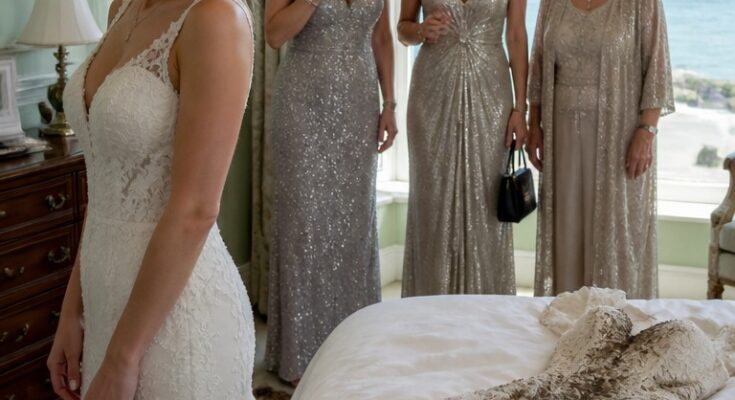
The bridal suite at the Hawthorne Estate smelled like cedarwood, ocean air, and expensive roses that had no idea they were sitting beside a catastrophe.
My wedding gown was spread across the bed beneath soft amber lights.
But not the way I had left it.
The corset had been sliced open.
The silk skirt had been cut down every seam.
The cathedral train lay in shredded pieces like someone had taken their time — carefully, deliberately — wanting me to understand this was personal.
A pair of silver fabric shears rested neatly on the velvet chair near the window.
Then my phone buzzed.
One text.
One photo.
One word.
“Oops.”
For several seconds, I simply stood there with my hand still gripping the brass doorknob.
I didn’t scream.
I didn’t cry.
I didn’t touch the dress.
My name is Lauren Whitmore.
And by thirty-one, I had learned the difference between being gentle and being powerless.
My family had confused the two my entire life.
In the Whitmore family, my younger sister Savannah was the golden daughter — magnetic, dramatic, impossible to criticize without my mother rushing to defend her before anyone even spoke.
I was the dependable one.
Which, in my mother’s language, meant useful.
I handled problems.
Remembered birthdays.
Fixed disasters quietly.
Absorbed insults gracefully because “respectable women don’t make scenes” was practically carved into the Whitmore bloodline.
Savannah could destroy something precious and somehow I would still be told not to upset her.
So when she stood at my rehearsal dinner in Cape Cod wearing a champagne satin gown, raised her glass, and joked about me “finally giving up control long enough to get married,” everyone laughed.
But I noticed something else.
Her eyes flicked briefly toward the bridal suite hallway.
Most people would have missed it.
I don’t miss things.
I worked as a senior insurance underwriter in Boston specializing in luxury personal assets — fine jewelry, artwork, couture gowns, heirlooms.
My entire career revolved around one question:
Does the evidence match the story?
Two weeks before the wedding, I had insured my gown myself.
Custom couture silk.
Appraised at $19,000.
Photographed.
Documented.
Filed.
My grandmother Eleanor’s heirloom lace veil had its own policy rider too.
My mother used to mock me for documenting everything.
She called it cold.
Paranoid.
“Very Lauren.”
But standing outside Suite 214 watching my wedding dress destroyed by my own sister, I understood something with terrifying clarity.
This wasn’t rage.
Rage is messy.
This was planned.
Every cut followed structural seams.
Every slice targeted the weakest points of the fabric.
Whoever did this didn’t just want to ruin a dress.
They wanted to ruin the moment I walked down the aisle.
And then my mother arrived holding a glass of white wine.
She looked at the dress.
Then at me.
And said:
“Lauren, it’s only fabric. Stop being dramatic.”
That was the moment everything changed.
Not because of what she said.
Because of what she didn’t say.
She never asked who did it.
Never looked shocked.
Never glanced at the scissors.
And tucked beneath her arm was a black leather clutch with the silver edge of a hotel keycard sticking out.
A keycard to my suite.
I looked at it.
She noticed.
For the first time all evening, her smile tightened.
“We are not calling the police,” she said calmly. “Tomorrow Savannah will apologize and we’ll move on like adults.”
“Okay, Mom,” I answered softly.
She brought me chamomile tea afterward and told me to get some sleep.
I set the untouched cup on the nightstand.
Then I opened the navy leather binder I had packed for the wedding weekend — the one my maid of honor had laughed at me for bringing.
Inside were the policy documents.
Appraisals.
Photographs.
Claim forms.
Timestamps.
Coverage details.
The binder wasn’t revenge.
It was evidence.
At 12:08 a.m., I called the insurance carrier’s emergency claims division.
I gave them my employee ID, policy number, and one sentence:
“My wedding gown was intentionally destroyed.”
The agent asked quietly:
“Would you like Special Investigations involved?”
“Yes,” I replied.
There was a pause.
Then she said something I would never forget.
“You don’t have to destroy your family yourself, Ms. Whitmore. We can handle that part.”
I looked at my grandmother’s shredded veil hanging from the mirror.
“Yes,” I said again.
By 12:30 a.m., hotel management had sealed the bridal suite.
By 3:00 a.m., we had the electronic keycard logs.
9:11 p.m. — Duplicate key issued to Margaret Whitmore.
11:17 p.m. — Savannah Whitmore entered Suite 214.
11:39 p.m. — Savannah exited.
11:46 p.m. — I arrived.
Then came the security footage.
My mother handing Savannah the keycard in the parking lot.
Savannah walking toward my suite.
My mother calmly returning to the rehearsal dinner bar while my wedding dress was being cut apart upstairs.
I still didn’t cry.
Some pain doesn’t break you.
It seals something shut forever.
At 4:15 a.m., my fiancé’s attorney emailed us two words:
Filing immediately.
At sunrise, I walked across the dew-covered lawn toward the guest cottage where my mother was staying.
The door was unlocked.
The family iMac still glowed on the desk.
And my mother’s email account was open.
I didn’t touch the computer.
I simply lifted my phone and photographed the screen.
One email thread stretched across three weeks.
Subject line:
Lesson Plan.
My blood turned cold.
October 29:
“She needs to learn she isn’t the center of this family.”
November 6:
“The shears arrive Wednesday.”
November 18:
“Make sure she sees it first.”
November 20:
“No evidence. Just the dress.”
Behind me, the cottage door opened.
I turned.
My grandmother Eleanor stood there wearing a camel coat over her nightgown, holding a long cedar box in both hands.
She looked at the glowing screen.
Then at me.
And said quietly:
“I’ve been waiting thirty years for your mother to finally put her cruelty in writing.”
Inside the cedar box was Eleanor’s 1964 wedding gown.
Six hours later, I walked down the aisle wearing it.
At exactly 12:02 p.m., two police officers knocked on Savannah Whitmore’s condo door in downtown Boston.
She answered wearing my grandmother’s pearl earrings — the same earrings she had claimed she “lost” eleven years earlier.
“Ms. Whitmore,” one officer said calmly, “you are being charged in connection with felony property destruction and conspiracy.”
Savannah’s face went white.
Her only response?
“My mother will fix this.”
But my mother couldn’t fix it.
Because insurance companies don’t care about family loyalty.
They care about recovery.
Subrogation.
That was the word Savannah had never heard before.
It meant the insurance carrier that paid my claim now had the legal right to come after her personally for every dollar.
The lawsuit hit her condo within days.
Liens.
Court filings.
Restitution.
Probation.
And then the real collapse began.
The leaked arrest video spread online.
Brand sponsorships disappeared.
Her influencer contracts vanished almost overnight.
But losing money wasn’t the worst thing my family lost.
They lost the mask.
Two weeks later, the Whitmore Family Trust voted unanimously to remove my mother from inheritance distributions after the emails became part of the official record.
Savannah’s trust was frozen permanently.
My grandmother told me only one thing afterward:
“A family name means nothing if the people carrying it destroy each other.”
Six months later, the preservation box holding my cut veil still sits in the top shelf of my closet beside the navy insurance binder.
I kept the damage visible on purpose.
Not because I enjoy remembering pain.
Because documentation matters.
Families rewrite history all the time.
Evidence doesn’t.
People still ask me whether I regret pressing charges.
Whether I regret “destroying the family.”
I always give the same answer.
My sister didn’t destroy a dress.
She tried to destroy the version of me that had finally stopped accepting humiliation quietly.
And my mother didn’t protect her.
She orchestrated her.
My name is Lauren Whitmore Beaumont.
I am thirty-one years old.
And the night my family destroyed my wedding dress was the night I finally stopped letting them destroy me too.
Three months after the wedding, the Whitmore scandal should have been over.
Savannah had sold her condo.
My mother had vanished from every charity board she once controlled.
The insurance company had recovered nearly all the damages through court-ordered restitution.
And I had finally started sleeping through the night beside my husband, Nathan.
The world believed the story was finished.
My sister destroyed my wedding dress.
My mother helped her.
They got caught.
Simple.
Except it wasn’t.
Because people who spend their lives manipulating others rarely commit only one crime.
And the first clue arrived inside a plain manila envelope with no return address.
It showed up on a rainy Tuesday morning at my office in Boston.
Inside were three things:
A photocopy of a death certificate.
A bank statement.
And a handwritten note.
You’re investigating the wrong betrayal.
At first, I assumed it was connected to the insurance lawsuit.
But then I saw the name on the death certificate.
Arthur Whitmore Sr.
My grandfather.
Cause of death:
Cardiac arrest.
Date:
October 14th, 1997.
I frowned immediately.
That couldn’t be right.
My grandfather had died in 2011.
I knew because I had attended the funeral.
I still remembered the black umbrella my grandmother carried that day.
I still remembered my mother crying beside the casket.
So why was there a second death certificate fourteen years earlier?
Then I looked at the bank statement.
A monthly trust payment — $18,000 — deposited every month into a private account under a company name I didn’t recognize.
The payments had continued for twenty-nine years.
Including last month.
My hands went cold.
Someone officially declared dead in 1997 had still been receiving money.
I called my grandmother immediately.
“Grandma… who is Arthur Whitmore Sr. really?”
Silence.
Long silence.
Then I heard her sit down heavily.
“Oh God,” she whispered.
“You found it.”
That afternoon, Nathan drove me to Bristol.
My grandmother Eleanor looked older than I had ever seen her.
Not fragile.
Exhausted.
Like someone who had spent decades holding shut a door that finally broke open.
She poured tea with trembling hands.
Then she told me the truth that detonated the entire Whitmore family history.
Arthur Whitmore Sr. had not died in 2011.
The funeral had been fake.
The man buried in that grave was another body entirely.
My grandfather had disappeared in 1997 after the FBI began investigating financial fraud tied to several Rhode Island real estate trusts.
My mother knew.
My grandmother knew.
And eventually Savannah knew too.
The family had hidden him for nearly three decades.
I stared at her.
“You buried an empty coffin?”
“No,” Eleanor said quietly.
“We buried someone else.”
The room tilted.
Nathan actually stood up from his chair.
“What do you mean someone else?”
My grandmother closed her eyes.
“In 1997, your grandfather caused a car accident while driving drunk.”
Her voice cracked.
“A young man died instantly. Arthur survived.”
I felt sick already.
“But Arthur had been moving money illegally through trust accounts for years. If the police investigated deeply enough after the crash, everything would surface.”
“So your family covered it up,” Nathan said coldly.
Eleanor nodded once.
“They paid officials. Falsified records. Declared Arthur legally dead. Then relocated him under another identity in Nova Scotia.”
I couldn’t breathe.
All those years…
The trust…
The secrecy…
My mother’s obsession with appearances…
Everything suddenly made horrifying sense.
The Whitmore empire had never been built on prestige.
It had been built on fraud.
And then Eleanor delivered the final knife.
“Your wedding wasn’t the first time your mother tried to destroy someone to protect the family secret.”
I looked at her slowly.
“What does that mean?”
Eleanor stood up, walked to the fireplace, and pulled out an old photograph hidden behind the mantel clock.
A young woman.
Beautiful.
Dark-haired.
Maybe twenty-five.
Holding a baby.
Me.
My stomach dropped.
“That’s not me,” I whispered automatically.
“It is,” Eleanor said.
“No,” I said louder.
“That’s impossible. Mom gave birth to me.”
Eleanor started crying.
For the first time in my life, I saw my grandmother cry.
“She raised you,” she whispered.
“She did not give birth to you.”
Everything inside me stopped.
The woman in the photo was named Isabel Moreno.
She had worked as a housekeeper for the Whitmore family in the early 1990s.
And according to Eleanor…
She had an affair with my father.
I was the result.
When Isabel threatened to expose both the affair and Arthur’s financial crimes after the fatal crash in 1997, she disappeared.
Three months later, Catherine Whitmore announced she was “adopting” me privately after a distant cousin lost custody.
None of it had been true.
My mother had stolen me.
I actually backed away from the table.
“No.”
Nathan grabbed my arm before I lost balance.
“No,” I repeated.
“You’re lying.”
“I wish I were.”
“What happened to Isabel?”
Eleanor’s silence answered before her mouth did.
I felt the blood drain from my face.
“She’s dead?”
Another silence.
Then:
“We don’t know.”
That was worse.
The FBI reopened the case six weeks later.
Not because of my wedding.
Because the insurance investigation uncovered offshore trust records connected to the same shell corporations my grandfather used decades earlier.
The moment investigators started tracing money, the old lies unraveled fast.
My mother was arrested first.
Wire fraud.
Conspiracy.
Identity falsification.
Obstruction.
Savannah cooperated almost immediately in exchange for immunity.
But immunity didn’t save her reputation.
The public already hated her for the wedding scandal.
Now America learned the glamorous Whitmore family had spent thirty years hiding a dead man, laundering trust money, and covering up a fatal accident.
The media frenzy became monstrous.
True crime podcasts.
Documentaries.
News specials.
But none of that mattered to me anymore.
Because I only cared about one question.
Who was Isabel Moreno?
For months, I searched every database I could access.
Employment records.
Immigration filings.
Hospital archives.
Nothing.
Until one night Nathan walked into our apartment holding a faded envelope.
“No return address,” he said quietly.
Inside was a photograph.
An older woman standing outside a small bakery in Santa Fe, New Mexico.
Written on the back:
She watches your interviews every night.
My hands shook so badly I almost dropped it.
Three weeks later, Nathan and I flew to Santa Fe.
The bakery sat on a quiet corner covered in climbing roses.
I remember every detail:
The smell of cinnamon.
The tiny brass bell over the door.
The sound of my heartbeat trying to break through my ribs.
And then the woman behind the counter looked up.
Same eyes.
Same chin.
Mine.
She froze instantly.
One plate slipped from her hands and shattered across the floor.
Neither of us spoke at first.
Because some truths are too large for language.
Finally she whispered:
“Lauren?”
I started crying before I even realized I was crying.
For the first time in this entire story.
Not when my dress was destroyed.
Not when my mother betrayed me.
Not when my family collapsed.
Now.
Because after thirty-one years, I was finally looking at someone who saw me as a daughter instead of a threat.
Later that night, Isabel told me everything.
She had not abandoned me.
She had run.
After discovering Arthur Whitmore’s fraud and threatening to go to police after the fatal accident, she was warned that powerful people would destroy her and take her baby.
Then one night, she woke up in a hospital after being drugged in a staged car crash.
By the time she recovered, I was gone.
The Whitmores told authorities she was mentally unstable and had surrendered custody voluntarily.
She spent years searching for me until legal threats and fear finally forced her into hiding.
My mother had spent decades convincing the world she was protecting the Whitmore name.
But the truth?
She had been protecting herself.
Six months later, federal agents found Arthur Whitmore Sr. alive in a coastal town in Canada under another identity.
Eighty-two years old.
Still hiding.
Still collecting money.
The arrest made international headlines.
My mother took a plea deal.
Savannah disappeared completely from public life.
The Whitmore estate was dismantled through civil judgments and federal seizure.
And my grandmother Eleanor?
She signed over everything she still legally controlled to me before entering assisted care.
When I visited her for the final time, she looked at me with tears in her eyes and whispered:
“I spent thirty years protecting the wrong people.”
I kissed her forehead and answered softly:
“You finally protected the right one.”
Today, Nathan and I live in New Mexico.
Far away from Rhode Island society pages and old family lies.
Sometimes I help Isabel close the bakery at night.
Sometimes we sit outside beneath desert sunsets and talk about all the years we lost.
And sometimes I think about the sentence that changed my entire life.
The night my wedding dress was destroyed, I thought my family was humiliating me.
I didn’t realize they were panicking.
Because the moment they attacked me…
they accidentally started the investigation that destroyed every lie they had buried for thirty years.