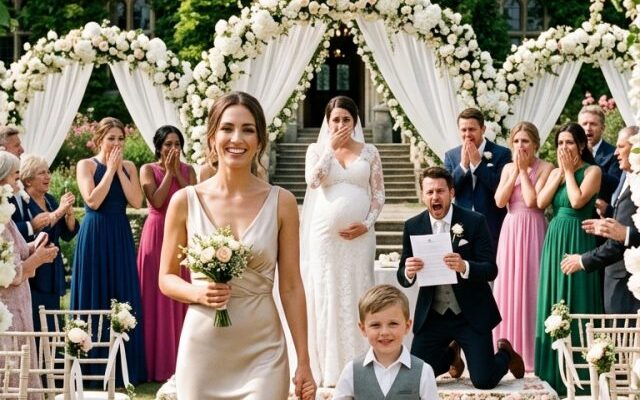
Chapter 1: The Shadows of the Gala
The crisp, early evening air of Greenwich, Connecticut, felt less like a gentle autumn breeze and more like a suffocating vacuum of humiliation.
I stood in the deep shadow of a massive, ivy-draped limestone pillar at the edge of the sprawling estate garden. I was thirty-five, wearing a modest, off-the-rack navy dress that I had spent three weeks saving up to buy. Surrounding me on the manicured lawns were three hundred of the wealthiest people on the East Coast—hedge fund managers, real estate tycoons, and socialites dripping in diamonds and old money.
They were all here to celebrate the wedding of Richard Sterling, my billionaire ex-husband, and his new bride, Tiffany. Tiffany was twenty-four, a former Instagram model, and she was currently sporting a very visible, highly publicized six-month baby bump.
Richard had abandoned me and our son, Leo, exactly ten years ago. I had spent the last decade working two jobs, clipping coupons, and slowly, painfully rebuilding my life from absolute scratch after Richard’s high-priced lawyers legally outmaneuvered me, leaving me with pennies and the sole, exhausting responsibility of raising our child.
I hadn’t wanted to come to this wedding. But Richard had sent the invitation via courier, accompanied by a threatening, manipulative email stating that if Leo didn’t attend to “show respect to his new stepmother and future brother,” Richard would indefinitely suspend his meager, court-ordered college fund contributions.
He didn’t invite us because he wanted to heal old wounds. He invited us so he could use us as a contrasting backdrop to his glittering, new “triumph.”
On the grand, floral-draped podium at the center of the garden, Richard stood triumphant. He was wearing a bespoke tuxedo, his silvering hair perfectly styled. One hand held a crystal champagne flute; the other was splayed possessively over Tiffany’s pregnant belly.
He tapped the microphone, a smug, predatory smile stretching across his face.
“To find gold, my friends,” Richard sneered into the microphone, his voice echoing off the limestone walls of the mansion, “one must sometimes sift through a lot of dirt.”
He raised his glass, and to my absolute horror, he pointed a manicured finger directly at the specific shadow where Leo and I were standing. He made sure every single guest knew exactly where the “dirt” was located.
“For years, I was held back by mediocrity. By dead weight,” Richard declared, his voice rising in theatrical volume. “But today, I am redeemed! Tiffany is pregnant with a son. A true heir. A pure Sterling who won’t be tainted by the failures of the past!”
The crowd erupted. It wasn’t polite applause; it was sycophantic, cruel, echoing laughter. Hundreds of eyes swiveled toward the pillar. Wealthy women whispered behind their hands, looking at my cheap dress. Men chuckled, raising their glasses to the groom’s ruthless candor.
My world shrank to the size of a pinhead. The humiliation pinned me to the grass like a physical weight. I wanted the earth to open up and swallow me. I wanted to bolt, to run to my ten-year-old Honda Civic in the valet lot and hide my burning face in my hands.
But a firm, surprisingly strong grip anchored me to the spot.
I looked down. Fifteen-year-old Leo was holding my arm. He was wearing a simple, dark suit we had bought at a discount department store. He had always been a quiet boy, growing up too fast, absorbing the stress of our lives with an unnatural, silent resilience.
But right now, looking at my son’s face in the dim lighting of the garden, I didn’t see a wounded, humiliated child.
His jaw was set. His posture was rigid. His dark eyes were locked onto his father’s laughing face with a look of terrifying, unnatural calm. It was the look of an apex predator patiently waiting for the prey to step onto the trapdoor.
“Leo, please,” I begged in a frantic, choked whisper, grabbing his hand. “Let’s just go. Don’t listen to him. Let’s just turn around and walk away.”
Leo slowly turned his head to look at me. He didn’t cry. He simply smiled—a cold, razor-sharp smile that didn’t reach his eyes.
“It’s time, Mom,” Leo whispered, his voice entirely devoid of fear.
With his free hand, he reached into the inner breast pocket of his cheap suit jacket. He pulled out a beautifully embossed, heavy gold envelope—a piece of stationery that, I would soon discover, was about to turn this multi-million-dollar wedding into a psychological crime scene.
Chapter 2: The Approach
The cruel laughter of the elite guests still hung in the chilly evening air, mixing with the gentle notes of the string quartet playing softly near the bar.
I couldn’t move. My feet felt glued to the manicured grass. My heart hammered a frantic, sickening rhythm against my ribs as I watched my teenage son step out from the safety of the shadows.
“Leo, no!” I hissed, but he was already gone.
He didn’t act like a wounded child running to his father for validation. He didn’t look down at the ground. He walked with his shoulders back, his spine perfectly straight, marching directly toward the grand, floral-draped podium at the center of the lawn.
The crowd parted slightly as he moved through them. The whispering intensified. The laughter died down into confused, buzzing murmurs.
What is the ex-wife’s kid doing? Is he going to make a scene? Is he going to cry?
Richard stopped laughing as he noticed Leo approaching. He leaned casually against the microphone stand, adjusting his silk bow tie. A smug, victorious, and profoundly arrogant grin stretched across his face. Richard was a man who thrived on dominance. He assumed—with staggering, fatal miscalculation—that his son was walking up to the stage to surrender. He thought Leo, broken by the public insult, was coming up to beg for scraps of affection, or perhaps to offer a coerced, pathetic public congratulation to prove his loyalty.
As Leo reached the base of the short wooden stairs leading up to the podium, Richard actually held out his free hand, expecting Leo to shake it in defeat in front of his wealthy investors and business partners.
Leo didn’t take his hand.
He stopped at the bottom of the stairs, standing perfectly still. He held the gold envelope down at his side.
“I brought a special wedding gift for you, Dad,” Leo said.
His voice didn’t crack. It didn’t waver with teenage anxiety. It was smooth, steady, and carried perfectly across the front rows of the silent garden, even without the aid of the microphone.
Richard chuckled patronizingly, keeping his hand extended. “Is that so? Well, hand it up here, son. Let’s see what you and your mother managed to scrape together.”
Leo didn’t move to hand him the envelope. Instead, he looked past Richard, his dark eyes locking briefly onto Tiffany, the pregnant bride, who was smiling a vacuous, perfectly glossed smile.
“You didn’t leave us because we were mediocre, Richard,” Leo stated, dropping the title of ‘Dad’ with a cold, verbal
thwack
that made several guests in the front row physically flinch.
Richard’s smug grin faltered slightly. His hand slowly dropped to his side. “Excuse me?”
“You didn’t leave because you were destined for a greater legacy,” Leo continued, his voice rising just enough to command the attention of the entire garden. “You fled, ten years ago, because you were terrified. You were terrified of what the doctors at the Mount Sinai Fertility Clinic told you in that private consultation room.”
An old, deeply buried panic flickered rapidly behind Richard’s eyes. He took a half-step backward, the microphone whining with a brief spike of feedback.
He was completely, blissfully unaware that the yellowing piece of paper inside the gold envelope Leo was holding wasn’t a sentimental letter, a cheap gift card, or a plea for a father’s love. It was a certified, biological death sentence for his massive, fragile ego.
Chapter 3: The Irreversible Truth
Standing by the pillar, my breath caught violently in my throat. My hands flew to my mouth in sheer, unadulterated shock.
I recognized the gold envelope. It was from the heavy, expensive stationery set I used for my freelance graphic design business. But it wasn’t the envelope that made the blood drain from my face; it was the specific clinic name Leo had just spoken out loud.
Mount Sinai Fertility Clinic.
Ten years ago, just months before Richard packed his bags, drained our joint accounts, and abandoned us, he had been violently ill. He had contracted a severe, prolonged, and untreated case of bilateral epididymitis—a complication from an infection he had stubbornly refused to see a doctor for until the pain became unbearable.
When he finally went to the specialists at Mount Sinai, the damage was already done.
I remembered sitting in that sterile, cold consultation room, holding his hand. The doctor had been gentle but absolute. The infection had caused massive, permanent scarring and blockages. Richard’s sperm count was zero. He was diagnosed as one hundred percent, permanently, and irreversibly sterile. There was no surgery, no treatment, and no miracle that could fix it.
Leo was our only child, conceived years before the illness. He was a biological miracle that Richard could never, ever replicate.
Richard’s reaction to the news hadn’t been sorrow; it had been a violent, toxic rage. His entire identity was wrapped up in his virility, his power, and his “legacy.” He couldn’t handle the agonizing, emasculating shame of his own medical failure. So, like the true narcissist he was, he projected his profound inadequacy onto me. He branded me “dead weight,” claimed our marriage was stifling his greatness, and fled to maintain his illusion of perfection among a new circle of friends who didn’t know his secret.
I had never told anyone. I had taken the physical copy of the lab report, shoved it into an old lockbox, and buried it deep in the back of my closet to protect his pride, even as he was destroying my life.
I didn’t know that three weeks ago, while searching for his original birth certificate for a high school summer program application, Leo had found the key to the lockbox. He hadn’t just found his birth certificate; he had found the heavily stamped, undeniably official medical file detailing his father’s irreversible sterility.
And now, standing in front of three hundred elite guests, my fifteen-year-old son extended his arm, holding the gold envelope out to the man who had just boasted about a “new heir.”
“You spent ten years telling the world my mother and I were trash,” Leo said, his voice ringing with a terrifying, absolute authority that seemed far too large for his teenage frame. “But my mother kept your secret. She let you play the king. She let you pretend you were a god.”
Leo took one step up the wooden stairs.
“I won’t.”
He thrust the gold envelope directly against Richard’s chest.
“Open it,” Leo commanded. “Read the lab results from Dr. Evans. Read the part in the summary where it explicitly states
‘Complete Azoospermia. Zero motility. Permanent and irreversible sterilization.’
The garden went dead, suffocatingly silent. The string quartet stopped playing mid-note. The clinking of champagne flutes ceased entirely.
On the stage, Tiffany, the beautiful, twenty-four-year-old pregnant bride, suddenly went rigidly stiff. The vacuous smile slid off her face, replaced by a look of sheer, unadulterated panic. She looked as if she were going to violently vomit all over her custom Vera Wang gown.
Chapter 4: The Shattered Heir
With his hand trembling so violently he could barely grip the thick paper, Richard Sterling broke the wax seal on the gold envelope.
He didn’t want to look. He wanted to throw it away, to call for security, to laugh it off as a teenage prank. But the absolute, terrifying silence of the crowd, and the dead, unwavering stare of his son, forced his eyes downward.
He pulled the yellowed, officially stamped medical document from the envelope.
The fading red ink of the Mount Sinai logo glared up at him. His eyes scanned the familiar, devastating medical jargon he had spent a decade trying to outrun.
Diagnosis: Complete Azoospermia. Irreversible.
The paper shook violently in his hands, rustling loudly into the microphone he still held near his chest.
Richard slowly, agonizingly turned his head. His eyes, wide and bloodshot with sudden, horrific realization, locked onto his new bride.
Tiffany was backing away from the podium. She was taking slow, terrified steps backward, her hands instinctively flying up to protectively cover her six-month baby bump. Her face was as pale as a sheet of parchment, her eyes darting frantically toward the exits of the garden.
“Who…” Richard choked out. The microphone picked up the ragged, devastated, wet sound of his breath, broadcasting his agony to the entire estate. He took a stumbling step toward her. “Tiffany… whose baby is that?!”
“Richard, please, I can explain!” Tiffany sobbed, shaking her head wildly, tears ruining her immaculate bridal makeup. “It was just one time! I thought you wanted a baby so badly, I just wanted to give you—”
The elite guests gasped in a collective, horrified, and entirely delighted shock.
The multi-million-dollar, highly publicized wedding of the year had just, in a matter of thirty seconds, become the most explosive public paternity scandal in the history of Greenwich high society. The whispers erupted into a deafening roar of gossip, pointing fingers, and shocked exclamations.
The heavy, expensive microphone slipped from Richard’s numb fingers. It hit the wooden stage with an ear-piercing, electronic screech of feedback that made people cover their ears.
Richard fell to his knees on the stage. He let out a raw, guttural, agonizing scream of pure, absolute humiliation that silenced the entire garden once more. It was the sound of a man watching his ego, his carefully constructed legacy, and his entire fabricated reality violently implode in real-time.
Leo didn’t flinch at the sound of his father’s agony. He didn’t smile. He didn’t gloat.
He simply stood at the bottom of the stairs, adjusting the cuffs of his cheap suit jacket with the meticulous precision of a hitman packing away his rifle.
“Congratulations on the heir, Richard,” the teenager said smoothly, his voice slicing through the bride’s sobbing. “Looks like you finally found exactly what you deserve.”
Leo didn’t wait for a response. He didn’t look at the crowd. He turned his back on the carnage, walked calmly down the grassy aisle, and headed straight for the limestone pillar where I was standing.
As the stage descended into violent, screaming chaos—with Richard lunging to his feet, screaming obscenities at his weeping bride, and wealthy investors whispering furiously into their phones about the groom’s mental stability—Leo reached out and gently took my trembling hand.
“Let’s go home, Mom,” he whispered softly.
He led me out of the garden, past the staring valet attendants, and into the cool, liberating night air, leaving the smoking, ruined crater of Richard Sterling’s life completely behind us.
Chapter 5: The Aftermath
Six months later, the contrast between the two diverging paths of our lives was absolute, staggering, and undeniably poetic.
In the tabloids, the financial blogs, and the vicious, whispering circles of high-society gossip columns, Richard Sterling was a spectacular, monumental laughingstock.
The fallout from the wedding had been swift and merciless. His swift, vicious annulment from Tiffany—who, it was revealed by the paparazzi, had been sleeping with Richard’s own twenty-six-year-old personal trainer—had dragged his name through the mud for months. The highly publicized scandal had made him a liability to his conservative, old-money investors. Two of his largest hedge fund partners had pulled their capital, citing “instability in executive leadership,” which cost him tens of millions of dollars and permanently destroyed his corporate reputation.
He was currently living alone in his massive, empty, twenty-room mansion, drowning in legal fees and the crushing, inescapable reality that his “pure Sterling legacy” was nothing but a punchline to a joke everyone else was in on.
Miles away from the depressing, grey walls of his corporate ruin, the morning sunlight was streaming through the windows of the cozy, peaceful kitchen in my small suburban home.
I stood at the stove, pouring a fresh cup of coffee. The oppressive, heavy weight of the past ten years—the constant feeling of being “less than,” of being the discarded trash—had completely, utterly vanished.
Leo was sitting at the kitchen table, a plate of scrambled eggs in front of him. He was hunched over his laptop, deeply focused as he typed out the final draft of his early-admission college applications. He looked brilliant, grounded, and entirely, wonderfully unbothered by the chaos of the Sterling empire crumbling to the ground.
I looked at my son, feeling a profound, unshakeable sense of safety and immense pride.
For ten years, Richard had tried to convince me that I was dead weight. He had tried to make me believe that by raising a child alone on a meager salary, I was destined for a life of mediocrity and failure.
He was wrong. I hadn’t been dead weight. I had been the solid, unyielding foundation that allowed this incredible, fiercely protective young man to grow into a giant. The poison of the past decade had been completely extracted, drawn out by the very child the abuser thought he could use as a pawn.
I walked over and placed a fresh plate of buttered toast in front of him. I gently kissed the top of his head, smelling the clean scent of his shampoo.
“Thanks, Mom,” Leo smiled, not looking up from his screen.
I walked back to the counter, completely at peace with my life, the quiet hum of the refrigerator the only sound in the house. I was entirely, blissfully unaware that Richard’s frantic, tearful, begging voicemails—pleading for forgiveness, pleading to see his “only true son”—were currently being automatically, ruthlessly routed to a blocked digital folder on Leo’s phone, a folder my son would never, ever bother to check.
Chapter 6: The True Legacy
Three years later.
It was a bright, warm, beautifully clear afternoon in late May on the historic, ivy-covered campus of a prestigious Ivy League university.
I was sitting in the third row of a massive, crowded auditorium, wearing a new, tailored dress that I had bought with the profits from my now highly successful, expanding graphic design business. The air was buzzing with the excited chatter of proud parents, faculty members, and graduating students.
I clutched a glossy event program in my hands, my heart hammering with a frantic, joyful rhythm.
Today was the university’s annual undergraduate honors convocation.
Sometimes, when the world was very quiet, I still remembered the heavy, suffocating smell of the limestone pillar at that garden wedding. I still heard the terrifying, cruel echo of Richard’s laughter booming through the speakers as he pointed at me in the dark.
But the memory had lost all its power. It no longer held any pain, any shame, or any fear.
Richard had stood on a stage and bragged to the world about finding gold while discarding trash. He had been so blinded by his own narcissism, so desperate to prove his own worth, that he was completely, fatally blind to the fact that he had thrown away the only true, lasting legacy he would ever have.
The dean of the science department stepped up to the podium, tapping the microphone.
“And now, for the recipient of the Vanguard Fellowship for Excellence in Bio-Engineering,” the dean announced, his voice echoing proudly across the auditorium. “For his groundbreaking undergraduate research… Mr. Leo Sterling.”
The crowd erupted into thunderous, genuine applause.
Eighteen-year-old Leo walked across the stage. He was tall, handsome, and radiated a quiet, unshakeable confidence. He wasn’t wearing a cheap suit anymore; he wore a perfectly fitted academic robe, his future limitless and entirely his own.
He shook the dean’s hand, accepting the heavy glass plaque.
As he turned to face the crowd, Leo didn’t look at the university president, and he didn’t look at the flashing cameras of the campus press. He scanned the third row, his dark eyes locking instantly and unerringly onto mine.
He held the award up slightly, pointing a single finger directly at me, and flashed a brilliant, fearless, and incredibly joyful smile.
I smiled back, tears of absolute, profound certainty spilling down my cheeks.
A true heir isn’t built by a wealthy surname, a massive trust fund, or a sociopathic need for control. A true legacy is forged in the quiet, desperate moments of survival, built by the fierce, unwavering love of a mother, and protected by the unbreakable strength of a son who knows exactly what she is worth.
As the auditorium erupted into cheers and my son walked down the stage steps toward me, I knew that the dark, pathetic ghosts of our past had been permanently, irrevocably left in the dust. We had survived the fire, and now, we were walking fearlessly into a brilliantly bright, unshakeable future.