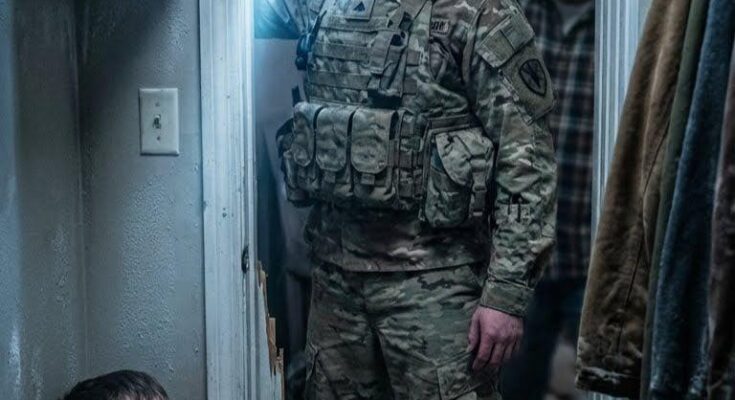
Chapter 1: The Weight of Paper Walls
This is the chronicle of a war I never asked to fight, a record of the night I traded my future for my brother’s life. They told me the law was a shield, but for two years, I watched it become a suffocating shroud. They told me the system worked, but the system doesn’t have a heart; it has a ledger, and my name was written in the red.
My name is Jack, and at twenty-four, I have spent more time in a flight suit or under the chassis of a
Peterbilt
than I have in a “traditional home environment.” That was the phrase the social worker, a woman named Mrs. Gable whose perfume smelled like stale lilies and judgment, used to dismantle my life. Two years ago, a patch of black ice on a
Montana
highway turned my parents’ sedan into a twisted heap of scrap metal. In an instant, I wasn’t just a former
Marine Corps
sergeant with a discharge paper and a set of wrenches; I was the sole guardian of a six-year-old boy named Leo.
Or at least, I should have been.
The state of
Montana
saw it differently. They saw my grease-stained cuticles, my cramped one-bedroom apartment above
Mick’s Auto Shop
, and my lack of a spouse as a series of red flags. They saw a man who had survived three tours in the desert but couldn’t, in their estimation, survive a PTA meeting. So, they took him. They took my Leo and handed him over to
The Hendersons
On paper,
The Hendersons
were a miracle. Thomas and Martha were pillars of the community in a wealthy suburb of
Bozeman
. He was a deacon; she was a florist. Their house was a sprawling Victorian with a wrap-around porch and a yard the size of a football field. They had “structure.” They had “stability.” They had everything I didn’t, except for one thing: the blood bond that tied my soul to that boy.
I worked double shifts, sometimes twenty hours straight, scrubbing the grime of the world off my skin just to prove I could afford a better zip code. Every Sunday at 4:00 PM, I was allowed a fifteen-minute phone call. For the first few months, Leo talked about the big yard. Then he started talking about the rules. Then, he stopped talking much at all.
“Hey, buddy,” I said into the receiver last Sunday, my voice thick with a forced cheerfulness that felt like swallowing glass. I was sitting on a crate in the garage, the smell of diesel and old oil my only company. “How’s that model airplane coming along? The one with the dual propellers?”
There was a silence on the other end, the kind of heavy, pressurized silence that precedes a storm. I could hear Leo’s shallow breathing. “I… I lost the glue, Jack,” he whispered. “Mr. Henderson said I’m clumsy. He said my hands are ‘idle tools.’ He took it away.”
A cold spike of adrenaline shot through my marrow.
Idle tools?
That sounded like a sermon, not a parenting technique. “It’s just glue, Leo. Don’t worry about it. I’ll send more in the mail tomorrow. Are you eating okay? You sounded tired last week.”
“I’m okay,” Leo said, but his voice cracked, a tiny, fragile sound that threatened to shatter my heart. “Jack? When are you coming? Please… when? I don’t like the quiet here. It’s too quiet.”
I gripped the phone so hard the plastic casing creaked under the pressure of my calloused palm. My knuckles were white, matching the scars I’d earned in
Helmand Province
. “Soon, Leo. I promise. I’m doing the paperwork. I’m fighting every single day. Just hold on for me, okay?”
“I’m trying,” he breathed.
Suddenly, the background noise on the line changed. I heard the sharp, rhythmic
thud-thud-thud
of heavy footsteps on hardwood. A door slammed—a heavy, final sound—and a man’s voice, booming and devoid of warmth, roared: “Who said you could use the phone? That wasn’t earned!”
“Jack—!” Leo started to cry out, but the line went dead.
I stared at the silent device in my hand, the dial tone a mocking staccato in my ear. The garage felt smaller, the shadows longer. My gut, trained by years of scanning for IEDs, told me that the quiet Leo feared wasn’t the absence of noise—it was the presence of a predator.
Chapter 2: The Blizzard of 3:14 AM
Sleep didn’t come. It never does when the ghosts are loud. I spent the night pacing the length of my apartment, staring at the legal folders piled on my kitchen table—letters from the
Department of Child Services
, denials of custody, “evidence” of my financial instability. Each page felt like a brick in a wall built to keep me from my brother.
The phone buzzed on my nightstand at 3:14 AM. In the military, that’s the “witching hour,” the time when your guard is lowest and the enemy is most likely to move. I swiped the screen before the first vibration could end.
“Leo?”
“Jack?” The whisper was so faint I had to press the phone against my ear until it hurt. He was crying, but it was a muffled, terrified sob, the sound of a child trying to be invisible. “Jack, I’m scared. They put me in the dark again. In the small room.”
My blood turned to liquid nitrogen. “Where are you, Leo? Are you in your bedroom?”
“No,” he gasped, and then came the words that would change my life forever. “They won’t let me eat. I’m so hungry, Jack. He said if I don’t learn to be ‘humble,’ I don’t get the bread. It’s been two days. I’m so cold.”
I was out of bed before he finished the sentence. I didn’t grab a coat; I grabbed my boots and the keys to my
Ford F-150
. “Leo, listen to me. I’m coming. Do you hear me? I am coming right now. Don’t you dare move. Stay in that room, stay quiet. I’ll be there before the sun is up.”
“I can’t stay on… he’ll hear the light of the phone…”
Click.
The world outside was a nightmare of white. A late-season blizzard had descended on the
Gallatin Valley
, a wall of wind and ice that turned the highway into a graveyard of stalled cars. The radio screamed warnings about road closures, advising all “non-essential” personnel to stay indoors.
I wasn’t personnel. I was a brother.
I drove like a man possessed. The truck fishtailed on black ice, the tires screaming for purchase, but I didn’t lift my foot. I pushed that engine until it roared in agony, my eyes fixed on the narrow cone of my headlights. I saw Leo’s face in the swirling snow—his wide, trusting eyes, now hollow with hunger. My knuckles were white on the steering wheel, my mind a repetitive loop of tactical calculations.
Six hours,
the GPS said. I did it in four.
I didn’t care about the state troopers or the black ice. I didn’t care about the laws of physics. I only cared about the thirty miles an hour I was stripping away from the distance between us. By the time I pulled onto the winding, manicured driveway of the
Henderson Estate
, the truck’s radiator was hissing and my heart was a rhythmic hammer against my ribs.
The house was dark, a silent Victorian monster looming against the gray pre-dawn sky. It looked perfect. It looked “stable.” It looked like a tomb.
I didn’t knock. I didn’t call. I walked up to that ornate oak door and pounded with the weight of my entire body. I wanted them to feel the vibration in their bones. I wanted them to know that the wolf was at the door.
A porch light flickered on, yellow and sickly. The door opened a crack, held by a heavy security chain. Thomas Henderson stood there, his silk pajamas pristine, his face a mask of righteous indignation. He didn’t look like a child abuser; he looked like a man who believed his own lies. In his hand, he gripped a wooden baseball bat.
“You have no right to be here, Jack,” Henderson said, his voice a low, dangerous rumble. He didn’t look surprised; he looked annoyed. “Leo is being disciplined. He is learning the value of obedience. Now go away, boy, or I’ll call your parole officer and make sure you never see him again.”
“Open the door, Thomas,” I said. My voice was beyond anger. It was the calm, flat tone I used when the comms went down and the mission went sideways. “Open the door, or I’m coming through it.”
“He’s being punished for his own good,” Henderson sneered, tightening his grip on the bat. “You wouldn’t understand ‘good.’ Now, get off my porch.”
Chapter 3: The Scent of Cinnamon and Concrete
Thomas Henderson was a man who had spent his life winning. He won in the boardroom, he won in the church, and he won by using the law to take a child from a better man. He thought the baseball bat made him dangerous. He didn’t realize that a man who has lost everything is the most dangerous force in nature.
He swung the bat—a clumsy, overhead strike born of arrogance. I didn’t even blink. I stepped inside the arc of the swing, my left palm catching the wood, the impact vibrating up my arm. I didn’t feel pain; I felt clarity. I twisted the bat out of his soft, uncalloused hands with a jerk that probably dislocated his shoulder.
Then, I kicked the door.
The frame didn’t just give; it exploded in a spray of splinters. I sent Henderson stumbling backward into the foyer, his silk pajamas catching on a decorative umbrella stand. I stepped over him, the bat held loosely at my side.
“Leo!” I screamed. My voice echoed through the high ceilings of the Victorian house.
The upstairs was a gallery of expensive taste—plush carpets, oil paintings, the faint, lingering scent of cinnamon rolls from the previous night’s dinner. The contrast was a physical blow to my stomach. They were eating cinnamon rolls while my brother was starving in the dark.
“Jack?” A woman’s voice. Martha Henderson appeared at the top of the stairs, her face pale, her hands trembling as she clutched a cordless phone. “We’re calling the police! You’re a criminal! You’re just like they said!”
I ignored her. I followed the draft. In a house this big, the heat rises, leaving the basement as a cold sink. I ran toward the kitchen, toward a door tucked behind the pantry. It was secured with a heavy, industrial-grade padlock—the kind you use for a shipping container, not a child’s room.
“Where is he?” I roared, turning back to Thomas, who was trying to crawl toward his wife.
“He’s learning!” Henderson wheezed. “He’s learning to be—”
I didn’t let him finish. I brought the handle of the baseball bat down on the padlock with every ounce of Marine-bred fury I possessed. Once. Twice. The metal shrieked and snapped.
I threw the door open and hit the light switch. The basement was unfinished, a cavern of gray concrete and weeping pipes. In the far corner, beneath the stairs, was a small storage closet. I ripped the door open.
The smell hit me first—the scent of damp stone, old dust, and the metallic tang of fear.
Leo was curled in a fetal position on the bare concrete. He was wearing nothing but a thin t-shirt and underwear. His skin was the color of skim milk, and I could see the sharp, jagged outline of his ribs with every shallow breath. The air was so cold our breath came out in ragged plumes of mist.
“Leo,” I whispered, dropping the bat.
He flinched, his entire body convulsing as he tried to pull further into the corner. He didn’t recognize my voice at first. He only knew that the door had opened, and in this house, an open door meant more pain.
“It’s me. It’s Jack. I’m here, buddy. I’m here.”
I reached out and pulled him into my arms. He weighed nothing. He felt like a bundle of dry sticks wrapped in parchment. As I lifted him, his head fell against my shoulder, and I saw the bruises—a map of purple and yellow continents stretching across his upper arms where someone had gripped him too hard.
“Jack?” he breathed, his voice a ghost of a sound. “Did I do good? I didn’t… I didn’t cry. He said if I cried, it would be another day.”
My heart didn’t just break; it disintegrated. I felt a heat rising in my chest that had nothing to do with the blizzard outside. It was a cold, white-hot coal of vengeance.
Upstairs, I heard the heavy, muffled sound of Henderson’s voice. “Yes! He’s in the house! He’s armed! Send everyone! He’s trying to kill us!”
I stood up, wrapping my heavy flannel jacket around Leo’s shivering frame. I didn’t hurry. I didn’t hide. I walked back up those basement stairs with my brother in my arms, my face void of everything but the singular purpose of what came next.
“It wasn’t discipline, Thomas,” I whispered to the empty basement. “It was torture.”
Chapter 4: The Witness
I placed Leo gently on the expensive floral sofa in the living room. He looked like a fallen bird against the silk upholstery. I tucked the jacket tighter around him, kissed his forehead, and turned to face the foyer.
Thomas Henderson was standing by the broken front door, his phone still pressed to his ear, his eyes darting toward the driveway where the first faint sounds of sirens began to wail through the storm. He saw me approaching and scrambled backward, his heels skidding on the polished hardwood.
“Stay back!” he shrieked. “The police are sixty seconds out! You’re going to spend the rest of your life in a cage, you animal!”
“Good,” I said. My voice was so calm it seemed to frighten him more than a shout would have. “I want them here.”
Henderson blinked, his mouth hanging open. “What?”
“I want them to see,” I said, closing the distance between us. “A man like you… you thrive in the dark. You use the law like a curtain to hide what you are. But tonight, Thomas, the curtain stays open. I want them to witness exactly what I’m about to do to you. And I want them to see why I did it.”
“You’re crazy,” he whimpered, backing into a heavy mahogany table. “I’ll sue you. I’ll—”
I didn’t give him the chance to threaten me again. I didn’t use the bat. That would have been too quick, too impersonal. I used my hands—the hands that had fixed his cars, the hands that had been told they weren’t good enough to hold a child.
I struck him with the precise, calculated force of a man trained in the art of the “controlled takedown.” A blow to the solar plexus to take his breath. A strike to the liver that turned his face a sickly shade of gray and dropped him to his knees.
He gasped, clawing at my shins. “Please…”
“Did you hear him ‘please’ you, Thomas? When he was hungry? When he was freezing on that concrete?”
I grabbed him by the collar of his silk pajamas and dragged him across the floor. He was heavy, but I felt like I was pulling a bag of feathers. I dragged him all the way to the basement door, to the edge of the darkness he had forced my brother to inhabit.
“You like the cold? You like the quiet?” I hissed, forcing his head down so he had to look into the black abyss of the basement. “Let me show you the cold.”
Blue and red lights began to pulse against the frosted windows, casting long, rhythmic shadows across the walls. The sirens died down, replaced by the heavy
thump-thump
of car doors and the frantic barking of a K9 unit.
I let go of Henderson’s collar. He slumped against the doorframe, weeping, his nose a mess of blood, his dignity a shredded ruin. I didn’t run. I didn’t try to climb out a back window. I stood in the center of the foyer, my back to the door, my empty hands raised at shoulder height.
The front door burst open.
“POLICE! DROP THE WEAPON! GET ON THE GROUND!”
Six officers flooded the room, their tactical lights blinding me, the red dots of their lasers dancing across my chest. I didn’t move. I didn’t flinch.
“Check the boy on the couch,” I said, my voice projecting over the shouting. “Then check the basement closet. Then, you can arrest me.”
The lead officer, a veteran with a thick mustache and eyes that had seen too much, signaled for his team to fan out. He looked at me, then at the broken man at my feet, then at the tiny, shivering bundle on the sofa.
“Check ’em,” the officer barked.
I felt the cold bite of steel as the handcuffs snapped around my wrists. I didn’t fight. As they pushed me toward the door, I looked back at Leo. He was staring at me, his eyes wide, but the terror was gone. For the first time in two years, he looked safe.
Chapter 5: The Reckoning of Officer Miller
The interrogation room at the
Bozeman Precinct
smelled of floor wax and stale coffee. I sat in the metal chair, my hands cuffed to a bar on the table. I wasn’t cold anymore. For the first time in months, the fire in my chest had settled into a steady, peaceful hum.
The door opened, and the veteran officer from the house walked in. He carried a manila folder and two paper cups of coffee. He set one in front of me and sat down, clicking off the recording camera with a practiced flick of his thumb.
“I’m
Officer Miller
,” he said. He didn’t look like a man about to process a violent felon. He looked like a man who was tired of the world. “I spent the last four hours at the Henderson place. My guys found the basement. They found the locks. They found the lack of food in the pantry… and they found the ‘discipline’ journals Martha Henderson kept.”
He tossed a photo onto the table. It was a picture of the closet. The concrete floor was stained with Leo’s tears.
“The kid… Leo… he’s at the hospital,” Miller continued. “He’s being treated for malnutrition and Stage 1 hypothermia. He told the social worker everything. He told them about the ‘dark time.’ He told them about the glue.”
I closed my eyes, a single tear carving a path through the dried blood on my cheek. “Is he going back?”
Miller leaned back, his chair creaking. “To the Hendersons? Not a chance in hell. They’re being booked on multiple counts of child endangerment, aggravated abuse, and kidnapping under the guise of foster care. Thomas is screaming for a lawyer, but Martha… she’s already breaking. She’s terrified of going to women’s prison.”
He paused, looking at my knuckles, which were swollen and split.
“And me?” I asked.
“You broke into a private residence. You committed aggravated assault on a ‘protected’ foster parent. You destroyed property.” Miller sighed, rubbing his eyes. “On paper, Jack, you’re a violent offender. You’re looking at five to ten.”
He looked at the camera, then back at me.
“But the judge assigned to the morning bail hearing? He’s a father of three. And I’ve got four guys who will swear that Henderson ‘tripped’ on his way to the basement door. Seems like a lot of people in this town were tired of Thomas Henderson’s ‘righteousness.’”
I looked Miller in the eye. “I’d do it again. I’d do it a thousand times.”
“I know you would,” Miller whispered. “That’s the problem. And that’s the solution.”
The legal battle that followed was a blur of headlines and depositions. The “System” that had failed Leo was suddenly on trial itself. The
Department of Child Services
was purged. Mrs. Gable was fired. The Hendersons’ Victorian house was seized as part of a civil suit.
I spent three weeks in a holding cell before a pro-bono lawyer, moved by the viral story of the “Marine Who Braved the Storm,” got my charges reduced to trespassing and simple assault with a deferred sentence.
When I finally walked out of that precinct, the snow had stopped. The air was crisp, the sun reflecting off the white peaks of the
Bridger Range
. A silver sedan was waiting at the curb.
Mrs. Gable’s replacement, a younger woman named Sarah who didn’t smell like lilies, stepped out of the car. She looked solemn.
“Jack,” she said. “The court has finalized the emergency revocation of the Hendersons’ status.”
My heart froze. “And Leo? Where is he going next?”
After everything—the blizzard, the basement, the arrest—the fear that they would still find a reason to keep us apart was the only thing that could truly break me. I stood there, a man with a criminal record and a broken truck, waiting for the final blow.
Chapter 6: The Feast of Peace
Six months later.
The apartment above
Mick’s Auto Shop
is gone. In its place is a small, two-bedroom cottage on the edge of town, paid for by the settlement from the state and my new job as the shop foreman. It’s not a Victorian mansion. It doesn’t have a wrap-around porch. But the walls are thin enough that I can hear Leo breathing from the next room, and that is all the architecture I need.
There is a new lock on the front door. It’s a deadbolt that keeps the world out, not a padlock that keeps people in.
Leo sits at the kitchen table, his face filled out, his eyes bright with the mischievous spark of an eight-year-old boy. He is currently attacking a stack of blueberry pancakes with a ferocity that makes me smile every single morning. He’s gained fifteen pounds. The bruises are long gone, though he still insists on keeping a nightlight shaped like a star in the corner of his room.
“Slow down, kid,” I laugh, ruffling his hair as I pour more syrup. “Nobody’s taking it away. There’s more in the pan.”
Leo pauses, a smudge of maple syrup on his chin. He looks up at me, his fork suspended in mid-air. “I know, Jack. Because you’re here.”
I look down at my hands. A faint, jagged scar remains on my knuckles from the night I shattered Thomas Henderson’s world. I think about the probation meetings, the community service, and the way people in town look at me—some with fear, most with a quiet, nodding respect.
I used to think that being a Marine was about following orders. I realize now that being a man is about knowing when to break them. Justice isn’t found in a file folder or a courtroom; it’s found in the marrow of your bones when you decide that someone’s pain is more important than your own safety.
The trauma doesn’t disappear. Sometimes, when the wind howls against the window, Leo still flinches. Sometimes, I still wake up in a cold sweat, reaching for a rifle that isn’t there. But we carry the scars together, and that makes them lighter.
Leo looks out the window at the first few flakes of a new winter snow. “Do you think he’s cold, Jack? Wherever he is?”
I know he’s talking about Henderson. I know he’s wondering if the man who hurt him is feeling the same bite of the frost.
I join him at the window, putting a protective arm around his shoulders. I watch the city turn white, the streetlights flickering on one by one.
“I don’t know, Leo,” I say softly. “But we never will be again.”
I reach over and close the blinds, shutting out the cold, the dark, and the ghosts. I turn back to the warm, bright kitchen where the smell of pancakes lingers like a benediction. We aren’t just surviving anymore. We are living. And for the first time in my life, the quiet is exactly what it should be.
It is peace.
If you want more stories like this, or if you’d like to share your thoughts about what you would have done in my situation, I’d love to hear from you. Your perspective helps these stories reach more people, so don’t be shy about commenting or sharing.