Chapter 1: The Ten-Thousand-Dollar Lie
For three agonizing weeks, I hadn’t slept a single, continuous hour. Every time I closed my eyes, I heard my twenty-six-year-old daughter’s voice breaking into wretched, terrified sobs through the phone speaker.
I am Helen. I was fifty-four years old. I worked as a senior administrative assistant at a mid-sized regional bank, a job I had held for over twenty years. My life was defined by modest, sensible choices, clipped coupons, and an absolute, unwavering devotion to my only child, Chloe.
Chloe lived in a world I could barely comprehend. She had moved to Europe shortly after college, chasing a glamorous, high-society lifestyle she funded entirely through “influencer” gigs, obscure consulting jobs, and a heavy, relentless reliance on the safety net of my checking account.
But three weeks ago, the frivolous demands for rent money and designer shoes had violently halted, replaced by a call that stopped my heart dead in my chest.
“Mom,”
Chloe had wept, her voice weak and rasping.
“It’s stage three stomach cancer. The doctors here… they say it’s incredibly aggressive. If I don’t get the ten thousand dollars for the experimental surgical procedure by Friday, I won’t make it. My insurance won’t cover it.”
I didn’t hesitate. I didn’t ask to speak to her doctor. I didn’t question why an experimental surgery required a cash wire transfer. When your child tells you they are dying, logic is instantly incinerated by maternal panic.
I logged into my retirement account. I liquidated exactly ten thousand dollars—the bulk of my meager life savings—and wired it immediately to the international account she provided.
But wiring the money wasn’t enough. I was absolutely terrified that my only child would be wheeled into a foreign operating room alone, with no one to hold her hand when she woke up. I took out a predatory, high-interest personal loan from my credit union to buy a last-minute, wildly expensive transatlantic flight to be by her side.
I flew fourteen hours in economy, my knees aching, clutching a small, insulated canvas bag containing her favorite homemade banana bread—the only thing I thought she might be able to keep down after stomach surgery.
I arrived at the address Chloe had texted me from her “hospital bed.”
I stepped out of the taxi, expecting to see the sterile, imposing glass facade of a high-end European medical clinic.
Instead, I stood on the manicured, pristine gravel driveway of a breathtaking, sprawling, sixteenth-century historic estate in the rolling hills of Tuscany. The air didn’t smell of iodine and bleach. It smelled of blooming jasmine, roasted lamb, and the sharp, expensive tang of vintage champagne.
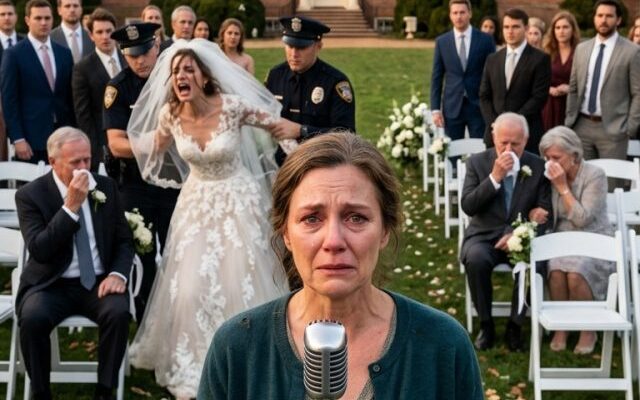
A massive, incredibly lavish, high-society wedding reception was in full swing.
Waiters in crisp white tuxedos circulated among hundreds of guests draped in silk and diamonds. A string quartet played softly near a towering, multi-tiered cake decorated with imported white orchids.
I stood there in my sensible, slightly wrinkled travel slacks and my worn cardigan, clutching my canvas bag of banana bread, utterly disoriented. I thought I had given the taxi driver the wrong address. I thought it was a cruel mistake.
And then, I looked past the towering floral archway in the center of the manicured lawn.
Standing there, radiating absolute, glowing, perfect health, holding a crystal flute of champagne and laughing brightly with a group of wealthy men, was the “dying” cancer patient.
It was Chloe.
She wasn’t wearing a hospital gown. She was wearing a custom, breathtakingly expensive, heavily beaded white silk wedding dress.
The air was violently sucked out of my lungs. The world tilted on its axis, the Italian sun suddenly feeling cold and sterile.
My daughter didn’t have stomach cancer. She wasn’t dying.
She had faked a terminal illness to steal her mother’s retirement savings to fund a luxury wedding venue deposit.
But as I stepped onto the manicured lawn, my knees weak from jet lag, crushing betrayal, and profound shock, I had absolutely no idea that the daughter I had rushed across the world to save was about to look me dead in the eye and deliver a blow far more lethal, and far more sociopathic, than any terminal disease.
I didn’t run toward her. I stood completely frozen at the edge of the sprawling, manicured lawn, my mind desperately struggling to process the monumental, catastrophic magnitude of the deception.
I watched Chloe throw her head back in a delicate, practiced laugh, resting her hand intimately on the arm of a tall, incredibly handsome, wealthy-looking man who was clearly the groom.
She turned her head slightly to accept a fresh glass of champagne from a passing waiter.
And then, her eyes locked onto mine.
The radiant, joyful bride didn’t light up with the happy surprise of seeing her mother unexpectedly arrive at her wedding.
Her face violently contorted. The color drained from her cheeks, leaving her looking sickly and panicked. The smile instantly morphed into a mask of sheer, unadulterated, panicked fury.
She whispered something urgently to the groom, excusing herself, and marched purposefully, aggressively across the lawn toward me. She didn’t look like a daughter. She looked like a predator whose trap had just been discovered by a scavenger.
She didn’t stop to hug me. She didn’t ask how my flight was.
She grabbed my upper arm with a bruising, desperate force, her perfectly manicured nails digging painfully into my bicep through my thin cardigan. She practically dragged me around the side of a large, white catering tent, forcefully shoving me out of sight of the wealthy guests.
“WHY ARE YOU HERE?!” Chloe hissed, her voice a harsh, venomous whisper, her eyes darting frantically around to ensure no one had seen us. “LEAVE BEFORE ANYONE SEES YOU!”
I stared at her. I looked at the heavy diamond necklace resting against her collarbone. I looked at the expensive, flawless makeup covering her perfectly healthy face.
“Why aren’t you in the hospital?” I asked, my voice trembling so violently I could barely form the words. “Chloe… you said you had stage three stomach cancer. You said you were dying.”
Chloe rolled her eyes. It was an exaggerated, deeply annoyed, and utterly sociopathic gesture, completely devoid of a single ounce of shame or remorse.
“I needed the money for the venue deposit, Mom,” Chloe snapped, waving her hand dismissively as if stealing ten thousand dollars was a minor inconvenience. “Arthur’s family—my new in-laws—are old money. They are incredibly wealthy. They think I come from money, too. I couldn’t ask them to pay for the venue, and I couldn’t have you showing up looking like…
that
.”
She looked me up and down, her gaze raking over my sensible, worn travel clothes and my cheap canvas bag with pure, aristocratic disgust.
“You’re ruining everything!” Chloe shrieked quietly, her panic escalating. “If Arthur’s mother sees you, she’ll know I’m not a trust fund baby! She’ll know I lied about my background! You have to leave right now! Go back to the airport!”
The world around me went dead silent. The lively string quartet and the clinking glasses faded into a deep, heavy void.
The girl I had raised, the girl I had sacrificed everything for, had just looked me in the eye and admitted to faking a terminal, agonizing illness specifically to steal my retirement savings for a party. And now, she was aggressively banishing me from her presence because my poverty embarrassed her.
In that exact, singular fraction of a second, the devoted, terrified, accommodating mother inside me completely, permanently died.
I did not cry. I did not scream. I did not slap her face or fall to my knees in hysterical grief, begging for an explanation.
A profound, freezing, absolute clarity washed over my brain. It was the “grey rock” method executed with lethal, mechanical perfection. The heartbreak evaporated, instantly replaced by a cold, crystalline, calculating emptiness.
I realized I did not have a daughter. I had a parasite. And I had just been given the absolute, undeniable permission to sever the host.
I looked at the stranger in the white silk wedding dress.
I nodded once, a slow, deliberate motion.
I turned my back on her. I walked away from the catering tent, back down the long, gravel driveway, and out the heavy iron gates of the estate without uttering a single, solitary syllable.
As the gates closed behind me, Chloe scoffed, likely assuming I would simply fly home, “get over it,” and eventually forgive her because I always did.
She was completely, blissfully unaware that the silence she had just aggressively demanded from me was about to become the most expensive, catastrophic, and legally annihilating silence of her entire life.
Chapter 3: The Digital Dossier
The fourteen-hour flight back to the United States was a masterclass in psychological detachment.
I sat in my cramped economy seat, the drone of the airplane engines a comforting white noise. I didn’t shed a single tear. I didn’t order a drink to numb the pain. I didn’t try to sleep.
I opened my laptop, resting it on the small plastic tray table.
Chloe had always assumed I was just a naive, old, technologically illiterate woman who stamped papers at a regional bank. She viewed me as a simpleton who couldn’t navigate the modern world.
She had absolutely no idea that I worked in the administrative backend of the bank’s wire transfer division. I understood the precise, unforgiving, and heavily monitored mechanics of international financial routing better than anyone she had ever met.
I didn’t just wire her the money and forget about it.
I opened a secure, encrypted folder on my desktop. I had saved every single frantic, weeping text message she had sent me over the last three weeks. I had saved the voicemails where she explicitly stated she was “dying of stage three stomach cancer.”
More importantly, I had saved the digital, PDF copies of the “medical bills” and “oncology reports” she had emailed me as proof to secure the funds.
I spent four hours on the flight methodically tearing those documents apart. I cross-referenced the doctor’s name, the hospital letterhead, and the billing codes. They were entirely fabricated. She had forged them using a cheap PDF editor, likely assuming I would be too panicked to verify them.
I compiled the text messages, the forged medical documents, and the exact IP address and routing numbers of the international wire transfer into a flawless, undeniable, comprehensive digital dossier.
By the time the plane’s wheels touched down on the tarmac in my home city, I wasn’t a grieving mother. I was an untouchable architect of justice.
I bypassed my house entirely.
I drove straight from the airport to the local police precinct. I walked into the harsh, fluorescent-lit lobby and requested to speak to a detective in the financial crimes division.
I sat in a small interview room and formally, officially reported a ten-thousand-dollar international wire fraud and theft by deception. I handed the detective the flash drive containing the dossier. I watched his eyes widen as he read the forged medical documents and the text messages.
“She used a fabricated terminal illness to extract funds across international borders,” the detective murmured, looking up at me with a mixture of profound pity and professional respect. “Ma’am, this is a severe federal offense. I will fast-track this to the FBI’s wire fraud division and issue the warrant requests immediately.”
“Thank you, Detective,” I said smoothly, my voice devoid of emotion.
I left the precinct and drove directly to the office of a ruthless, highly-rated real estate attorney.
Chloe’s crimes weren’t just limited to the wire fraud. She had one significant, tangible asset tying her to the United States. Seven years ago, I had foolishly co-signed the mortgage and put my name on the deed to a modest, two-bedroom condo we had purchased together as an “investment.” Chloe currently rented it out, using the income to supplement her European lifestyle.
I sat across from the attorney and handed him the deed.
“I want to initiate an immediate, forced partition sale of this property,” I instructed coldly. “I want to liquidate the asset to recoup my stolen funds. And I want the legal notices served publicly to her current residence.”
The attorney smiled, a sharp, predatory expression. “Consider it done.”
Finally, I drove home to my quiet, modest apartment. I walked into the kitchen, set my keys on the counter, and plugged my cell phone into the charger.
I didn’t check my messages. I didn’t look at social media.
I went into the settings, turned the phone completely off, and placed it in a drawer.
The bank was permanently closed. The mother was officially dead.
I made myself a cup of hot tea and sat on my porch, enjoying the absolute, deafening, beautiful silence, fully aware that exactly halfway across the world, a newlywed bride was about to experience the terrifying, inescapable panic of a declined credit card.
Chapter 4: The Fraud Freeze
Four days later.
The sun in the Maldives was blindingly bright, reflecting off the crystal-clear, turquoise water surrounding the ultra-exclusive, five-star private island resort.
Chloe was sitting in the opulent, open-air lobby, wearing a designer sundress she had undoubtedly purchased with my stolen money. She was glowing, projecting the aura of a wealthy, aristocratic bride on the perfect honeymoon. Her new husband, Arthur—a man who believed he had married into a high-society European family—was sitting nearby, reading a newspaper.
Chloe confidently approached the sleek, marble concierge desk.
“I’d like to settle the bill for the private yacht excursion and the couples’ massage from yesterday,” Chloe said smoothly, offering the concierge her heavy, platinum credit card with an arrogant smile. “It should be around five thousand dollars, I believe.”
“Certainly, Mrs. Vance,” the concierge replied politely, taking the card and swiping it through the terminal.
He waited for the approval chime.
Instead, the machine emitted a harsh, loud, jarring beep. The screen flashed a stark red error message.
The concierge frowned slightly, running the card again.
Declined.
“I apologize, ma’am,” the concierge said, his professional smile faltering slightly. “Your card has been declined by your bank.”
Chloe scoffed, rolling her eyes in exaggerated annoyance. “That’s impossible. It’s a high-limit card. It’s probably just a fraud alert because I’m traveling internationally. Just run this one.”
She pulled a second credit card from her designer wallet—a card tied directly to her primary checking account, the very account where my stolen ten thousand dollars had been routed before the wedding.
The concierge swiped it.
The machine beeped louder. A highly specific, rare, and alarming code flashed on the small screen:
CODE 04: SEIZE AND HOLD – FEDERAL FRAUD.
The concierge’s expression hardened into professional ice. He did not hand the card back. He discreetly slipped it into a secure slot beneath the desk.
“I am sorry, ma’am,” the concierge stated, his voice dropping an octave, drawing the attention of several nearby wealthy guests. “But your secondary card has also been declined. Specifically, it has been flagged with a ‘Seize and Hold’ federal fraud code. Your bank has instructed us to confiscate the physical card immediately.”
Chloe’s smug, arrogant smile instantly vanished. The color violently drained from her deep, expensive tan. “Confiscate it?! What are you talking about?! Give me my card back!”
Arthur, hearing his new wife’s raised voice, folded his newspaper and walked over to the desk, a look of deep suspicion crossing his face. “Chloe, what is going on? Is there a problem paying the bill?”
“No, darling, it’s just a stupid bank error,” Chloe stammered, her hands beginning to shake as sheer, unadulterated panic clawed at her throat. She stepped away from the desk, pulling her phone from her purse. “I’ll call them right now and clear it up.”
She dialed her primary bank in the United States.
The automated system didn’t ask for her pin. It didn’t offer to read her balance. It immediately transferred her directly to a live agent in the fraud resolution department.
“Ma’am,” the stern, unyielding voice of the investigator echoed through her phone. “Your accounts, and all linked accounts associated with your social security number, have been entirely frozen pending a formal, federal grand larceny and wire fraud investigation.”
“Fraud?!” Chloe shrieked, her voice cracking into a hysterical whisper, desperately trying to keep Arthur from hearing. “I didn’t commit fraud! I have ten thousand dollars in that account!”
“Ma’am, we have received a formal, documented dispute and a police report regarding a ten-thousand-dollar wire transfer,” the agent informed her brutally. “The sender has provided irrefutable evidence that you utilized wire communication and fabricated medical documents to extract restricted funds under false pretenses. That constitutes a felony under federal wire fraud statutes. Your funds are seized pending clawback. Have a nice day.”
Click.
Chloe dropped the phone from her ear. She was trapped on an island in the middle of the Indian Ocean with absolutely no money, a massive, unpaid hotel bill, a highly suspicious, wealthy husband demanding answers, and a looming federal indictment waiting for her at the airport.
In a state of pure, suffocating terror, Chloe frantically dialed my number.
The phone rang once. And then it clicked directly to voicemail.
She rapidly typed a text message, her thumbs flying across the screen:
Mom! What did you do?! Call the bank right now and tell them it was a gift! They’re freezing my accounts! Arthur is asking questions! I have no money! Please!
She hit send.
The message status remained
Delivered
. It never changed to
Read
My silence was a concrete wall. I didn’t argue with her. I didn’t demand an apology. I simply closed the bank, locked the door, and threw away the key.
As Chloe sank to the polished marble floor of the resort lobby, weeping hysterically as her wealthy new husband stared at her in absolute, disgusted horror, she realized with crushing, undeniable clarity that she hadn’t just banished an embarrassing, poor mother from her wedding.
She had permanently, irrevocably banished herself from the only safety net she ever had.
Chapter 5: The Clawback
Six months later, the universe had aggressively, flawlessly balanced the scales.
The contrast between the catastrophic, smoldering ruins of Chloe’s life and the soaring, peaceful, and fiercely protected reality of my own was absolute.
In a harsh, fluorescent-lit, wood-paneled federal courtroom downtown, Chloe’s nightmare officially concluded.
The fallout from the Maldives had been swift, brutal, and entirely merciless. Stranded at the resort with no money and her cards seized, Arthur had been forced to pay the exorbitant hotel bills himself just to allow them to leave the island. When he returned to the United States and discovered the massive federal fraud investigation, the forged medical documents, and the horrifying reality that his new bride was a broke, sociopathic con artist who had stolen from her own mother, the illusion of his perfect marriage shattered completely.
Arthur’s wealthy, elite family didn’t hesitate. They deployed a team of ruthless lawyers and secured an immediate annulment based on fraudulent misrepresentation. Chloe was dumped back in the United States with absolutely nothing.
Faced with the irrefutable digital evidence of the wire memo, the forged oncology reports, and the overwhelming resources of the federal prosecutors pursuing the wire fraud charges, her defense attorney strongly advised her to take a plea deal.
Chloe sat at the defense table. She was no longer the arrogant, beautiful bride draped in custom silk. She was wearing cheap, ill-fitting clothes she had likely bought at a thrift store. She looked aged, hollowed out, and utterly broken.
She wept loudly as the federal judge sternly denied her plea for leniency, citing the sociopathic, predatory nature of faking a terminal illness to extort a parent.
The judge sentenced Chloe to three years of strict probation, avoiding prison time but ensuring her life was permanently derailed. She was saddled with a felony conviction, making her virtually unemployable in the corporate sector. She was ordered to pay massive, aggressive financial restitution, garnishing any future wages she might earn to repay the court costs.
Her life in high society was completely, permanently annihilated. She was a pariah, completely ostracized from her wealthy friends who had watched the scandal unfold on the internet.
Miles away from her misery, the atmosphere was entirely, wonderfully different.
Brilliant, warm sunlight streamed through the massive bay windows of my beautiful, newly purchased cottage by the sea in a quiet, coastal town in Oregon.
The ten thousand dollars had been swiftly, legally recovered by the bank’s fraud division and safely returned directly into my account. Furthermore, my ruthless real estate attorney had successfully forced the partition sale of the condo I co-owned with Chloe. Because she was legally liable for the fraud and the legal fees, the judge awarded me the vast majority of the equity from the sale.
I used the recovered funds and the condo payout to leave my old city behind entirely, purchasing my beautiful new home outright.
I was entirely untouchable. I was surrounded by peace, security, and a life I had built entirely on my own terms. I had joined a local gardening club. I spent my mornings walking on the beach.
There was no tension in the air. There were no frantic, demanding phone calls for bailouts. There were no cruel, sociopathic lies about fake diseases, and absolutely no need to ever feel like a disposable bank account again.
There was only the immense, empowering, beautiful weightlessness of absolute safety, funded by a life built on unyielding boundaries.
I sat at my kitchen table, sipping a cup of premium tea. I picked up a heavy pen and signed the final closing documents on a new, small investment property.
I was completely, blissfully unbothered by the fact that earlier that morning, a pathetic, multi-page, tear-stained begging letter from Chloe had arrived in my mailbox, pleading for forgiveness and a small “loan” to help her avoid eviction from a cheap apartment.
It was a letter I had immediately, without reading a single word, dropped directly into the heavy-duty industrial paper shredder in my home office.
Chapter 6: The True Celebration
Exactly one year later.
It was a vibrant, brilliantly warm, and unimaginably beautiful Sunday afternoon in late September. The sky over the Oregon coastline was an endless, vibrant expanse of azure blue, completely free of clouds.
I was fifty-five years old, and my life was a fully actualized, joyful triumph.
I was hosting a massive, lavish, and incredibly intimate luncheon on the sprawling, sun-drenched patio of my coastal cottage. The air was filled with upbeat music, the smell of catered seafood, and the genuine, uninhibited laughter of my chosen family.
I was surrounded by close friends, neighbors, and supportive colleagues from my new community who brought true, uncomplicated joy and profound respect to my life. They were people who loved me for my mind, my loyalty, and my presence—not as an ATM to be exploited.
I stood near the edge of the stone patio, wearing a beautiful, flowing summer dress, holding a glass of crisp, cold iced tea.
As I looked out over the endless, powerful, crashing waves of the Pacific Ocean, my mind drifted back, for a brief, fleeting moment, to that terrifying afternoon exactly one year ago.
I remembered the sprawling, opulent estate in Tuscany. I remembered the white orchids, the crystal flutes, and the devastating, crushing realization that I had been tricked into funding a party I wasn’t allowed to attend.
I remembered the cold, arrogant, sociopathic face of the daughter who had looked at me and demanded I leave before her wealthy new friends saw my cheap clothes.
She had thought she was forcing me to disappear. She genuinely believed that by aggressively banishing me and stealing my life savings, she could assert her absolute dominance, force my submission, and permanently establish my place at the bottom of her fake, elite hierarchy.
She was entirely, blissfully unaware that by forcing me to walk out those massive iron gates, she wasn’t throwing me away.
She was simply, beautifully, and violently handing me the exact, detailed map I needed to permanently escape the suffocating, toxic prison I had lived in for twenty-six years.
I smiled, a fierce, radiant, and deeply peaceful expression touching my lips in the warm ocean breeze.
I had spent my entire adult life giving everything I had to save my daughter. I had sacrificed my savings, my peace, and my own happiness to protect her.
But it took a devastating, fake cancer diagnosis, and one declined credit card, to teach me the absolute, undeniable truth of survival.
The greatest, most profound trip you can ever take in your entire life is the journey of walking away from the people who actively demand your destruction.
“To Helen!” my best friend, Sarah, called out from the center of the patio, raising her glass high into the air, her eyes filled with genuine love and respect. “To the strongest, most beautiful woman we know!”
“To Helen!” the crowd of my friends echoed, raising their glasses in unison, the sound of genuine, loving laughter filling my beautiful home.
I raised my glass high to the clear blue sky.
I left the dark, pathetic ghosts of my past permanently bankrupt, locked away in their own self-made, miserable prisons of consequence. I turned my back on the edge of the patio, took a long, satisfying sip of the iced tea, and stepped fearlessly, brilliantly, and unapologetically into the bright, limitless, self-made future that I had built entirely, and exclusively, for myself.