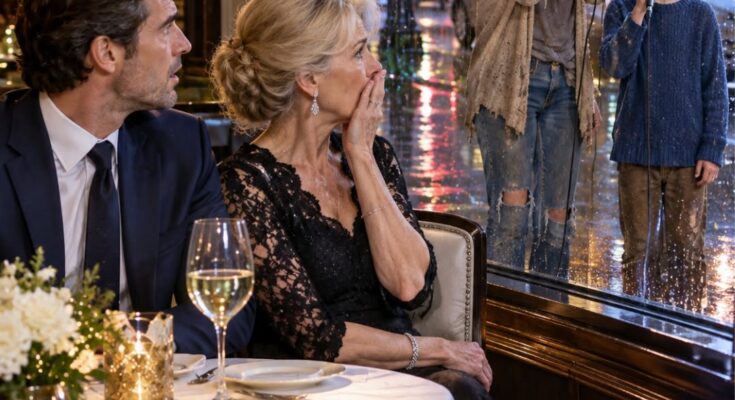
“Who taught you that song?”
Ethan Carter put down his fork and knife before suddenly standing, nearly causing his mother to knock over her water glass.
Outside the restaurant on Congress Avenue in Austin, Texas, a boy who appeared to be about seven was singing beside a small portable speaker. The melody meant nothing to anyone else, but Ethan recognized every word. He knew because he had written those four lines himself thirteen years earlier, when he and his former wife were living in a cramped apartment on San Antonio’s east side.
“What is it?” Margaret asked.
Ethan said nothing.
At forty-two, he owned a construction-material hauling company, ran three warehouses outside Austin, and had a fleet of more than forty trucks. That night, he had brought his mother out to celebrate the opening of another branch.
Yet four simple lines from an old song were enough to erase fifteen years of business success from his thoughts.
The boy finished singing and rushed over to the woman gathering coins near the speaker.
Ethan’s throat tightened.
“Claire…”
She looked up.
Eight years apart seemed to disappear within a few silent seconds.
Claire Bennett looked thinner than Ethan remembered. She wore a simple sweater, with her hair pulled back. Exhaustion showed on her face, but the quiet determination he knew so well was still there.
“It’s been a long time,” she said.
Then Margaret came outside.
She saw Claire first.
Then she noticed the boy.
Her purse slipped from her hand.
Ethan immediately turned toward his mother. Margaret almost never lost her composure, but now the color had vanished from her face.
“Mom?”
“I’m feeling dizzy.”
Ethan recognized that expression.
It wasn’t dizziness.
It was fear.
He walked toward the boy.
“What’s your name?”
The child looked at Claire before replying.
“Noah Bennett.”
“How old are you?”
Claire’s expression hardened.
“Ethan, you don’t need to interrogate him.”
“Seven years and five months,” Noah answered innocently.
Suddenly, Ethan could barely hear the traffic around them.
He and Claire had been divorced for eight years.
Then he remembered their final night before signing the papers. They had argued, cried, and eventually held one another like two people who still loved each other but no longer knew how to live together.
Ethan examined the boy’s eyes.
Then the way he furrowed his brow.
Then the slight tilt of his head whenever he was confused.
It looked exactly like Ethan in his childhood photographs.
“Claire… who is Noah’s father?”
She gave a bitter laugh.
“You’re seriously asking me that eight years later?”
“What is that supposed to mean?”
Claire stared straight at him.
“It means I tried to tell you eight years ago.”
A chill went through Ethan.
Behind him, Margaret gripped her purse until her knuckles turned white.
At that moment, two men walked over.
“We already warned you. If you’re going to perform here, you have to pay us.”
One reached toward the bag where Claire had collected the coins.
Noah quickly stepped in front of them.
“Don’t take my mom’s money!”
Ethan grabbed the man’s wrist.
“Let go.”
He pointed toward the restaurant’s security cameras and told the manager to call the police. The men retreated, muttering threats as they vanished down the street.
After they left, Ethan offered to drive Claire and Noah home.
Claire gathered the speaker.
“I don’t need you suddenly showing up to rescue us. I’ve managed on my own for eight years.”
She took Noah’s hand.
Ethan tried to stop her.
“Claire…”
She looked back.
“If you really want to know who his father is, start by asking your mother what she received from me eight years ago.”
Ethan slowly faced Margaret.
His mother lowered her eyes.
For the first time, Ethan realized the answer might have been concealed inside his own home all these years.
What he discovered next was worse than anything he could have imagined.
Ethan didn’t sleep that night.
Before sunrise, he took out a box of old photographs and found one from years earlier. He and Claire stood proudly beside the first truck they had ever bought.
They had almost nothing back then.
Claire had sold several gold bracelets given to her as wedding gifts to help pay the down payment on that truck. During the day, she did bookkeeping for a local hardware store. At night, she calculated fuel costs, tolls, overdue invoices, and customer debts.
The company now worth millions had truly started with a notebook balanced on bags of cement.
And Margaret had once loved her daughter-in-law.
Until the years went by without grandchildren.
First came the hints.
Then the home remedies.
Then the remarks grew crueler.
“A house without children eventually becomes an empty one.”
Claire saw a specialist. The doctor couldn’t find anything conclusive and suggested that Ethan get tested too.
He refused.
“I’m healthy. I work twelve-hour days, drive trucks, and almost never get sick.”
Whenever Claire asked him to stand up for her against his mother’s comments and remind Margaret what the doctor had actually said, Ethan always answered the same way:
“You know how Mom is. Just ignore her and put up with it.”
Eventually, those words ruined their marriage.
At a family dinner, Margaret compared Claire to “a tree that couldn’t bear fruit.”
Claire waited for her husband to defend her.
Ethan stayed silent.
A few weeks later, they signed the divorce papers.
The night before, they still loved each other enough to make one final mistake, or perhaps share one last act of love, that would change both their lives forever.
Three days after the divorce became official, Claire collapsed at work.
She was pregnant.
When Ethan visited her after their unexpected reunion, Claire finally explained what had happened.
“I came to your house with the test results in my hand. Your mother answered the door. I left a letter for you.”
Ethan went pale.
“I never got it.”
“When I was four months pregnant, I went to your company. I left my phone number with Rebecca in accounting.”
“No one ever gave it to me.”
“And when Noah was born, I mailed a photograph to your house.”
Silence.
“Three times, Ethan. I tried to reach you three times.”
Something inside him shattered.
For eight years, Claire believed Ethan knew Noah existed and had simply chosen to leave him behind.
For eight years, Ethan believed Claire had moved on and created a new life without him.
“I want a DNA test,” he finally said.
Claire’s eyes flashed with anger.
“You still don’t believe me?”
“No. That’s not why. I want there to be something no one can ever question again. Not my family, not yours, and not me.”
Claire agreed for one reason.
“I’ll do it so no one ever looks at my son like he has to prove where he came from.”
Three days later, they went to a laboratory.
Ethan sat in the hallway, unable to stay still.
When the specialist placed the results before him, Ethan only had to read the conclusion once.
Probability of paternity: greater than 99.99%.
Noah was his son.
Ethan closed his eyes.
Seven birthdays.
Seven Christmas mornings.
His first day of school.
Every fever.
Every scraped knee.
Every night Claire had spent sewing other people’s clothes while their son slept nearby.
All of it had happened without him.
Claire left the laboratory with the quiet dignity of someone who had never needed the result to prove anything.
Ethan went straight to his mother’s house. He walked into Margaret’s room.
“I want the box, Mom.”
For a moment, Margaret looked as though she had stopped breathing.
“What box?”
Ethan placed the DNA results on the table.
“The box where you kept Claire’s letters.”
Margaret went rigid.
Then, slowly, she reached into her purse and took out a small key.
At that moment, Ethan realized he was only seconds away from discovering exactly who had taken eight years of his son’s life from him.
PART 3
Inside the box were three things.
A copy of an ultrasound.
A yellowed letter.
And a photograph of Noah as a newborn.
Ethan picked up the photograph first.
The baby was wrapped in a blue blanket. On the back, Claire had written:
“This is Noah. I’m not asking you to come back to me. I only want you to know that you have a son.”
Ethan had to sit down.
“When did this arrive?”
Margaret began to cry.
“Not long after he was born.”
“And the letter?”
“Before that.”
“And the phone number Claire left at the company?”
Margaret lowered her head.
“I got that too.”
Ethan slammed his palm against the table.
“Three times!”
“Please let me explain.”
“You had three chances!”
Margaret covered her face.
When Claire first came to her door pregnant, Margaret had been terrified.
Not because she thought the baby wasn’t Ethan’s.
Because she suspected he was.
For years, Margaret had blamed Claire for not giving the family a grandchild. She had spoken in front of relatives, friends, neighbors, and employees as though Claire’s infertility had been medically confirmed.
If Claire returned pregnant only weeks after the divorce, every cruel accusation Margaret had made would come back to expose her.
And there was another reason.
She feared Ethan would take Claire back.
So she hid the first letter.
Months later, she intercepted the phone number Claire had left with Rebecca.
And when the photograph of the newborn arrived, Margaret knew the truth.
“He looked exactly like you when you were born,” she admitted through tears. “That night, I held the phone in my hand. I was going to call you.”
“Then why didn’t you?”
“Because I thought you’d hate me.”
Ethan let out a hollow, broken laugh.
“You were afraid I’d hate you, so you let my son grow up believing his father didn’t want him?”
Margaret reached toward him.
Ethan stepped back.
“You spent years saying you wanted a grandchild. You prayed for one. You pressured Claire until our marriage fell apart because you wanted a grandchild.”
His voice began to break.
“And when that grandchild finally existed, you hid him because protecting your pride mattered more.”
“I made a mistake.”
“No, Mom. Forgetting an anniversary is a mistake. What you did was a decision you made again every single day for eight years.”
Margaret cried quietly.
Ethan stared at the letter.
For several seconds, he desperately wanted to blame his mother for everything.
It would have been easy.
Then he remembered something Claire had asked him before their divorce:
“Did you ever stop to wonder how much it hurt while you kept telling me to put up with it?”
And Ethan realized something even more painful.
“You hid Noah,” he said. “That’s on you. But our divorce is partly on me.”
Margaret looked up.
“I pressured you.”
“And I was her husband.”
Ethan took a deep breath.
“I was the one who refused to get tested. I let people blame Claire when no one had any proof. I told my wife to tolerate things she never should have had to tolerate.”
For the first time in eight years, Ethan didn’t need to make his mother responsible for everything just to convince himself he was innocent.
The next afternoon, he went to see Claire.
She was fixing the zipper on a pair of jeans.
Ethan placed the letter, ultrasound, and photograph on the table in front of her.
Claire slowly lowered her needle.
She didn’t need to ask.
“So you know now.”
“Yes.”
For several seconds, she stared at the old photograph of Noah.
“For months, I believed you’d received it.”
Ethan swallowed hard.
“I never knew.”
“Now I believe you.”
Those words didn’t comfort him.
They made him feel worse.
“I’m sorry.”
Claire smiled sadly.
“For which part?”
Ethan immediately understood.
There wasn’t one apology large enough to cover everything.
“For refusing to get tested. For leaving you alone while my family blamed you. For telling you to put up with it. For signing the divorce papers while convincing myself that staying silent meant I wasn’t taking sides.”
Claire looked away.
“The worst part wasn’t what your mother said to me. It was walking back into our bedroom knowing you’d heard the same things… and still hearing you tell me to be patient.”
Ethan offered no excuses.
Then he asked about Noah.
Claire agreed to let him get to know his son slowly.
That same day, the three of them met at a café.
Noah kept looking between his mother and Ethan.
“Your mom and I need to tell you something,” Ethan said.
“Am I in trouble?”
“No. You didn’t do anything wrong.”
Ethan struggled to say the next words.
“I’m your biological father.”
Noah became still.
He looked at Claire.
She nodded.
Then he turned back toward Ethan.
“Then… why didn’t you come to my birthdays?”
The question went straight through Ethan.
He could have blamed Margaret immediately.
He could have told Noah that his grandmother had hidden everything and made himself seem completely innocent.
He didn’t.
He refused to use someone else’s wrongdoing to protect himself in front of his son.
“Because the adults made mistakes. I didn’t know you existed, but I also made choices before you were born that helped things end up this way.”
Noah quietly considered it.
“So do I have to call you Dad?”
“No.”
Ethan shook his head.
“You can call me whatever feels right. You don’t owe me a feeling today that I wasn’t here for seven years to earn.”
For the next several weeks, he remained “Ethan.”
At first, Ethan handled the situation the same way he handled problems in business.
With money.
He transferred a large amount to Claire and started looking for an apartment near Noah’s school.
Claire returned the money.
“You can pay your share of his school expenses, medical bills, clothes, and whatever else your son needs. But you’re not buying our life.”
“I’m only trying to make things right.”
“You can’t put a price on eight years.”
Ethan fell silent.
“If you want to be his father,” Claire continued, “start by showing up.” So he did.
He picked Noah up from school.
They went out for burgers and sandwiches.
He helped him with his math homework.
He discovered that Noah hated onions, was terrified of thunderstorms, and bounced his right leg whenever he got nervous.
One Wednesday, Noah came down with a fever.
Ethan spent three hours sitting outside the doctor’s office.
Nothing dramatic happened.
And that was exactly why the afternoon meant so much to him.
It was one of those ordinary moments he had missed for seven years.
Margaret, meanwhile, tried to approach Noah in an entirely different way.
One afternoon, she arrived carrying the keys to an apartment.
“Claire, I want to put this property in Noah’s name.”
Claire didn’t take them.
“Are you trying to buy your way into being his grandmother?”
“That’s not what I’m doing.”
“Eight years ago, you used the child you believed I couldn’t have to decide my worth as a woman. Now you’re trying to use the child I did have to erase what you did.”
Margaret turned pale.
“He’s my grandson.”
“Exactly. Your grandson. Not your property.”
Margaret insisted that Noah should live with Ethan because he could provide “better opportunities.”
Ethan arrived while they were arguing and heard her.
“Mom, enough.”
“But this place is small. You have space, money, access to better schools…”
Only weeks earlier, Ethan might have thought the same way.
“Noah lives with his mother.”
Margaret stared at him.
“He’s a Carter.”
“He’s also a Bennett. And long before I showed up as his father, he was the son Claire fed, protected, loved, and raised alone for seven years.”
“I just want what’s best for my grandson.”
“Then start by understanding that loving him doesn’t give you the right to control his life.”
Margaret left in tears.
That night, Ethan didn’t go after her.
Not because he stopped loving his mother.
But because he finally understood that loving your mother doesn’t mean agreeing with her when she’s wrong.
Weeks later, the two men who had been demanding money from street vendors and performers returned.
Claire discovered that she wasn’t their only target. They had been intimidating food vendors, musicians, artists, and others working in the area.
Several victims had threatening messages and videos. Ethan offered to hire attorneys.
Claire accepted only legal advice.
“We’re filing the complaint ourselves.”
About a dozen victims went to the authorities together. With statements, recordings, messages, and surveillance footage from nearby businesses, it was no longer one struggling woman’s word against two intimidating men.
As they walked away, Ethan stayed beside Claire.
“The old you would’ve tried to avoid getting involved.”
Claire smiled.
“The old me backed away because I wanted peace.”
“And now?”
“I learned that when you keep backing away, people eventually learn they can keep pushing.”
Ethan understood she wasn’t only talking about those men.
Months later, Margaret returned to Claire’s home.
She brought no keys.
No money.
She didn’t even ask about Noah first.
“I came to apologize.”
Claire let her inside.
“I don’t expect you to call me Mom again,” Margaret continued. “And I don’t expect you to forget. I just need to admit that what I did was unforgivable. First, I blamed you without proof. Then I hid your son because I was too afraid to admit that I had been wrong.”
Claire listened without interrupting.
“I can’t give Noah those years back,” Margaret said. “That’s what hurts me most.”
Claire waited before responding.
“I can let go of the resentment. But that doesn’t mean pretending none of it happened.”
Margaret nodded.
“If you want to know Noah as his grandmother, I won’t prevent that. But never use love as an excuse to make decisions for other people again.”
So Margaret began from the beginning.
No expensive gifts.
No demands that Noah call her Grandma.
One afternoon, she arrived with homemade sweet potatoes.
Noah picked one up, inspected it, and laughed.
“It’s completely crushed.”
“I made it myself.”
“It looks like it lost a fight.”
Margaret laughed with him.
It was the first time Claire could watch the two of them together without feeling like someone was trying to take something from her.
By the end of the year, Claire rented a small storefront for her alterations business.
Ethan offered to invest.
She declined.
He accepted her decision without arguing.
He had learned that respecting someone sometimes meant knowing when to stop asking.
One afternoon, while Noah was at school, Ethan finally found the courage to ask:
“Do you think there could ever be another chance for us?”
Claire stopped folding a shirt.
She looked at the man she had once shared hunger, debt, dreams, and the struggle of building a business from nothing with.
She didn’t hate him anymore.
But she was no longer the woman who had spent years waiting for him to defend her.
“You can become a wonderful father, Ethan.”
He understood before she finished.
“But our marriage ended eight years ago.”
Ethan smiled sadly.
“I guess I needed to ask.”
“You did.”
Claire pointed toward a repaired ceramic vase on the counter.
“Some broken things can still hold flowers. But that doesn’t mean you have to pretend they were never broken.”
Ethan never asked again.
A few weeks later, he sat outside Claire’s shop helping Noah tune an inexpensive guitar.
The boy tried to sing the old song that had brought their lives together again outside the restaurant.
He hit the wrong note.
“Keep singing like that and we’ll have the whole neighborhood moving out,” Ethan joked.
Noah burst out laughing.
He tried again.
And missed the note again.
Then, without thinking, he asked:
“Dad, how does this part go?”
Everything became still.
Noah seemed to realize what he had just said.
Claire froze, the shirt she had been folding still in her hands.
Margaret, arriving with a bag of pastries, stopped in the doorway.
Ethan felt tears gather in his eyes.
But he didn’t pull Noah into a hug.
He didn’t want to turn the moment into something the boy had to repeat.
Instead, he took the guitar, adjusted one of the strings, and said:
“Try again.”
Noah looked at him.
Ethan smiled.
“Dad’s listening.”
The boy started the song again.
Claire lowered her head to hide a small smile.
Margaret quietly cried in the doorway.
She had finally heard the word she had wanted for so many years.
But now she understood that the word didn’t belong to a family name.
It didn’t belong to money.
And it didn’t even automatically belong to blood.
Ethan had been Noah’s biological father from the moment the boy was born.
But he still had to learn how to become his dad.
And in the end, all of them came to understand a simple truth much later than they should have: blood may prove where a child comes from, but only presence, respect, patience, and everyday love can make that child choose who to run toward when he needs to feel at home.