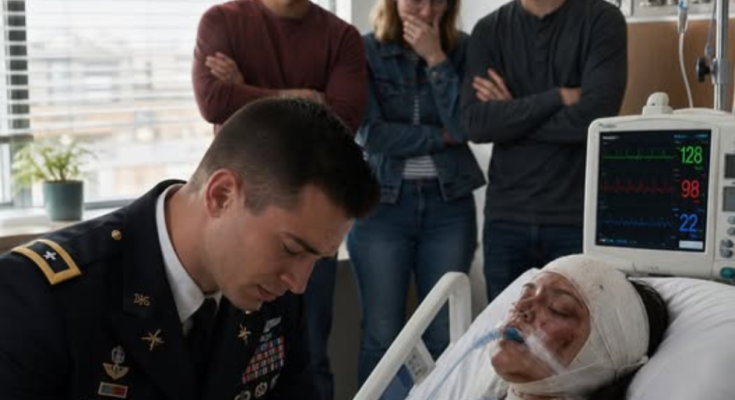
The plain green hospital gown looked too large on Lily’s thin shoulders, the stiff cotton fabric bunching around her collarbone like a shroud.
I sat in the brown vinyl chair by the bedside, holding a heavy blue knit blanket in my lap to keep my fingers from twitching.
Every four seconds, the hospital heart monitor gave a low, green-tinged hum that vibrated in my teeth.
A plastic cup of lukewarm black coffee sat on the bedside table, bought from the lobby machine for three dollars.
The coffee had a thin skin of dust on the top, and I had not touched it.
Lily’s hair was damp, sticking to her forehead in dark, sweat-matted strands.
I used a paper tissue to wipe a smear of dried blood from the shell of her ear, my hands as steady as they had been in the desert.
Her fingers twitched on the white sheet, her knuckles scraped raw and painted with yellow antiseptic.
At ten past midnight, her eyelids finally fluttered.
She looked at me, her eyes clouded with the heavy dose of morphine they had given her at ten.
She tried to open her mouth to speak, but her jaw was wired shut with silver metal brackets that caught the light.
A muffled, wet sound escaped her throat.
I leaned closer, resting my hand on the mattress near her arm.
“Do not try to move, Lily,” I said. “The doctor is coming back.”
She fidgeted with the silver medical wristband on her left wrist, her fingers scraping against the plastic tag.
Her eyes held a sudden, sharp panic that I had only seen in men behind enemy lines.
I reached into my trousers pocket and let my thumb rub over the silver skull coin I always kept there when the world went loud.
The cold metal always helped me think.
Lily closed her eyes again, her breathing slowing as the medication pulled her under.
I stood up and pulled the blue knit blanket over her chest, tucking the edges under the mattress.
Her small leather backpack was resting on the floor by the bedside chair.
The strap was torn, and the zipper was jammed with dry gray dirt from the plaza floor.
I picked it up and set it on the table next to the cold coffee.
Doctor Avery was waiting near the nurses’ station, his white coat stained with a drop of blue ink near the pocket.
He was looking at the glowing X-ray board, where six distinct white cracks showed on the gray film of Lily’s skull.
He tapped the middle crack with the tip of a cheap blue ballpoint pen.
“Three fractures on the left, three on the right,” Avery said, his voice flat.
“Are they clean?” I asked.
“Clean enough for a surgeon, not for a father,” he said, turning to look at me. “She is nineteen, Mr. Walker. Her bones are resilient, but this took a great deal of force.”
“What kind of force?”
“The impact came from a heavy object, Walker. Or a steel-toed boot. Multiple strikes while she was on the ground.”
“Any other injuries?”
“Bruises on her shoulders and ribs,” Avery said. “Defensive wounds on her forearms. She fought them.”
He tapped the pen against the plastic frame of the light board.
“This was not a random campus fight, Colonel Walker,” Doctor Avery said.
I did not blink.
“I am a security consultant, Doctor,” I said.
“I was at Bragg in ninety-eight,” Avery said, adjusting his glasses. “I saw what your boys did in the valley. I know the signature of a professional strike.”
“She is nineteen,” I said again, my voice flat.
“And she was carrying something they wanted,” Avery said. “This was not a robbery, Walker. Her purse was still on her shoulder when they brought her in. Her phone was in her pocket.”
“What are you saying?”
“They did not want her money,” Avery said, turning off the light board. “Get her out of this town when she can walk.”
I left the hospital through the side doors, where the autumn air smelled of wet asphalt and rotting leaves.
I drove the three blocks to the university campus in my old sedan.
The tires did not make a sound on the wet asphalt, which was littered with damp yellow leaves.
I parked near the library and walked toward the science building plaza where the freshman had found her.
The autumn wind was cold, carrying the smell of damp earth and river water from the valley.
The concrete plaza was dark.
Every single safety light on the high poles was dead, their black glass bulbs reflecting nothing but the gray clouds above.
I walked to the center of the plaza, my boots clicking softly on the paving stones.
I found the spot near the concrete planter.
The university maintenance crew had tried to wash the stone, but a dark, star-shaped stain remained near the edge of the concrete.
I knelt down on one knee, my trousers soaking up the cold moisture from the pavement.
There was a small, torn corner of green paper caught in the drain cover three feet away, but I left it.
I stood up and walked to the brick wall of the science building.
I looked up at the dome camera mounted fifteen feet above the plaza entrance.
The camera was a gray model, its serial number printed in small white letters on the casing: TX-four-eight-zero.
The small red LED light at the base of the camera was completely dark.
I followed the black conduit pipe down the wall to the main power junction box.
The heavy iron latch of the junction box was hanging open, its brass padlock gone.
Inside, the three heavy copper switches had been pulled down into the off position.
The black challenge coin I had carried since my days with Task Force Specter sat in my left pocket, heavy and solid.
I pulled it out and held it against the cold metal of the box.
The switches had been wiped clean of grease, but there were fresh silver scratches on the brass terminals where a tool had been used to short the secondary circuit.
Someone had known exactly which breaker to pull to blind the cameras on the east wall.
The campus security office was located in the basement of the administration hall.
The air inside smelled of stale popcorn and floor wax.
Officer Gregory Vance sat behind a grey metal desk, his uniform shirt unbuttoned at the collar.
He was nervously flipping through an empty aluminum clipboard, his thumb leaving greasy marks on the clean white paper.
“I need the camera logs for the science plaza,” I said, standing in front of his counter.
Vance did not look up.
“We had an equipment failure,” he said, his voice dropping into a tired, defeatist sigh. “We recorded nothing.”
“The junction box was opened manually,” I said.
Vance stopped flipping the pages of the empty clipboard.
“We have a lot of kids on this campus, Mr. Walker,” he said, finally looking at my chin. “Pranks happen. Someone probably thought it would be funny to turn off the lights.”
“They beat my daughter until her jaw was in six pieces,” I said.
“We are looking into it,” Vance said. “But without the cameras, we do not have much to go on.”
He picked up a yellow pencil and began to sharpen it with a small plastic sharpener, the shavings falling into his palm.
“You should let this go, for Lily’s sake,” Officer Vance muttered.
“You were on duty at nine fifteen,” I said.
“I was patrolling the north lot,” Vance said, his eyes shifting to his empty coffee mug.
“The north lot is a mile from the science building,” I said.
“That is where the call came in,” Vance said. “A broken window at the athletic center. Turned out to be a false alarm.”
“And who called it in?”
“An anonymous tip,” Vance said, looking down at his desk. “It was dark, there are no witnesses, and the cameras are down.”
I knew he was lying because the green indicator light on the wall behind him was flashing, showing the western server was still online and receiving data.
But I did not tell him that.
I turned and walked out of the office, the heavy glass doors swinging shut with a quiet hiss.
I walked back to the science plaza, the cold air clearing the smell of the security office from my lungs.
The streetlights on the main road a block away cast long, yellow fingers of light through the bare oak trees.
I stood in front of the open junction box again, my fingers tracing the fresh scratches on the brass switches.
Nineteen years of quiet civilian life, of lawnmowers and parent-teacher conferences, had just ended.
I stared at the empty padlock loop and realized my quiet life had just shattered.
The blue knit blanket was still draped over the vinyl chair when I returned to room four twelve at nine the next morning. Lily was asleep, her breathing shallow, the wired metal in her jaw casting small shadows under the harsh overhead light.
Her canvas backpack sat on the bedside table, smelling of damp earth and rain from the campus plaza pavement. I unzipped the main compartment, careful not to let the metal slider clink against her plastic water pitcher.
Inside, nestled beneath her biology textbook and a pack of blue pens, was her green university sweatshirt, torn at the left shoulder. I pulled it out, the fabric stiff where the mud had dried in patches.
As I unfolded the heavy cotton, my fingers brushed against something stiff in the front pouch pocket. It was a jagged scrap of white paper, torn from a spiral notebook, with dark brown smears drying across its surface.
I flattened it on the tray table, my thumb tracing the rough edges. Three hand-written names stared back at me in Lily’s neat, slanted print: Ethan, Brandon, and Tyler.
I turned the scrap over to see if anything else was written on the back, but the reverse side was blank. I reached into my pocket and took out my parking receipt, checking the digits I had scribbled down in the dark at one in the morning.
The serial number of the campus security camera, Model TS-four hundred, serial number eight-eight-four-two-one, was written in my own block print right next to the time of the stamp. That camera had been pointed directly at the spot where Lily fell, and someone had turned off the power before she got there.
Lily stirred in the bed, her fingers twitching against the white sheet, but her eyes remained closed. I folded the bloodstained scrap of paper and slipped it into my shirt pocket, right against my chest.
Officer Vance was sitting on the bench outside the double doors at half past nine, chewing on the end of a yellow wooden pencil. His uniform shirt looked like he had slept in it, the collar curled and damp with sweat.
“We need to talk about the plaza,” I said, standing over him until he looked up from his empty clipboard.
Vance sighed, a long, tired sound that smelled of peppermint and stale tobacco. “Mr. Walker, I told you last night. The cameras went down. Main power surge.”
I pulled the folded scrap of paper from my shirt pocket and held it three inches from his nose. “My daughter wrote these down before they hurt her. Ethan, Brandon, and Tyler.”
The pencil stopped moving. Vance looked at the paper, then at my face, his cheeks losing what little color they had under the hallway fluorescent tubes.
He closed his black notebook with a sharp snap and slid it into his side pocket. “Without witnesses to place them in that courtyard at midnight, there is nothing the police can do.”
“The camera serial number is eight-eight-four-two-one,” I said. “The power box was unlocked from the inside.”
Vance stood up, his leather belt squeaking against his holster as he adjusted his stance to block the doorway.
“You should let this go, for Lily’s sake,” Officer Vance muttered.
“She is nineteen,” I said.
“Then she has a lot of life left to live,” Vance said, his eyes darting toward the elevators at the end of the hall. “Do not make it harder for her than it already is.”
The cafeteria was nearly empty at ten, save for a nurse in green scrubs sleeping in a corner booth. I bought a cup of black coffee for three dollars, the paper cup thin enough to burn my palm.
I sat at a plastic table near the tray return and took out my phone, typing the first two names into the search bar. Ethan Cole was the sophomore president of the university business club, his face smiling from a local news article about a new science building.
His father was Thomas Cole, the owner of Cole Construction, the company currently finishing the three-story concrete plaza where Lily had been found.
The second name, Brandon, led me to a campaign website with a banner of red, white, and blue. Brandon Hale was a student representative, and his mother was Senator Margaret Hale, who chaired the state capital finance committee.
I scrolled down the page, my thumb rubbing the silver skull coin in my pocket as the connection clicked into place. The state finance committee had approved the fifteen-million-dollar grant for the university’s new science hall three months ago.
The third name was Tyler, whose last name was Miller, the son of the university’s largest private athletic donor.
These were not boys who spent their weekends in local holding cells. They were the children of the people who owned the bricks, the land, and the police who patrolled them.
I took a sip of the lukewarm coffee, the taste bitter and flat on my tongue. I had spent nineteen years believing I could raise a daughter in a quiet town where the rules applied to everyone.
At eleven, I stood by the glass doors of the main lobby, watching the rain begin to pool on the concrete driveway outside.
Officer Vance walked through the lobby, his head down, his thumb hooking into his utility belt. He did not look at the reception desk or the security guard sitting behind the counter.
He pushed through the heavy glass doors into the gray morning air. A black sedan with tinted windows was idling by the yellow curb, its exhaust rising in white plumes against the wet brick wall.
The rear door opened before Vance even reached the curb. A man in a dark, tailored suit sat in the back, his face half-hidden by the shadow of the doorframe.
Vance leaned in, spoke for ten seconds, and then slid onto the leather seat beside him. The door clicked shut, the locks falling into place.
I watched the black sedan speed away from the hospital curb.
The tires of the black sedan had left dark scuff marks on the hospital curb, but the street was empty by the time I reached my truck. I drove back to my small brick house on Elm Street, the silence in the cab heavier than the autumn air.
By two in the afternoon, Raymond Reyes was sitting at my kitchen table. He was a broad, weathered man who looked like he had been carved out of a pine log, his gray hair cropped close to his skull.
A single black challenge coin lay between us on the yellowed Formica, its tarnished edges catching the gray light from the window. Raymond picked it up, his thick, grease-stained fingers turning the heavy metal over and over.
He adjusted his plain black wristwatch, the cheap rubber strap clicking against his wrist. His gravelly voice sounded like dry stones sliding down a hill.
“You kept this,” Raymond said.
“I kept it,” I said.
“Lily is nineteen, Daniel. She is not part of the unit.”
“She is in room four twelve with her jaw wired shut.”
Raymond placed the coin back on the exact center of the table, lining it up with a deep scratch in the laminate. He looked at my hands, then down at his own.
“How is she doing?” he asked.
“She tried to speak this morning,” I said, my voice flat. “But they have her on a liquid diet, and she cannot move her mouth.”
“She is tough,” Raymond said, his voice softening slightly. “She always had her mother’s stubborn streak.”
“The three names on her paper are Ethan Cole, Brandon Hale, and Tyler Vance,” I said. “I need to know everything about their families.”
Raymond stared at the black coin, his thumb tracing the worn insignia of our old command. He did not look up.
“If we dig this grave, Colonel, we both go back under,” Reyes said.
“The shovel is already in the dirt,” I said.
Raymond let out a low, raspy sigh that sounded like sandpaper on pine. He reached into his flannel shirt pocket, pulled out a small notepad, and wrote down the names.
“Cole is the contractor’s boy,” Raymond said. “Hale’s mother is the state senator. What about Tyler Vance?”
“He is the campus detective’s nephew,” I said.
Raymond stopped writing, his pencil hovering a fraction of an inch above the paper. He tapped the lead against his thumb.
“We need to check the school’s money,” I said. “Start with the new science building.”
Raymond stood up, his heavy boots creaking on the old linoleum. He did not say yes, but he did not leave the coin behind. He slid it into his pocket and walked out to his truck.
I watched him back down the gravel driveway, his exhaust leaving a thin trail of blue smoke in the damp air.
At four in the afternoon, the smell of copper wire and cold grease filled my nose inside Raymond’s metal salvage shed. The corrugated tin walls rattled as a truck rumbled past on the state highway outside, and the wind whistled through the gaps in the wooden ceiling.
A single computer terminal hummed in the corner of the workspace, casting a pale green light over several rusted engine blocks. Raymond stood over it, his broad shoulders hunched as he scrolled through rows of financial logs.
“The university science building fund is public record, but the sub-accounts are locked behind three firewalls,” Raymond said. “I had to route the query through an old server in Toledo.”
He tapped the keyboard with two thick fingers, bringing up a ledger of outgoing transactions. The screen flickered, reflecting green lines across his calloused hands.
“Look at the dates,” I said.
“August twelve, September three, and October fifteen,” Raymond said. “Three transfers of exactly two hundred thousand dollars each.”
“All going to the same place?”
“An offshore account registered to a holding company called Great Lakes Logistics,” Raymond said. “But the authorization came from inside the administration building.”
He pointed his grease-stained finger at a string of letters and numbers stamped next to the October transfer.
“A private bank transfer code,” I said. “Zero nine four two delta.”
“That code requires two separate digital signatures to clear the university’s main bank,” Raymond said.
“Whose name is on the second line of the bank transfer?” I asked.
Raymond clicked the mouse, but the screen went dark. A solid red warning box flashed twice in the center of the monitor.
“The Toledo server just went offline,” Raymond said, his jaw tightening.
“Did they trace the query?”
“No,” Raymond said, looking at the dead screen. “But someone just pulled the plug on the campus side.”
“Then we go to the campus,” I said.
I parked my truck near the campus quad at five in the afternoon. The damp yellow leaves on the pavement stuck to the soles of my boots as I walked toward the red brick administrative offices, passing students holding paper coffee cups and laughing.